
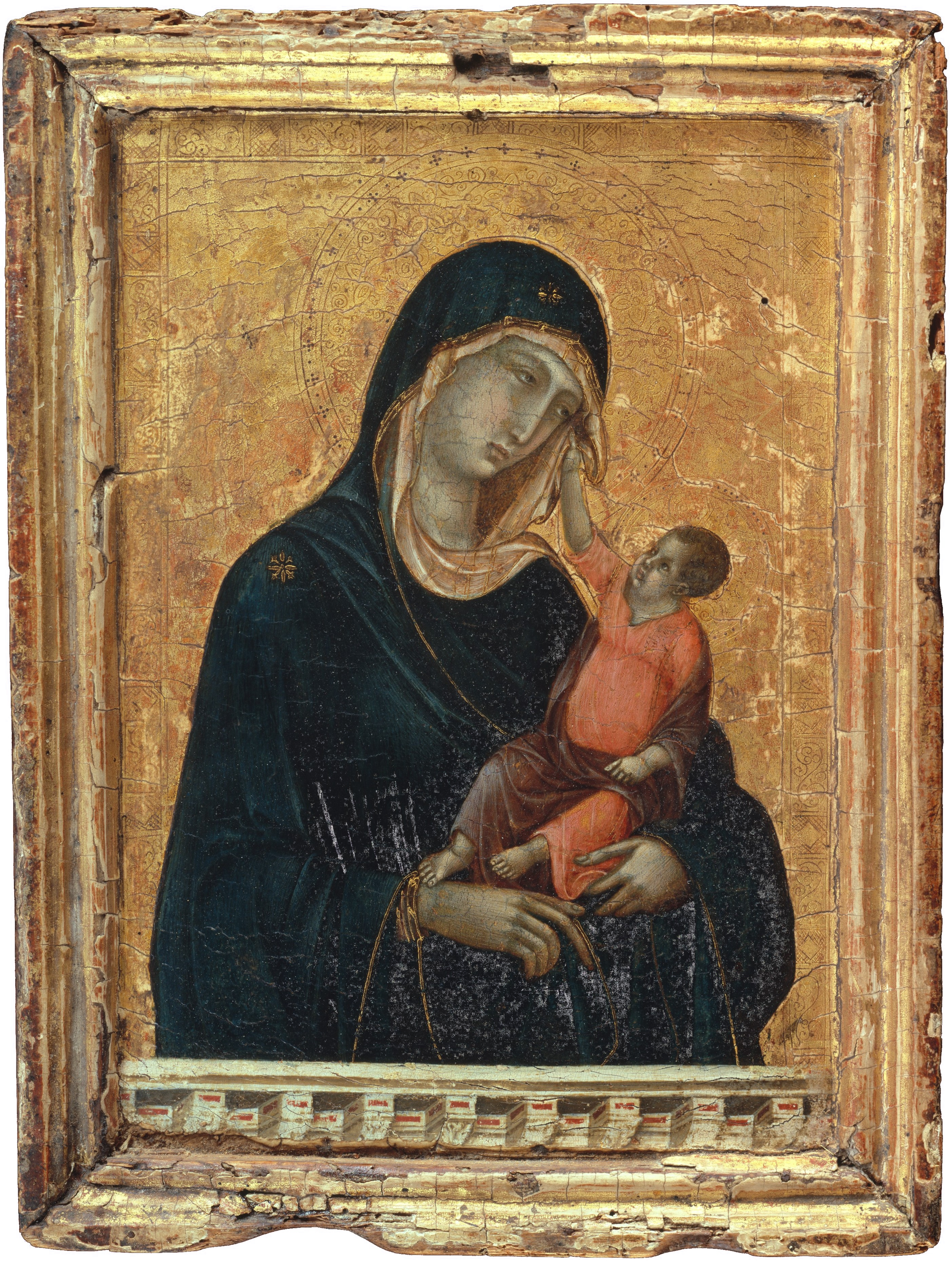
Duccio di Buoninsegna: Madonna with Child, c. 1300, Wikimedia Commons (Public domain)
The ‘Gold-ground’ aesthetic
Understanding the art of the sacred stage
An introduction to Italian gold-ground panel painting, c. 1250–1430 — its Byzantine origins, workshop technique, the Florentine and Sienese schools, and the masters who defined the tradition.
In a technical sense, a gold-ground artwork is any painting, mosaic, or manuscript illumination whose background is composed of gold leaf.¹ But that definition barely begins to account for what these objects actually are: one of the most concentrated and enduring expressions of devotional intent in the history of Western art, produced over roughly two centuries and still commanding serious attention — scholarly, institutional, and commercial — seven hundred years later.
Art historians use the term to describe a specific corpus: religious panel paintings made between the mid-13th and early 15th centuries, primarily in Italy. The Virgin Mary (Madonna), Christ, Angels, and Saints appear against fields of shimmering gold — not a color, but a substance, a material stand-in for divine light itself.

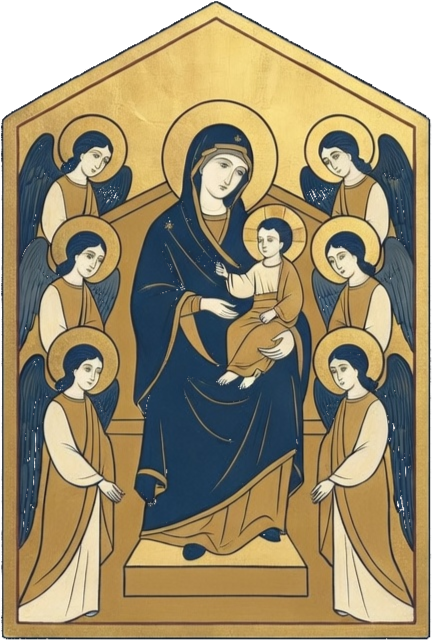
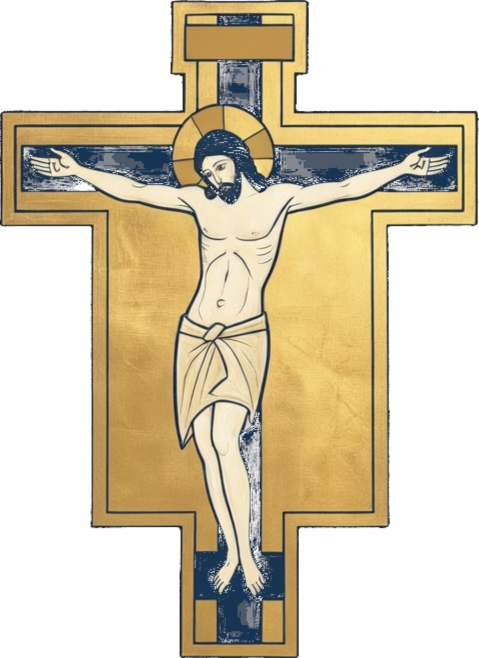
Table of contents
Gold as theology
Florence and Siena: Two schools, one golden age
From private devotion to grand altarpiece: Understanding the objects
The alchemy of the workshop
The artists to know
The end of an era — and why it matters for collectors
Gold as theology
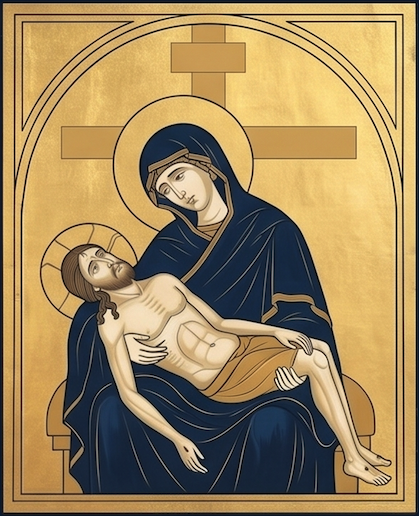
Gold did not enter the painter's vocabulary by accident. Since at least the sixth century, Christian artists understood gold to be uniquely suited to representing divinity — it radiates warmth, catches candlelight differently from every angle, and refuses to behave like ordinary pigment. The gold background of a Byzantine icon is not a backdrop in any conventional sense: it is a sacred stage, a declaration that the scene unfolding before the viewer exists outside ordinary time and space.
The sack of Constantinople in 1204 brought Byzantine objects — relics, goldwork, and icons — to Italy, above all Venice, providing Western artists with direct models and stimulating demand for panel painting in the Byzantine manner. Italian artists encountered them, absorbed their visual logic, and began to work within — and then decisively beyond — the tradition they represented. They retained the gold ground and the hieratic solemnity of Byzantine figuration, but brought something new: volumetric modeling through half-tones, psychological expressiveness in facial treatment, and an emerging interest in architectural and narrative depth. These innovations did not abolish the gold-ground tradition — they matured it, and in so doing laid the groundwork for the Renaissance that would eventually supersede it.

From private devotion to grand altarpiece: Understanding the objects
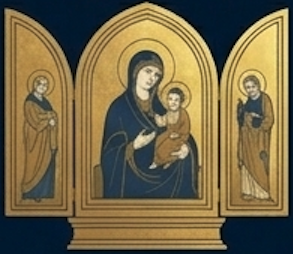
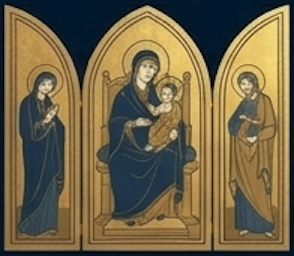
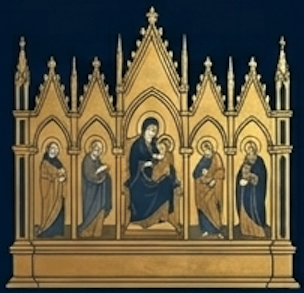
Gold-ground works were made for diverse audiences and served distinct spiritual functions.
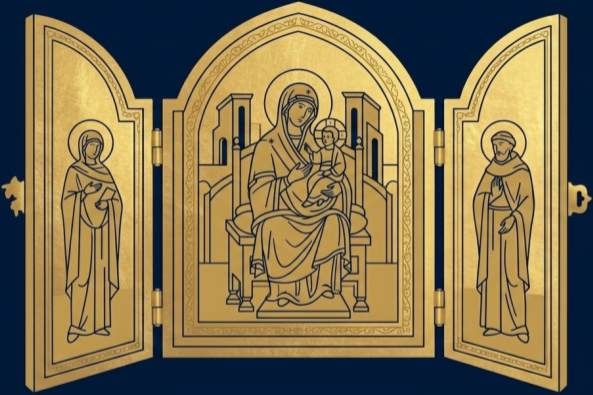
At the most intimate scale were small mobile devotional paintings and altars, often depicting the Hodegetria — the Virgin with her hand raised toward the Christ child, directing the viewer's gaze to him as the savior of mankind.² These images were used for private prayer in domestic settings: carried on journeys, kept in bedchambers, handled as material intermediaries between the faithful and the divine. In Siena, their devotional power was understood in almost literal terms: the city's Franciscan congregation, founded on the belief that the Virgin offered protection against plague, drought, and warfare, would bring gifts before her portraits hanging in chapels or mounted on street corners and light candles at her feet.
At the other extreme were the great polyptychs — multi-panel altarpieces that could comprise tenor more panels hinged together and housed in elaborate carved and gilded frames adorned with buttresses, piers, and Gothic pinnacles that echoed the architectural vocabulary of the cathedrals in which they stood. These works could exceed ten feet in both height and width. They were didactic instruments, deploying visual narrative to convey scripture and moral teaching to populations that were largely illiterate — the gold ground providing a luminous field against which the stories of Christ's life or a saint's martyrdom could unfold with sovereign clarity.
Between these extremes lay portable altarpieces, triptychs, and small altarpieces designed for private chapels, traveling altars, and monastic settings. Each format carried its own conventions — of scale, of subject, of frame type — and collectors benefit from understanding these distinctions before building or extending a collection.
Florence and Siena: Two schools, one golden age
While gold-ground panel painting was practised across Europe — in France, Spain, and Central Europe — its heart was unambiguously Italian. And within Italy, the story is largely one of creative rivalry between two city-states separated by barely fifty miles but divided by fundamentally different artistic temperaments.
Florence was the school of form. Its painters were preoccupied with structure, volume, and the illusion of physical weight. Siena was the school of poetic grace: its tradition privileged lyrical line, refinement of surface, and an almost musical sense of colour within the gold-ground convention. If Florence was the laboratory for the spatial logic that would become Renaissance perspective, Siena was where the gold-ground idiom achieved its fullest decorative and emotional eloquence.
Other centers — Genoa, Venice, Perugia or the Veneto — maintained their own regional schools, each inflected by local patronage networks and cross-cultural contact. Paolo Veneziano in Venice absorbed Byzantine and Western Gothic influences simultaneously; Roman workshops served a papacy with different visual ambitions from the merchant communes of Tuscany. The geography of gold-ground production, in other words, is richer and more varied than the standard Florentine-Sienese narrative suggests.
The alchemy of the workshop
Gold-ground painters were not solitary geniuses in the Romantic sense. They were master craftsmen operating within highly organized workshop structures, and the production of even a modest panel was a multi-stage, multi-person process of considerable technical complexity.
It began with the panel itself — typically poplar, seasoned to reduce the risk of future warping — planed smooth and then coated with multiple layers of gesso: a mixture of chalk and animal-skin glue that provided a bright, stable surface for everything that followed.³ The composition was sketched in charcoal and then incised with a scalpel.
Before any gold was applied, the areas to be gilded received a coat of bole — a reddish-brown clay primer that gave the subsequent gilding its characteristic warmth. Gold coins were melted, hammered into sheets of extraordinary thinness (approximately three square inches per sheet), and applied to the bole surface with a soft brush. Once dry, the gold was burnished to a high sheen and then worked with sharp tools: tiny holes punched in precise patterns to articulate haloes, borders, and decorative passages, creating texture that catches light differently from different angles and at different times of day. Each workshop developed its own distinctive punching patterns — one of the technical signatures by which scholars today attribute works to specific hands and ateliers.
The figures themselves were added last, in egg tempera: pigment suspended in egg yolk, a fast-drying medium that demands decisive brushwork and rewards meticulous layering. Unlike the oil paints that would eventually supersede it, tempera does not permit reworking or blending in any conventional sense. The painter had to think and execute simultaneously — a discipline that gives gold-ground figures their particular quality of compressed intensity.
The artists to know
Because workshop production was the norm and individual authorship was not the cultural value it would later become, many gold-ground painters remain anonymous. Scholars group their works by stylistic characteristics — the treatment of hair and hands, the rendering of drapery folds, the handling of spatial depth — and assign them conventional names derived from a notable surviving work: "the Master of the Baptistery of Parma," "the Master of Monte Oliveto," and so on. This is not a failure of the historical record so much as a reflection of how the period understood artistic production: as skilled craft, not individual expression.
That craft was nonetheless extremely well rewarded. When the city of Siena commissioned Duccio di Buoninsegna to paint the Maestà for its cathedral in 1308, it paid him 3,000 florins — at a time when an unskilled labourer might earn between 20 and 25 florins in an entire year.
Several names did survive, and they define the canon:
Cimabue (c. 1240–1302) is the acknowledged forefather of the Italian gold-ground tradition⁴ — the first painter to engage seriously with Byzantine conventions while beginning to strain against them.
Giotto di Bondone (c. 1267–1337), Cimabue's pupil, represents the decisive Florentine break toward physical volume and narrative dynamism. His figures have weight; they cast psychological shadows.
Duccio di Buoninsegna (c. 1255–c. 1318) is Siena's counterpart — not a follower of Giotto but an independent master whose Maestà remains one of the most ambitious achievements of the entire period.
The generation that followed divided along the same civic lines. In Siena: the Lorenzetti brothers, Pietro (c. 1280–1348) and Ambrogio (c. 1290–1348), and Simone Martini (c. 1284–1344), whose work achieves a refinement of Gothic lyricisim unmatched in the Western tradition. In Florence: Andrea di Cione, called Orcagna (c. 1308–1368) and Bernardo Daddi (c. 1280–1348), whose workshop output extended Giotto's legacy across the mid-Trecento.
The end of an era — and why it matters for collectors
The decline of gold-ground painting was gradual and did not constitute a rejection. It was displaced by new technical possibilities: oil paint, which allowed for glazes, impasto, tonal gradations, and — crucially — the freedom to revise. And by the invention of linear perspective, typically credited to Masaccio's Holy Trinity fresco of around 1428 in Santa Maria Novella, Florence, which offered artists an entirely new system for organizing pictorial space. Where the gold ground declared the sacred to be outside space and time, perspective declared the sacred to inhabit a space contiguous with the viewer's own.⁵
For collectors, this historical transition matters because it defined the parameters of a field that is, by nature, finite. No new gold-ground panels from the period c. 1250–1430 will be produced. The corpus is closed. What moves between private hands and institutions, what surfaces at auction, what is deaccessioned or rediscovered — this is all there is.
¹ → Wikipedia, Gold ground: https://en.wikipedia.org/wiki/Gold_ground - The Wikipedia article also traces the technique's roots in Byzantine and medieval illumination.
² → Metropolitan Museum of Art, Cross-Cultural Connections in the Icon of the Virgin and Child: https://www.metmuseum.org/essays/thirteenth-century-icon-virgin-and-child
³ → Britannica, Tempera painting: https://www.britannica.com/art/tempera-painting - The primary technical manual for the period is Cennino Cennini's Il Libro dell'Arte (c. 1400), which describes these procedures in detail and remains an essential source for understanding workshop practice.
⁴ → Britannica, Cimabue: https://www.britannica.com/biography/Cimabue - Vasari opened his Lives of the Artists (1550) with Cimabue's biography, cementing his status as the origin point of Italian painting — though modern scholarship treats this narrative with some caution, noting Vasari's Florentine bias.
⁵ → Britannica, Linear perspective: https://www.britannica.com/art/linear-perspective - Linear perspective is generally credited to the Florentine architect Filippo Brunelleschi around 1415, and was codified by Leon Battista Alberti in Della Pittura (1435) — the treatise that gave Renaissance painters their theoretical framework.