
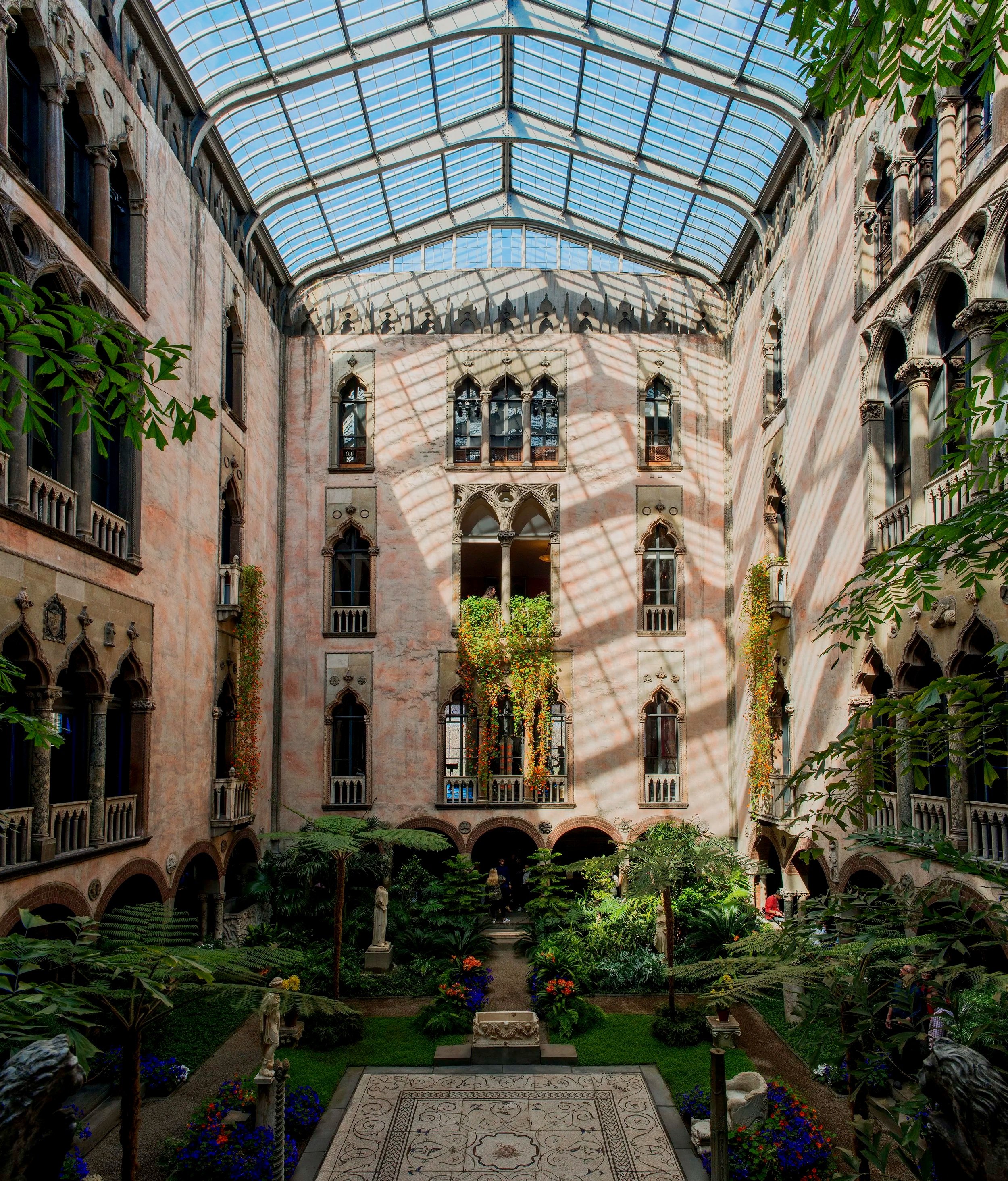
Museums
with Italian gold-ground panel paintings in their collections
Photo credit header: Main lobby Isabella Stewart Gardener Museum, Boston, USA, Wikimedia Commons, Creative Commons Attribution-Share Alike 4.0 International license
IMPORTANT NOTICE: This list is still a work in progress and should be treated as such. Information is still being added, and existing text is being double checked, further refined or corrected. Thank you.
A working directory of institutions holding Italian gold-ground panels, c. 1250–1430 with currently 86 museums in 21 countries, updated continuously.
From the Uffizi’s iconic Maestà triad to the National Gallery of Art’s exceptional US collection and specialized gems like the Lindenau-Museum’s 180+ panels, discover where to see works by Cimabue, Duccio, Giotto, Simone Martini, Gentile da Fabriano, the Lorenzettis, and other Masters.
-
Web: nga.gov
Selection: Duccio di Buoninsegna, Giotto, Simone Martini, Lippo Memmi, Pietro Lorenzetti, Nardo di Cione, Gentile da Fabriano
The National Gallery of Art holds what is widely considered the most important collection of early Italian paintings in the United States, and among the finest in the world. Its gold-ground holdings are exceptional in depth and scholarly documentation. The collection includes two predella panels from Duccio di Buoninsegna's monumental Maestà (1308–11), making the NGA the only institution in the United States to own works from this pivotal double-sided altarpiece. Alongside these stands a rare autograph panel by Giotto (Madonna and Child, c. 1310–15) and works by Simone Martini, Lippo Memmi, Pietro Lorenzetti, and Nardo di Cione. Gentile da Fabriano is represented by two outstanding panels: a Madonna and Child Enthroned of c. 1420 and a predella scene from the Quaratesi Polyptych (1425). The collection also preserves panels by Agnolo Gaddi, Lorenzo Monaco, and the Master of the Osservanza. Assembled primarily through the gifts of Andrew W. Mellon and Samuel H. Kress, the NGA's Duecento–Trecento holdings occupy their own dedicated galleries and remain a primary research destination for the field.
Last verified: July 2026
-
Web: metmuseum.org
Selection: Duccio di Buoninsegna, Giotto, Taddeo Gaddi, Agnolo Gaddi, Giovanni di Paolo, Gentile da Fabriano, Bartolo di Fredi, Lorenzo Monaco, Pietro Lorenzetti
The Met's collection of Italian medieval painting spans the full arc from Duccio and Giotto through the late Trecento and International Gothic, drawing on multiple exceptional bequests to build unparalleled depth across both Florentine and Sienese schools. A dedicated gallery is devoted to gold-ground painting, anchored by Duccio's Madonna and Child (c. 1290–1300), notable for its illusionistic parapet — among the first of its kind in Western painting. The Florentine strand is traced through Giotto, Maso di Banco — Ghiberti's "man of greatest genius" and Giotto's most accomplished pupil — Taddeo Gaddi, and Agnolo Gaddi. The Robert Lehman Collection contributes an incomparable group of Sienese works, particularly an extraordinary concentration of Giovanni di Paolo panels including his celebrated Creation of the World and the Expulsion from Paradise. Sassetta is represented by multiple panels including fragments from the great Borgo San Sepolcro altarpiece, his gold-scratching technique creating glittering effects that the museum notes were especially vivid by candlelight. The Met's holdings also include Gentile da Fabriano's early Venetian Madonna and Child with Angels (c. 1410), Bartolo di Fredi, Lorenzo Monaco, and Pietro Lorenzetti. In late 2024 the museum hosted the landmark exhibition Siena: The Rise of Painting, 1300–1350 before it travelled to London, confirming its central role in scholarship on the field.
Last verified: July 2026
-
Web: getty.edu
Selection: Gentile da Fabriano, Paolo Veneziano
The Getty's painting collection spans from about 1250 to 1920, and among its defining features are its exquisite late medieval Italian gold-ground panel paintings — a strength the museum has actively cultivated through both acquisitions and dedicated exhibitions. The outstanding figure is Gentile da Fabriano, represented by two panels of the highest quality from around 1420: the Coronation of the Virgin, originally a double-sided processional banner for a confraternity in Fabriano, its surface enriched with extensive gold tooling and pastiglia modelling that the Getty describes as resembling the work of contemporary goldsmiths, and the Nativity (Madonna of Humility), c. 1420–22. Gentile was celebrated in the fifteenth century as the greatest Italian painter of his age, and his technique — delicate brushwork, oil glazes, and intricately tooled gold leaf — is displayed at full intensity in both Getty panels. The Venetian Trecento is represented by Paolo Veneziano, whose Annunciation (c. 1340–45) served as the centrepiece of the Getty's 2021 monographic exhibition. In Paolo's paintings, intricately worked gold grounds and hieratic representations of saints are brought together with naturalistic narrative scenes and complex renderings of spatial form to spectacular effect. The museum's gold-ground holdings were further extended in 2025 by a major gift of Italian manuscript illuminations by Lorenzo Monaco, Giovanni di Paolo, Lippo Vanni, and Don Silvestro dei Gherarducci — to be displayed in a dedicated exhibition in 2027.
Last verified: July 2026
-
Web: philamuseum.org
Selection: Duccio di Buoninsegna, Bernardo Daddi, Allegretto Nuzi, Pietro Lorenzetti, Bartolomeo Bulgarini, Vitale da Bologna, Master of the Osservanza, Fra Angelico, Lorenzo Monaco, Jacopo di Cione, Niccolò di Pietro Gerini
When the Philadelphia lawyer John G. Johnson began collecting art in the late nineteenth century, he defied contemporary taste by acquiring Italian paintings from the early Renaissance. The approximately 1,300 works he bequeathed to the City of Philadelphia in 1917 — now housed at the Philadelphia Museum of Art — form one of the broadest collections of Italian medieval and early Renaissance paintings in North America, documented in Carl Brandon Strehlke's authoritative 2004 catalogue Italian Paintings, 1250–1450. Among the key Trecento works are an angel panel from the upper framing element of Duccio's Maestà (by 1311), three central panels of a dated altarpiece by Bernardo Daddi (1334), and a pentaptych of half-length saints attributed to Allegretto Nuzi (c. 1346) — alongside works by Pietro Lorenzetti, Bartolomeo Bulgarini, Vitale da Bologna, and the Master of the Osservanza. Fra Angelico, Lorenzo Monaco, Jacopo di Cione, and Niccolò di Pietro Gerini are also represented. The collection is notable less for a single spectacular holding than for its unusual geographical breadth — Central Italian, Sienese, Florentine, Bolognese, and Venetian schools are all present — making Philadelphia a particularly valuable resource for comparative study of regional traditions within the gold-ground period.
Last verified: July 2026
-
Web: thewalters.org
Selection: Pacino di Bonaguida, Lippo Vanni, Lorenzo Monaco, Master of the Panzano Triptych, Andrea di Bartolo, Lorenzo di Bicci, Master of the Straus Madonna
The Walters Art Museum holds one of the most distinguished gatherings of Italian gold-ground panel painting in the United States, the bulk of it entering the collection through Henry Walters' 1902 acquisition of the Massarenti Collection. Its Trecento holdings open with Pacino di Bonaguida's The Virgin and Child with Saints, painted around 1323–1327, one of the earliest and most important Florentine works of its kind on American soil. The Sienese strand is represented by Lippo Vanni's reliquary triptych of the Madonna and Child with Saints, painted for private devotion in the second half of the fourteenth century, in which the gold ground is tooled, punched, and worked in sgraffito to lend the surface a shifting, light-reactive depth — a technical highlight for any visitor interested in the craft of gilding.
The early Quattrocento is anchored by Lorenzo Monaco's The Crucifixion of Saint Peter, dated around 1390, alongside two panels of the Madonna and Child Enthroned with Saints by the Master of the Panzano Triptych, an anonymous Florentine painter active in the fourteenth century. The museum's Trecento and early Renaissance holdings also include works by Andrea di Bartolo, Lorenzo di Bicci, the Master of the Straus Madonna, and Silvestro dei Gherarducci, whose illuminated antiphonary leaf demonstrates the close ties between panel painting and manuscript gilding in this period.
Last verified: July 2026
-
Web: artic.edu
Selection: Master of the Bigallo Crucifix, Ugolino di Nerio, Niccolò di Pietro Gerini, Francescuccio Ghissi, Paolo Veneziano, Giovanni di Paolo, Sano di Pietro, Matteo di Giovanni
The Art Institute of Chicago holds one of the finest and least-published collections of early Italian panel painting in the United States, anchored by works spanning the Duecento through the early Quattrocento, the majority entering the collection through the Martin A. Ryerson bequest. The cornerstone is the Crucifix of around 1240 by the Master of the Bigallo Crucifix, a leading Florentine artist of the mid-thirteenth century working in a style that retains traditional Byzantine-derived linear patterning while introducing a new, more naturalistic system of lighting — one of the earliest works of its kind in any American collection.
The Trecento is represented by a major panel attributed to Ugolino di Nerio, Virgin and Child Enthroned with Saints Peter, Paul, John the Baptist, and Dominic and a Dominican Supplicant, dated around 1330, a key document of the Sienese workshop tradition descending from Duccio. The same gallery context brings together related Trecento gold-ground works, including a Virgin and Child by Niccolò di PietroGerini from 1390–1400, a Crucifixion by Francescuccio Ghissi from around 1370, and panels by Paolo Veneziano and his workshop depicting Saints Augustine and Peter and Saints John the Baptist and Catherine of Alexandria, both around 1350.
The most celebrated Sienese holding is the group of six surviving panels by Giovanni di Paolo from a twelve-part series illustrating the life of Saint John the Baptist, originally serving as the doors of a shrine for a relic associated with the saint. The narrative includes scenes of John's birth, his departure for the wilderness, his prophecy of Christ's coming, his baptism of Jesus, his imprisonment, and his beheading at Salome's request, making this one of the most complete Sienese narrative cycles outside Siena itself.
Together with strong holdings of Florentine cassone panels and fifteenth-century Sienese devotional works (Sano di Pietro, Matteo di Giovanni), this makes Chicago a destination collection for Trecento and early Quattrocento gold-ground painting, fully documented in the 1993 scholarly catalogue Italian Paintings Before 1600 in the Art Institute of Chicago.
Last verified: July 2026
-
Web: clevelandart.org
Selection: Ugolino di Nerio, Spinello Aretino
The Cleveland Museum of Art is home to one of the finest collections of medieval art in the United States, and its Italian Trecento gallery is anchored by a work of exceptional rarity. An altarpiece by Ugolino di Nerio, dating to around 1317 and surviving nearly intact, forms a major sightline object in the gallery and is among only a few such intact altarpieces now held in the United States. As a pupil of Duccio and a close observer of Simone Martini, Ugolino's mature style is spiritual and elegant, with a preference for brighter colours that distinguish it from his earliest, more strictly Ducciesque manner.
The late Trecento and early Quattrocento are represented by Spinello Aretino's Virgin and Child with Angels of 1405, a large central panel in tempera and gold on wood from a dismembered altarpiece, showing the Madonna enthroned with the infant Christ, flanked by kneeling angels and six-winged seraphim, with a Dead Christ in the predella zone below and the Blessing Christ above the arch — an ambitious Florentine-Aretine work in which the hierarchical gold-ground programme is still fully operative.
Last verified: July 2026
-
Web: mfa.org
Selection: Duccio di Buoninsegna (workshop), Bernardo Daddi, Giovanni di Paolo, Fra Angelico
The Museum of Fine Arts, Boston, holds a genuinely rich collection of early Italian panel painting, rich enough in Florentine and Sienese material that it was the subject of a dedicated scholarly catalogue, Italian Paintings in the Museum of Fine Arts, Boston, Volume I: 13th–15th Century(Laurence B. Kanter, 1997), examining 73 of the museum's early Italian works in full detail. The MFA's own account of its European galleries singles out an early fourteenth-century gold-ground triptych by Duccio and his workshop as one of the highlights of the collection — a small portable altarpiece, its wings depicting the Crucifixion flanked by Saints Nicholas and Gregory, of the same compact format and dimensions Duccio's workshop used for several such devotional shutters, examples of which are now scattered across other American and European collections.
Around this Sienese founding figure, the Boston catalogue documents a strong Florentine Trecento presence led by Bernardo Daddi, the leading Florentine painter of the generation after Giotto and the master who popularized the small-scale portable altarpiece — precisely the format exemplified by the Duccio triptych itself. The Sienese Quattrocento is carried forward by Giovanni di Paolo, the visionary early-fifteenth-century master whose luminous, almost dreamlike gold-ground panels represent one of the last great flowerings of the Sienese school, while Fra Angelico extends the Florentine holdings to the very threshold of the Renaissance. The collection's range beyond Tuscany includes Fra Carnevale, associated with the Marchigian and Urbino schools, and Carlo Crivelli, whose intensely linear, richly gilded Venetian-Marchigian idiom carried gold-ground ornament deep into the second half of the Quattrocento, long after Florence had largely moved on from it.
Displayed today within the museum's renovated Art of the Italian Renaissance galleries alongside sculpture, ceramics, and devotional objects for the home, the early Italian paintings are presented specifically to convey how pervasive such imagery was in the everyday religious life of Renaissance Italians.
-
Selection: Simone Martini, Giotto di Bondone, Fra Angelico, Giovanni di Paolo, Bernardo Daddi
The collection assembled by Isabella Stewart Gardner, under the advisory of Bernard Berenson, represents a highly concentrated, non-pareil ensemble of early Italian masters where every gold-ground panel is of foundational historical importance. The collection’s geographic and stylistic compass is anchored by Giotto’s Presentation in the Temple (c. 1320), an extraordinary panel from a series of Christological narratives that displays the master’s revolutionary handling of architectural space, weighty sculptural drapery, and human gravity. This stands in magnificent dialogue with Simone Martini’s Virgin and Child with Saints Paul, Lucy, Catherine, and John the Baptist (c. 1320), the only complete, multi-panel polyptych by the Sienese master outside of Europe, demonstrating the pinnacle of courtly elegance, sinuous line, and translucent glazes over gold leaf.
The Early Renaissance transition is charted with equal brilliance. Masaccio’s Young Man in a Scarlet Turban (c. 1425–1427) offers a striking example of the Florentine secular portrait, while Fra Angelico’s Dormition and Assumption of the Virgin (c. 1424–1434), a small reliquary tabernacle panel, sparkles with jewel-like pigments and visionary theological precision. Displayed precisely as Gardner intended within the idiosyncratic, atmospheric galleries of Fenway Court, these works—complemented by Piero della Francesca’s fresco of Hercules and Bernardo Daddi’s intimate devotional panels—provide an unmatched, immersive encounter with the spiritual and material brilliance of the Trecento and early Quattrocento.
Last verified: July 2026
-
Selection: Master of San Torpè, Segna di Bonaventura, Benozzo Gozzoli, Giovanni di Paolo, Sassetta (Stefano di Giovanni), Neri di Bicci, Fra Angelico
The Detroit Institute of Arts houses a remarkably rich and scholarly coherent collection of early Italian art, largely shaped during the mid-twentieth century under the transformative curatorial direction of Wilhelm Valentiner. The collection's roots in the Trecento are anchored by an exceptionally rare Madonna and Child by the Master of San Torpè (c. 1310), a Pisan contemporary of Duccio whose work retains rigid, hieratic Byzantine silhouettes while experimenting with a softer, more humanized modeling of the faces.
The high Trecento and early Quattrocento are particularly strong in Sienese expressions of the gold-ground tradition. A stellar highlight is Stefano di Giovanni’s (Sassetta) A Miracle of the Holy Sacrament, a panel from the famous Arte della Lana altarpiece (c. 1423–1426), which brilliantly showcases the artist's ability to fuse complex architectural perspective with the lingering, mystical atmosphere of the late Gothic style. This is paired with Giovanni di Paolo’s highly idiosyncratic, visionary panels and a lyrically rendered Madonna and Child by Benozzo Gozzoli. These narrative and devotional treasures, supplemented by substantial Florentine workshop panels from the circle of Neri di Bicci and Bernardo Daddi, establish the DIA as one of the premier midwestern repositories for studying the regional dialogues between Florence, Siena, and Pisa.
Last verified: July 2026
-
Selection: Giovanni di Paolo, Master of the 1310, Vitale da Bologna, Agnolo Gaddi, Mariotto di Nardo, Lorenzo Monaco, Sano di Pietro
The early Italian holdings at the High Museum of Art form a surprisingly robust nucleus of late medieval and early Renaissance painting, overwhelmingly anchored by the monumental 1958 Samuel H. Kress Collection donation. The foundational bedrock of the medieval gallery is the exceptional Madonna and Child Enthroned with Saints and Angels by the Master of the 1310, a rare and enigmatic Pisan or Lucchese painter working at the absolute dawn of the Trecento whose dynamic, linear drapery rhythms provide a fascinating counterpoint to Giotto's contemporary volumetric shifts in Florence.
The High’s collection is notable for its geographic diversity, featuring not only Tuscan masters but also Northern Italian outliers, such as a rare panel by the Bolognese master Vitale da Bologna. The late Trecento Florentine tradition is elegantly represented by Agnolo Gaddi and Mariotto di Nardo, whose works bridge the monumental style of the mid-century with the refined ornament of the International Gothic. The jewel of the Quattrocento Sienese holdings is Giovanni di Paolo’s The Crucifixion (c. 1440), a work defining the painter's signature expressive distortions, elongated figures, and emotionally charged use of gold leaf, making the High an indispensable Southern outpost for the study of early Italian devotional art.
Last verified: July 2026
-
Web: ncartmuseum.org
Selection: Giotto di Bondone and Workshop, Segna di Bonaventura, Bernardo Daddi, Jacopo del Casentino, Spinello Aretino, Defendente Ferrari, Matteo di Giovanni
The North Carolina Museum of Art boasts one of the most extensive and finest collections of early Italian panel paintings in the American South, a legacy resulting from North Carolina's historic 1947 state appropriation for art and a massive subsequent influx of seventy-three artworks from the Samuel H. Kress Foundation. The absolute pinnacle of the collection is the monumental Peruzzi Altarpiece (c. 1310–1315) executed by Giotto di Bondone and his workshop. This five-panel polyptych, depicting the Christ Blessing with the Virgin, Saint John the Evangelist, Saint John the Baptist, and Saint Francis, stands as one of the few multi-panel Giottesque altarpieces preserved intact within an American museum, displaying the master's unrivaled dignity, spatial gravity, and structural weight.
The Sienese and Florentine Trecento environments are fleshed out with remarkable breadth through Bernardo Daddi’s lyrical Madonna and Child Enthroned and Segna di Bonaventura’s precise, icon-like devotionals. The late fourteenth-century transition into the international style is carried out via a commanding, multi-panel altarpiece by Spinello Aretino and his workshop. Culminating in refined fifteenth-century Sienese gold-grounds by Matteo di Giovanni and the workshop of Sano di Pietro, the Raleigh collection offers an unbroken, textbook-quality narrative of Tuscan art from the height of the Middle Ages to the threshold of the modern era.
Last verified: July 2026
-
Web: georgiamuseum.org
Selection: Pietro Lorenzetti, Simone dei Crocefissi
The Georgia Museum of Art, the official art museum of the state of Georgia and an academic museum on the campus of the University of Georgia, holds its Italian medieval holdings within the Samuel H. Kress Study Collection, a gift of twelve paintings transferred to the museum in 1961 as part of the Kress Foundation's nationwide dispersal of European art to regional institutions. The Kress gift gave the Athens collection its only Duecento and Trecento gold-ground panels and remains the sole point of contact between the museum and the world of early Italian panel painting.
Among the works of direct relevance to this period are a panel attributed to Pietro Lorenzetti, one of the two great Sienese masters of the early Trecento who, alongside his brother Ambrogio, transformed the possibilities of pictorial space and human expression in panel painting, and a work by Simone dei Crocefissi, a Bolognese painter active in the second half of the fourteenth century whose output bridges the influence of the Riminese school and the broader late Trecento tendency toward more emotive, decorative gold-ground devotional imagery. Together these constitute the museum's primary connection to the era of Duecento and Trecento Italian panel painting. The broader Kress gift, spanning the thirteenth to the early nineteenth century, introduced to Athens what would otherwise have been entirely unavailable to students and scholars in the region.
The museum's particular distinction in this field lies not in the scale of its holdings but in its institutional commitment: it hosts the biennial Andrew Ladis Memorial Trecento Conference, the only recurring international gathering dedicated exclusively to fourteenth-century Italian art, organized in collaboration with the Trecento Forum and presented alongside the museum's own Kress Collection. For scholars of gold-ground painting, this makes Athens a periodically significant gathering point quite disproportionate to the modest size of its collection.
Last verified: July 2026
-
Web: nortonsimon.org
Selection: Guariento di Arpo, Paolo Veneziano, Lorenzo Monaco, Giovanni di Paolo
The Norton Simon Museum holds one of the strongest concentrations of early Italian gold-ground panel painting on the West Coast, gathered across three decades of systematic and sometimes spectacular collecting by the industrialist Norton Simon. The medieval and early Renaissance galleries bring together works from across the Italian peninsula — Venetian, Paduan, Florentine, and Sienese — that together trace the full arc of gold-ground painting from the Trecento through the early Quattrocento.
The Paduan master Guariento di Arpo is represented by a signed Coronation of the Virgin Altarpiece dated 1344, a work of exceptional preservation and ambition that documents the Veneto tradition of gold-ground panel painting at mid-century, with its characteristic Byzantinizing figure types set against elaborately tooled and punched gold. Paolo Veneziano, the leading Venetian painter of the first half of the fourteenth century, appears in the collection with a Madonna and Child of around 1340, a key example of the distinctively Adriatic synthesis of Byzantine formality and Gothic tenderness that defined the Venetian school before the influence of Florentine and Sienese modes fully arrived. A panel attributed to the Florentine Lorenzo Monaco, active in the transitional years between the Trecento and the International Gothic, extends the survey into the early fifteenth century.
The crown of the collection is the Branchini Madonna of 1427 by Giovanni di Paolo, a signed and dated monumental panel commissioned for the Branchini family chapel in San Domenico, Siena — a work widely regarded as one of the artist's supreme achievements and among the most technically complex gold-ground panels in any American collection. The Virgin sits in the pose of the Madonna of Humility while simultaneously crowned as Queen of Heaven, surrounded by seraphim and a meadow of symbolic flowers; the surface is built up through layers of sgraffito, stamped tooling, and glass gems set into Mary's crown, with the azurite and lapis lazuli of her robes recently conserved. Acquired in 1978, the Branchini Madonna formed the centerpiece of a major exhibition at the J. Paul Getty Museum in 2016–17 that reunited it with scattered panels from the same polyptych, establishing it as one of the most studied Sienese altarpieces outside Italy.
Last verified: July 2026
-
Web: artsbma.org
Selection: Tuscan School (Late Duecento), Florentine and Sienese Trecento panels
The Birmingham Museum of Art owes its entire collection of early Italian panel painting to the Samuel H. Kress Foundation, which placed twenty-nine paintings on long-term loan with the newly established museum in 1952 and formally deeded them — along with eight additional works — to the institution in 1961. The gift was foundational: the Kress paintings provided the nucleus around which the BMA's European collection was built, and they remain its most historically significant holding in this field.
Within the Kress group, the earliest works place Birmingham in contact with the Duecento tradition. A Madonna and Child with Saints attributed to a late thirteenth-century Tuscan painter — influenced by Cimabue and showing Sienese as well as Florentine characteristics — represents the Glykophilousa type, the tender, cheek-to-cheek Virgin, in a format derived from Byzantine devotional practice. The panel is classified in the Kress catalogue as among a group of Romanizing Florentines working in the shadow of the Magdalen Master, and its survival in Birmingham gives the collection a genuine thirteenth-century anchor. The Trecento is represented by a range of Florentine and related panels from the fourteenth and early fifteenth centuries.
The museum has engaged actively with the material dimension of this collection: it participated in the Kress Reconstruction Project at the University of Delaware, producing a full process reconstruction of a panel by the Florentine painter Giovanni del Biondo in order to demonstrate to visitors the layered technique of fourteenth-century gold-ground panel painting — gesso, bole, gold leaf, burnishing, punching, tempera — as described in Cennino Cennini's handbook. The dedicated Kress gallery has been reinstalled several times and remains a focus of the BMA's educational programming, making Birmingham one of the more active interpreters of its medieval Italian holdings among regional museums in the American South.
Last verified: July 2026
-
Web: epma.art
Selection: Lucchese School (c. 1200), Nicolò da Voltri, Sano di Pietro, Filippino Lippi
The El Paso Museum of Art holds one of the larger and more chronologically expansive Kress regional collections in the United States, comprising fifty-seven paintings and two sculptures spanning from around 1200 to the 1780s. The connection between El Paso and the Kress Foundation was a direct one: Samuel Kress's downtown five-and-dime store on the plaza was among his most profitable, and the museum accordingly received one of the most generously calibrated regional gifts, with a gold-ground core that extends further back in time than at many comparable institutions.
The collection opens with a Madonna and Child of around 1200 attributed to the Lucchese School, one of the earliest surviving panel paintings in any American regional museum — a work in the archaic Byzantine-derived tradition of Central Italian painting that predates even the innovations of Cimabue. It establishes El Paso's Kress group as a resource for the study of proto-Duecento panel painting rarely available outside major research centers. A Madonna and Child by Nicolò da Voltri, a Genoese painter active between 1385 and 1417 who worked under the combined influence of Barnaba da Modena and Taddeo di Bartolo, extends the survey into the late Trecento and documents the provincial diffusion of gold-ground practice along the Ligurian coast. Sano di Pietro, the prolific mid-fifteenth-century Sienese master, is present with an altarpiece that carries the gold-ground tradition into the Quattrocento.
The later Kress holdings are weighted toward the Italian Renaissance and Spanish Baroque, including works by Filippino Lippi and Lorenzo Lotto alongside significant Spanish paintings — a deliberate curatorial decision by the Kress Foundation to reflect the ethnic and cultural character of El Paso's borderland population. The collection as a whole thus spans a broader art-historical range than is typical for Kress regional gifts, with the medieval gold-ground panels serving as the chronological anchor for a survey that reaches to the eighteenth century.
Last verified: July 2026
-
Web: denverartmuseum.org
Selection: Riminese School (14th century), Niccolò di Pietro Gerini, Gherardo Starnina, Andrea di Bartolo
The Denver Art Museum received its Kress gift in 1954 — thirty-three paintings and four sculptures, dating from the mid-fourteenth to the mid-seventeenth century — under the condition that the city construct a fireproof, climate-controlled building to house them, which it did, inaugurating the museum's south wing specifically for the purpose. The Kress Collection remains the largest single gift of European Old Masters in the museum's history and provided Denver with its first major encounter with gold-ground Italian panel painting.
The medieval component of the gift covers both the Florentine and wider Italian Trecento traditions. A Crucifixion attributed to a Riminese painter of around 1325–30 represents the school of Rimini, an influential but understudied current of early Trecento painting that transmitted Byzantine expressive intensity into the upper Adriatic and central Italian sphere through its characteristic bold linearity and emotional figure types. Niccolò di Pietro Gerini, the prolific Florentine master of the late Trecento active between approximately 1368 and 1415, is present with The Four Crowned Martyrs of around 1390, a gold-ground narrative panel that entered the Kress collection as a Spinello Aretino before being correctly reattributed. Gherardo Starnina, a key figure in the transition from the late Trecento to the International Gothic in Florence, appears with a Saint Nicholas of Bari, and Andrea di Bartolo, a Sienese painter working in the tradition of his father Bartolo di Fredi, contributes a Crucifixion of 1400.
Together these works trace the late Trecento from Rimini to Florence to Siena and give Denver a collection that, while compact, covers the principal currents of Italian gold-ground painting in its final generation before the early Renaissance transformed the terms of the art. The scholarly apparatus for the collection was significantly advanced by the publication of The Kress Collection at the Denver Art Museum by chief curator Angelica Daneo, the authoritative reference for these holdings.
Last verified: July 2026
-
Web: mfah.org
Selection: Master of the Sienese Straus Madonna, Master of the Straus Madonna, Lorenzo Monaco, Fra Angelico, Giovanni di Paolo, Sano di Pietro
The Museum of Fine Arts, Houston, holds the most distinguished collection of early Italian gold-ground panel painting in the American South, assembled not through a Kress gift but through the extraordinary bequest of Percy Straus, chairman of Macy's department store, whose collection of late medieval and early Renaissance paintings entered the museum in 1944. Straus acquired with the close guidance of Richard Offner, the preeminent scholar of Florentine Trecento painting, and the result is a group of exceptional quality and coherence documented in the scholarly catalogue Italian Paintings 1300–1600 in the Museum of Fine Arts, Houston.
The Trecento is anchored by two anonymous masters named specifically after Straus Collection panels. The Master of the Sienese Straus Madonna, active in Siena around 1340–60 and possibly identical with the Master of the Ashmolean Crucifixion, is named for a Virgin and Child in the collection that adheres faithfully to the gold-ground devotional conventions of the mid-Trecento Sienese school. The Master of the Straus Madonna, a Florentine painter active approximately 1385–1415 who bridges the tradition of Agnolo Gaddi and the International Gothic of Lorenzo Monaco, is named for a Virgin and Child in a state of exceptional preservation, acknowledged as his masterpiece, with superb tooled gold patterning and a frame that is largely original. Richard Offner coined the artist's name upon seeing the panel, and scholars have since proposed an identification with Cenni di Francesco di Ser Cenni.
Lorenzo Monaco is present with two door panels depicting Saint Michael with the Angel Gabriel in the apex and Saint Francis with the Annunciate Virgin, from the early 1420s — transitional works between the gold-ground manner and the early Renaissance. Fra Angelico contributes a Saint Anthony Abbot Shunning the Mass of Gold of around 1435–40, one of the few works by this master in a Southern American collection. Giovanni di Paolo's Saint Clare Rescuing a Child Mauled by a Wolf, from around 1455–60, and a Virgin and Child with Saints by Sano di Pietro from the 1460s round out the Sienese Quattrocento holdings. Together the Straus panels constitute a privately assembled collection of unusual depth and scholarly distinction, making Houston a mandatory stop for researchers working on late Trecento and early Quattrocento gold-ground painting.
Last verified: July 2026
-
Web: brooksmuseum.org
Selection: Sienese, Florentine, and Venetian schools (13th–18th century); Follower of Pietro Lorenzetti, Lorenzo di Niccolò
The Memphis Brooks Museum of Art received its Kress gift in 1961, twenty-seven paintings and two sculptures tracing the Sienese, Florentine, and Venetian schools from the thirteenth to the eighteenth century. The connection to Memphis was direct and personal: Samuel Kress had opened his first five-and-dime store in the city in 1896, making Memphis one of his earliest commercial successes and therefore one of the institutions he chose to honor with a Kress allocation.
The medieval component of the gift reaches into the Trecento via a Saint John the Baptist attributed to a follower of Pietro Lorenzetti, dated before 1362, which was among the Kress Program in Paintings Conservation's focus works — a case study in the stamped gold tooling and punchwork of the Sienese tradition as described by Cennino Cennini. The attribution to the Lorenzetti circle places this panel in the orbit of the most spatially and expressively innovative workshop in Siena in the first half of the fourteenth century. Extending the survey into the late Trecento and early Quattrocento, a Martyrdom of Saint Stephen by Lorenzo di Niccolò, datable to around 1400, documents the tradition of the Florentine Orcagnesque school in its final generation — Lorenzo di Niccolò being a painter trained in the workshop of Niccolò di Pietro Gerini who carried the gold-ground manner through the turn of the century.
Together with the broader Italian, Dutch, British, and French holdings, the Brooks has built one of the most comprehensive encyclopedic collections in the mid-South. The Kress galleries have been the subject of the essay collection Brooks Museum Bulletin: Essays on the Collection, which includes specialist studies on individual paintings including a proposed polyptych reconstruction for one of the Trecento panels by Gail Solberg.
Last verified: July 2026
-
Web: philbrook.org
Selection: Taddeo di Bartolo, Allegretto Nuzi
The Philbrook Museum of Art occupies a 1920s Italian Renaissance–style villa built for Oklahoma oil magnate Waite Phillips and donated to the city of Tulsa in 1938. The setting — formal gardens, courtyard loggias, carved ceilings — establishes a frame of reference that the Kress Collection of Italian Renaissance and Baroque paintings, gifted in 1961, inhabits with particular aptness. The gift significantly strengthened the museum's European holdings, which had received an earlier boost from the bequest of American and European paintings by Laura A. Clubb in 1947.
Two works of particular relevance to the gold-ground tradition stand out. Taddeo di Bartolo, the Sienese painter who registered in the guild of artists in 1389 and became one of the most widely traveled and commissioned artists of his generation — with documented work in Pisa, Genoa, San Gimignano, Perugia, and Siena's own Palazzo Pubblico — is represented in the collection. His style, formed directly under the influence of Bartolo di Fredi and disseminated across the wider Tuscan and Ligurian sphere, made him the dominant Sienese painter of the late Trecento and early Quattrocento, and the Philbrook panel is one of the few opportunities in the central United States to study this artist outside of a major coast-side collection. Allegretto Nuzi, a Marchigian painter of Fabriano active in the mid-fourteenth century whose work fused Florentine influence derived from Maso di Banco with the expressive idiom of the Lorenzetti brothers, contributes a Crucifixion of around 1365. Working at the geographic and stylistic margins of the Florentine and Sienese schools, Nuzi produced a body of work that places him among the most individual of the Trecento provincial masters, and the Philbrook Crucifixion is a rare example of his gold-ground narrative painting in a regional American collection.
Last verified: July 2026
-
Selection: Lorenzo di Bicci (attributed), and gold-ground core of the Kress Study Collection; Italian, German, Dutch holdings
The Allentown Art Museum received one of the largest Kress regional gifts of all — more than fifty paintings and sculptures, the biggest allocation to any museum outside the major metropolitan centers — and the scale of this generosity was directly personal: Samuel Kress was born in Cherryville, Pennsylvania, a small community in Northampton County about twelve miles north of Allentown, and designated the local museum as a tribute to his birthplace. The Kress gift is consequently one of the most distinctive in the program, weighted not only toward the standard gold-ground Italian core but also toward rare German paintings, reflecting the Kress Foundation's deliberate decision to honor the German ethnic heritage of eastern Pennsylvania's population.
The gold-ground component includes a Crucifixion tondo attributed to Lorenzo di Bicci, of around 1399, closely related in type and style to the Orcagnesque followers of Niccolò di Pietro Gerini, and originally serving as the crowning finial of a Florentine altarpiece — a format well documented in Lorenzo di Bicci's output. This panel is among the earliest works in the collection and represents the late Trecento Florentine tradition at its most condensed and devotionally direct. The Kress catalogue notes its almost exact compositional correspondence with a documented Crucifixion by Lorenzo di Bicci at the Collegiata in Empoli.
What sets Allentown apart from most regional Kress recipients is the presence of rare German panel paintings, a category virtually absent from comparable institutions in the South and Southwest. The foundation deliberately assembled German works for this location, acknowledging the region's deep German-American roots, and the result is a collection with a double profile: a standard Italian gold-ground and Renaissance survey, paired with Northern European material rarely encountered in the regional Kress network. The collection is documented across several exhibition catalogues, most notably a Lafayette College traveling exhibition that drew directly from the Kress holdings to trace Italian Renaissance development from its fourteenth-century origins.
Last verified: July 2026
-
Web: honolulumuseum.org
Selection: Jacopo di Cione (triptych, 1391); Kress Collection of Italian Renaissance paintings
The Honolulu Museum of Art — founded in 1927 as the Honolulu Academy of Arts by Anna Rice Cooke — holds the geographically most remote collection of early Italian gold-ground panel painting in the United States, and one of its earliest medieval acquisitions is also among the most specific and documented: a signed triptych dated 1391 by Jacopo di Cione, the youngest of the three Cione brothers who dominated Florentine painting in the third quarter of the fourteenth century alongside Andrea Orcagna and Nardo di Cione. The triptych, painted for the Church of San Lorenzo in Florence, entered the museum's collection through the gift of Anna Rice Cooke in 1928 — one years before the Kress program began — establishing gold-ground Italian painting at the heart of the Western holdings from the institution's earliest years. The National Gallery of Art's catalogue of Jacopo's work cites the 1391 Honolulu triptych as evidence of the artist's late style, noting that in his final decade Jacopo progressively dissociated himself from the compositional energy of his earlier collaborative works with Niccolò Gerini and Giovanni del Biondo.
To this founding acquisition the Kress Foundation added its own gift, bringing a survey of Italian Renaissance and Baroque paintings that extended the museum's European holdings from the medieval period through the seventeenth century. Together the two layers of collection-building — the early gift of specific and art-historically significant medieval panels, followed by the broader Kress survey — give the Honolulu Museum an unusual dual profile: a late Trecento Florentine anchor acquired on scholarly and connoisseurial grounds, surrounded by the more encyclopedic Kress ensemble. For researchers working in gold-ground painting, Honolulu is the most distant and most surprising American venue in which to encounter a precisely dated and church-documented panel by one of the leading masters of the Orcagnesque generation.
Last verified: July 2026
-
Web : famsf.org
Selection: Master of San Lucchese, Ugolino di Nerio, Bernardo Daddi, Luca di Tommè, Lorenzo di Niccolò, Bicci di Lorenzo, Matteo di Giovanni
The Fine Arts Museums of San Francisco — the umbrella institution comprising the de Young Museum and the Legion of Honor — hold one of the finer collections of early Italian gold-ground panel painting on the West Coast, displayed in the Beaux-Arts galleries of the Legion of Honor. The early Italian holdings were transformed by the Samuel H. Kress gift, first exhibited at the M. H. de Young Memorial Museum in 1955 and formally deeded in 1961, which added a concentrated group of Trecento and Quattrocento gold-ground pictures to the museums' broader survey of European painting from Fra Angelico to Monet.
The Duecento–Trecento tradition is represented by a Madonna and Childwith Saints by the Master of San Lucchese, a Florentine painter active around 1345, notable for an unusual pictorial device: the upper section retains the traditional gold ground of the heavenly sphere, while the lower section opens onto a depicted floor and decorated wall, with the gold zone appearing to cast a shadow onto the wall as though it were a tapestry — a rare early experiment in reconciling gold-ground convention with spatial illusion. The core of the Sienese Trecento is anchored by Ugolino di Nerio, the direct heir of Duccio's workshop, represented by a Saint Louis of Toulouse, and by a Crucifixion by Luca di Tommè, a mid-fourteenth-century Sienese master who assimilated the lessons of Duccio, Simone Martini, and the Lorenzetti brothers and helped carry the decorative Sienese manner into the following century. Florentine painting of the same period is present through Bernardo Daddi, the leading Florentine painter of his generation and popularizer of the portable altarpiece, and through late-Trecento panels by Lorenzo di Niccolò (a Saint Paul) and Bicci di Lorenzo (Saint Stephen and Saint Anthony), documenting the Orcagnesque tradition at the turn of the fifteenth century.
The Sienese Quattrocento is represented by a predella panel, The Crucifixion, by Matteo di Giovanni, widely believed to have belonged to the artist's Massacre of the Innocents altarpiece commissioned in 1491 for Santa Maria dei Servi in Siena — an attribution first proposed by Roberto Longhi in a handwritten opinion preserved in the Kress Foundation archive and provided to Samuel Kress before his purchase. Together these works make the Legion of Honor the principal West Coast destination, alongside the Norton Simon in Pasadena, for the study of early Italian gold-ground painting.
Last verified: July 2026
-
Selection: Jacopo del Casentino, Bartolomeo Bulgarini, Niccolò di Ser Sozzo Tegliacci, Giovanni di Paolo, Guidoccio Cozzarelli
The University of Arizona Museum of Art holds the Kress gold-ground collection associated with Tucson — a distinct institution from the downtown Tucson Museum of Art — and one of the more historically significant Kress regional gifts in the Southwest. The collection was first shown to the public in 1951 during the inauguration of University of Arizona President Richard A. Harvill, and the Kress Foundation made its permanent gift of sixty-four objects in 1961. Spanning the fourteenth through the nineteenth century, the gift gave the university what its scholars regard as one of the finest concentrations of Old Master painting at any American university museum, anchored by a group of Trecento and Quattrocento gold-ground panels.
The Florentine Trecento is represented by Jacopo del Casentino, a prolific early fourteenth-century Florentine panel painter who — alongside Bernardo Daddi and others — was among the founders of the painters' Corporation of Saint Luke in Florence in 1339, and whose specialty in small devotional altars for private worship helped popularize the portable altarpiece across Italy; his Madonna and Child Enthroned exemplifies the Giottesque tradition inflected by Sienese influence. The Sienese school of the same generation is unusually well served: a Madonna and Child by Bartolomeo Bulgarini, the artist once known as "Ugolino Lorenzetti" whose style synthesizes Ugolino di Nerio and Pietro Lorenzetti, and a Madonna and Child with Angels by Niccolò di Ser Sozzo (Tegliacci), one of the leading Sienese panel painters and manuscript illuminators of the mid-Trecento, whose work descends from Simone Martini and the Lorenzetti brothers and who collaborated with Luca di Tommè.
The Sienese Quattrocento is carried by Giovanni di Paolo, represented by a Madonna and Child with Angels in his distinctive dreamlike Gothic idiom, and by a Crucifixion from Guidoccio Cozzarelli, a later fifteenth-century Sienese follower of Matteo di Giovanni. Alongside these gold-ground panels, the collection's single most celebrated object is the twenty-six-panel Retablo of the Cathedral of Ciudad Rodrigo by Fernando Gallego and Maestro Bartolomé — a monumental fifteenth-century Spanish altarpiece displayed in a dedicated gallery, regarded as one of the most important Spanish paintings of its century in any American collection. The Spanish weighting of the Tucson gift was a deliberate Kress Foundation decision, reflecting the region's Hispanic heritage in the same way the foundation directed Spanish works to El Paso, and it gives the collection a dual profile: an early Italian gold-ground core paired with an exceptional Iberian centerpiece.
Last verified: July 2026
-
Web: ringling.org
The John and Mable Ringling Museum of Art — the official state art museum of Florida — holds the largest and most significant collection of Italian, Spanish, and French Old Master paintings in the American Southeast, more than three hundred works assembled by the circus magnate John Ringling. Unlike the Kress regional museums, the Ringling's holdings came not from a foundation gift but from Ringling's own concentrated buying at auction between roughly 1927 and 1929, when he acquired hundreds of works from distinguished European collections dispersed in the interwar years. The collection's celebrated strength is the Italian and Flemish Baroque — above all the monumental Rubens cartoons for the Triumph of the Eucharist— but it opens chronologically with a group of late medieval and early Renaissance gold-ground panels of the Florentine, Sienese, and North Italian schools, displayed in the museum's Gallery of Medieval and Early Renaissance Art.
Because Ringling collected as a connoisseur building a comprehensive survey rather than as a specialist in the Italian "primitives," the early gold-ground panels function as the chronological foundation of a collection whose center of gravity lies in the sixteenth and seventeenth centuries.
Last verified: July 2026
-
Web: thewadsworth.org
Selection: Master of the Rasini Crucifixion (Altichiero?)
The Wadsworth Atheneum, founded in 1842 and opened in 1844, is the oldest continuously operating public art museum in the United States, and its European holdings — some nine hundred paintings, five hundred sculptures, and thousands of works on paper ranging from the medieval to the modern — are anchored by an internationally significant collection of Italian Baroque painting, with major works by Caravaggio, Orazio Gentileschi, and Bernardo Strozzi. The museum's engagement with early Italian gold-ground painting is more selective than that of the Kress study collections, but it is marked by works of exceptional quality rather than survey breadth.
The centerpiece of the museum's Trecento holdings is a recent and important acquisition: the Rasini Crucifixion of around 1350, a rare gold-ground panel from northern Italy attributed to an anonymous master active in Lombardy — with the Veronese painter Altichiero da Zevio advanced as a strong candidate for the attribution. Acquired in 2024 through the Ella Gallup Sumner and Mary Catlin Sumner Collection Fund, the small tempera-on-panel Crucifixion has been hailed by Keith Christiansen, curator emeritus at the Metropolitan Museum, as among the most significant Trecento works to reach the market in recent decades. Despite its modest scale of roughly 52 by 33 centimeters, the panel carries the narrative depth and emotional resonance of a monumental fresco, reflecting the transformative influence of Giotto and his followers on northern Italian painting; the artist's sculptural treatment of the crucified Christ, abstracted landscape, and dynamic composition mark it as a work of real ambition. Its distinguished exhibition history — it appeared in the landmark Mostra Giottesca in Florence in 1937 — and deep scholarly literature give it a documented pedigree unusual for a gold-ground panel of uncertain authorship.
The acquisition of the Rasini Crucifixionreflects the Atheneum's continuing commitment to strengthening its medieval and early Renaissance holdings alongside its celebrated Baroque collection. For the study of gold-ground painting, Hartford is best understood not as a Kress-style concentration of Duecento and Trecento panels but as an encyclopedic museum whose selective early Italian holdings are being deliberately deepened, with the northern Italian Crucifixion now serving as their focal point.
A note on scope: the Atheneum's early Italian gold-ground holdings beyond the Rasini Crucifixion aren't fully surfaced in public records — the collection database is being digitized on an ongoing basis, and its printed catalogues (including Masters of French Painting) cover other schools.
Last verified: July 2026
-
Web: timkenmuseum.org
Selection: Niccolò di Buonaccorso
The Timken Museum of Art — the free-admission "jewel box" of San Diego's Balboa Park, home to the Putnam Foundation's collection of European Old Masters, nineteenth-century American painting, and Russian icons — holds a small but exceptionally group of early Italian pictures within a compact collection of roughly fifty masterworks spanning seven centuries. Unlike the Kress regional museums, the Timken was built by the reclusive Putnam sisters and the Putnam Foundation through selective, high-quality acquisition rather than a single foundation gift, and its guiding philosophy is quality over quantity: each work is meant to reward close and unhurried looking.
The centerpiece of the museum's Trecento holdings is a monumental Madonna and Child of 1387 by Niccolò di Buonaccorso, one of the most accomplished masters active in Siena in the second half of the fourteenth century. At roughly 152 by 58 centimeters, the panel is unusually large and lavish: the Madonna sits on an elaborately carved Gothic throne and inclines her head toward the Christ Child, who offers her a white rose — symbol of purity — from a small basket on his lap, against a richly tooled and burnished gold ground. The work was the central panel of a now-dismembered signed and dated altarpiece, and its scale and costliness point to a prestigious commission, probably for the high altar of a church or an important private chapel; it is thought to derive from Santa Margherita a Costalpino near Siena. The Putnam Foundation acquired it in 1998 from the Kisters collection in Kreuzlingen.
The Timken holds a second work by the same artist — a small triptych known as the Virgin of Humility (c. 1370–75) — which, seen alongside the grand 1387 panel, demonstrates the range of an artist once dismissed as minor: from intimate private-devotional format to monumental altarpiece. Together the two Buonaccorso panels give this very small museum a concentrated pair of Sienese gold-ground works of real art-historical weight, complementing the Timken's better-known later holdings, which include San Diego's only Rembrandt and paintings by Veronese, Guercino, Petrus Christus, and Bruegel the Elder.
Last verified: July 2026
-
Web: nelson-atkins.org
Selection: Bernardo Daddi, Jacopo del Casentino, Bartolo di Fredi, Lorenzo Monaco, Gherardo Starnina, Giovanni di Paolo
The Nelson-Atkins Museum of Art, which opened in 1933 in a Beaux-Arts building in Kansas City, is best known for its encyclopedic reach and especially its Asian art, but its European galleries include a well-chosen group of early Italian gold-ground panels drawn partly from the museum's own acquisitions and partly from a gift of the Samuel H. Kress Foundation — placing Kansas City among the eighteen regional recipients of Kress's nationwide dispersal.
The Florentine Trecento is anchored by Bernardo Daddi, the leading Florentine painter of his generation and a pupil of Giotto who popularized the portable altarpiece; the museum holds his Virgin and Child Enthroned with Saints and Angels, a work of the mature Daddi manner in which the more naturalistic, light-modeled figures descend from Giotto while the graceful, ornamental sweetness reflects Sienese influence. A Coronation of the Virgin by Daddi at the Nelson-Atkins — from the same Platt/Duveen provenance that fed the Kress collections — has been the subject of technical study reuniting long-separated panels. Alongside Daddi, an early Florentine devotional panel by Jacopo del Casentino, the prolific fourteenth-century painter who co-founded the Florentine painters' Corporation of Saint Luke in 1339 with Daddi, and a Virgin and Child by Lorenzo Monaco, the Camaldolese monk-painter who bridged the gold-ground Trecento and the International Gothic, extend the Florentine survey to the turn of the fifteenth century. Gherardo Starnina, active in the transition to the International Gothic, is present through the Kress gift.
The Sienese school is represented by a Saint Peter by Bartolo di Fredi, one of the most prominent Sienese painters of the later Trecento, and — through the Kress gift — by a panel from Giovanni di Paolo, the distinctive and imaginative master of Quattrocento Siena. The Kress Foundation also gave the museum an important later work, Giovanni Bellini's Madonna and Child of around 1485, extending the Italian holdings into the Venetian Renaissance. Together with strong Northern holdings — Petrus Christus's Virgin and Child in a Gothic Interior among them — the early Italian panels give the Nelson-Atkins a compact but genuinely representative survey of gold-ground painting from the Florentine and Sienese Trecento through the early Quattrocento, documented in the Kress Foundation's digital archive and the museum's own collection catalogues.
Last verified: July 2026
-
Web: uffizi.it
Selection: Cimabue, Duccio di Buoninsegna, Giotto, Simone Martini, Gentile da Fabriano, Lorenzo Monaco
No single room in the world does more to explain the birth of gold-ground painting than the Uffizi's Sala delle Maestà (Room 2), where three towering altarpieces of the Madonna in Majesty, each roughly the height of two persons, stand side by side: Cimabue's Santa Trinita Maestà (c. 1280–90), Duccio di Buoninsegna's Rucellai Madonna (1285), and Giotto's Ognissanti Madonna (c. 1310).
Seen together, the three panels form the clearest possible visual argument for how the gold-ground tradition transformed within a single generation. Cimabue's Virgin, painted last among the great Byzantinizing masters, still floats within a flattened, coin-like space, her angels stacked rather than positioned; Duccio, working in Siena in the same years, opens the Gothic vein that would define an entire regional school — elegant, decorative, courtly, the gold itself becoming an expressive material rather than a mere backdrop. Then Giotto, in the same room, breaks the mold entirely: his Madonna sits within a throne that has real depth, her body has real weight, and — as generations of visitors have noted — she is unmistakably a mother rather than an icon. This one room is, in effect, the primary source for nearly every attribution, comparison, and stylistic argument that has run through this entire survey, from the Art Institute of Chicago's Master of the Bigallo Crucifix to the Kunstmuseum Bern's Duccio to the dismembered Lorenzo Veneziano altarpiece reassembled across Tours.
The Sienese school reaches its supreme refinement one room further on, in Simone Martini and Lippo Memmi's Annunciation with Saint Margaret and Saint Ansanus (1333) — the angel Gabriel's words to the Virgin rendered, extraordinarily, as raised gold lettering incised directly into the panel, an object where gold ceases to be background and becomes language itself — and in Ambrogio Lorenzetti's Presentation at the Temple (1342), painted less than a decade before the Black Death would end, in a single catastrophic year, the golden age of Sienese painting the Lorenzetti brothers and Simone Martini had built. From this room, the story fans out across every collection this survey has covered — Chicago's Master of the Bigallo Crucifix, Bern's Duccio, Cologne and Cambridge's shared Simone Martini pentaptych, the Straus and Fesch and Campana collections built in direct homage to what hangs here. The Uffizi is not one stop among many in the story of gold-ground painting; it is the source from which all the others, in one way or another, descend.
Last verified: July 2026
-
Web: galleriaaccademiafirenze.it
Selection: Bernardo Daddi, Giotto, Taddeo Gaddi, Andrea Orcagna (di Cione), Nardo di Cione, Agnolo Gaddi, Giovanni da Milano, Lorenzo Monaco
The Accademia's gold-ground collection from the 13th to early 15th century is particularly important, preserving works by the greatest Florentine artists of the period: the Master of the Magdalene, Giotto, the Master of the St Cecilia, Bernardo Daddi, Taddeo Gaddi, Andrea Orcagna, Nardo di Cione, Giovanni da Milano, and Agnolo Gaddi. It is structured around three dedicated Florentine Gothic rooms. The three rooms address, respectively, 13th and early 14th-century painting, the Giottesque painters, and Orcagna and his brothers.
Last verified: July 2026
-
Web: museitoscana.cultura.gov.it
Essentially a single-artist shrine. One room of the museum offers the most important and extraordinary collection of works on panel by Fra Angelico, alongside his in-situ frescoes throughout the convent cells and corridors. The 2025–26 retrospective at Palazzo Strozzi and San Marco reunited dispersed altarpiece components for the first time in over 200 years — worth noting as background for a potential article.
Last verified: July 2026
-
Web: pinacotecanazionalesiena.it
Selection: Duccio di Buoninsegna, Simone Martini, Pietro Lorenzetti, Ambrogio Lorenzetti, Guido da Siena
The Pinacoteca is particularly renowned for its collection of fondi oro paintings from the Sienese 13th and 14th centuries, tracing artistic evolution from Duccio di Buoninsegna to the Lorenzetti brothers, from Simone Martini to Sassetta. For fondo-oro purposes it is the premier Sienese school institution globally — Guido da Siena's panels represent some of the earliest dated Italian gold-ground works.
Last verified: July 2026
-
Selection: Simone Martini, Fra Angelico, Filippo Lippi
Its medieval and Trecento holdings are comparatively thin — the museum's strength lies in the 16th–17th centuries. The 2022 reopening of the ground floor presents an evocative journey from the hieratic image of the Madonna Advocata and gold-ground medieval paintings through to the complex works of Beato Angelico, Filippo Lippi, Antoniazzo Romano, and Perugino.
Last verified: July 2026
-
Web: museinazionalipisa.cultura.gov.it
Selection: Giunta Pisano, Simone Martini, Francesco Traini, Barnaba da Modena, Cecco di Pietro
Housed in a former Benedictine convent on the Arno, the Museo Nazionale di San Matteo holds the most important collection of Pisan medieval painting and sculpture in existence, and its gold-ground holdings span the full arc of the tradition from the twelfth century onward. A unique room of painted crucifixes includes work by Giunta Pisano, the leading Pisan painter of the thirteenth century whose Christ figures marked the shift from the triumphant, open-eyed Christus Triumphans of Romanesque tradition to the suffering, slumped Christus Patiens that would define Italian devotional imagery for centuries.
The Trecento gallery is dominated by the museum's absolute masterpiece: Simone Martini's Polyptych of Saint Catherine of Alexandria (1319–1320), a monumental seven-panel altarpiece complete with its predella and pinnacles, painted for the Pisan church of Santa Catherine and considered one of the summits of Sienese Gothic painting outside Siena itself — its gold ground, in the words of one local guide, the most dazzling in the entire museum. Beside it hangs a polyptych with Scenes from the Life of Saint Dominic by Francesco Traini, the leading Pisan painter of the mid-fourteenth century, from the same church. A dossal signed and dated 1301 by Deodato Orlandi, one of the earliest dated works in the collection, documents the moment just before Giotto's influence reshaped Tuscan painting, while Barnaba da Modena's Madonna of the Merchants and Madonna del Latte bring the distinctive Ligurian-Byzantine gold-ground style, also found in collections from Frankfurt to Milan, into direct Pisan context.
The later Trecento is represented by Cecco di Pietro, Jacopo di Michele ("il Gera"), and a cluster of dated, signed polyptychs by Martino di Bartolomeo and Giovanni di Pietro da Napoli from 1402–1405, alongside dismembered panels by Spinello Aretino and Agnolo Gaddi and further works by Taddeo di Bartolo — together giving Pisa an unbroken sequence of gold-ground painting from the earliest painted crosses through the very end of the International Gothic, before Masaccio's Saint Paul of 1426, the sole Pisan survivor of his dismembered Carmine polyptych, marks the definitive arrival of the Renaissance.
-
Web: museocivicomontepulciano.it
Selection: Margaritone d'Arezzo, Master of Badia a Isola, Jacopo di Mino del Pellicciaio
The Museo Civico di Montepulciano, in the fourteenth-century Palazzo Neri Orselli, holds within its Pinacoteca Crociani a small but genuinely important core of early Sienese and Florentine gold-ground painting, dating from the thirteenth through the eighteenth century, though the bulk of the founding Crociani bequest of 1861 was later, Florentine and Bolognese Baroque work. The medieval nucleus stands apart precisely for its rarity and age.
Its earliest and most significant work is a Saint Francis of Assisi on panel by Margaritone d'Arezzo, a painter documented in the second half of the thirteenth century and among the very first generation of Italian panel painters working before Cimabue — his flattened, hieratic, strongly outlined style representing panel painting at its most archaic, Byzantine-derived stage, decades before Duccio or Giotto would transform the tradition. A Madonna and Child with Two Angels, recently reattributed to the so-called Master of Badia a Isola, an anonymous Sienese painter named for the abbey near Monteriggioni, and a Coronation of the Virgin now given to Jacopo di Mino del Pellicciaio, a Sienese painter active in the mid-fourteenth century in the circle descending from Simone Martini and the Lorenzetti, extend the collection into the full Trecento. The museum also preserves a set of illuminated Florentine choir books from the first half of the fourteenth century, valuable evidence of the same gold-ground aesthetic applied to manuscript rather than panel.
The fifteenth century is represented more sparsely, chiefly by a monumental Nativity attributed to the Sienese painter Benvenuto di Giovanni, before the collection's emphasis shifts decisively, in its sixteenth-century and later holdings, toward the full Renaissance and Baroque. For its size, the Pinacoteca Crociani offers an unusually direct encounter with the earliest, pre-Giottesque phase of Tuscan panel painting, anchored by one of the few Margaritone d'Arezzo panels outside a major national gallery.
-
Web: pinacotecabrera.org
Selection: Bernardo Daddi, Ambrogio Lorenzetti, Barnaba da Modena, Lorenzo Veneziano, Gentile da Fabriano
The Pinacoteca di Brera, Milan's principal art museum, opened to the public in 1809 as part of Napoleon's ambition to create a great encyclopedic gallery of Italian art in the newly formed Kingdom of Italy — and its holdings were assembled accordingly, gathered from suppressed churches and convents across Lombardy, the Veneto, and the Marche rather than built around a single collector's taste. The result, more than four hundred works spanning from the fourteenth century to the twentieth, includes a room of medieval panel painting that one careful visitor account describes as running "from the thirteenth century to 1425" and containing, remarkably, works by more than a dozen distinct Trecento masters side by side.
The room traces gold-ground painting across nearly every regional school at once. Bernardo Daddi's Saint Lawrence (c. 1340) represents the mature Florentine tradition descending from Giotto; Ambrogio Lorenzetti's Virgin and Christ Child extends the Sienese school's great mid-century achievement into Lombardy's own civic collection; and Barnaba da Modena is present alongside Lorenzo Veneziano, the leading Venetian painter of the second half of the Trecento, whose work also anchors the Museu Nacional in Warsaw and, in fragmented form, the Musée des Beaux-Arts de Tours. Giovanni da Milano, Giovanni da Bologna, Andrea di Bartolo, and the anonymous Master of San Verano and Master of the Misericordia extend further still, alongside Giovanni Baronzio's narrative scenes from the life of Saint Columba — together forming one of the most geographically comprehensive single rooms of Trecento panel painting anywhere in Italy outside Florence and Siena themselves.
The room's culmination, and the collection's single most important gold-ground work, is Gentile da Fabriano's Valle Romita Polyptych (c. 1408–1412), painted for a Franciscan hermitage near the artist's native Fabriano. Gentile stands at the very hinge: the supreme master of the International Gothic, whose radiant color, courtly elegance, and meticulously tooled gold represent both the final, most opulent flowering of the medieval gold-ground tradition and, through his direct influence on the young Fra Angelico and Pisanello, its passage into the Renaissance proper. Fragments of Gentile's work recur across this survey — a Madonna and Child in Ferrara, panels of the dismembered Quaratesi Polyptych divided between London, Florence, and the Vatican, an altarpiece in Pavia — but the Valle Romita Polyptych, intact and in Milan, is the most complete single testament to his art. Together with later Renaissance masterpieces by Mantegna, Piero della Francesca, and Bellini, the Brera's Trecento and International Gothic room makes Milan, alongside Florence and Siena, one of the essential Italian destinations for the study of gold-ground painting in its own homeland.
-
Web: museodiocesano.it
Selection: Bernardo Daddi, Nardo di Cione, Gherardo Starnina, Sano di Pietro, Anovelo da Imbonate
The Museo Diocesano Carlo Maria Martini, in the cloisters of the Basilica of Sant'Eustorgio, holds a collection described by Milan's own regional museum authority as a unicum on the city's museum scene: forty-one gold-ground paintings of the fourteenth and fifteenth centuries, mostly Tuscan and Umbrian, donated by the collector Alberto Crespi. Unlike a general encyclopedic gallery, the Crespi collection was assembled and is displayed specifically as a dedicated survey of the fondo oro tradition, tempera-on-panel devotional images set against gold.
Its finest piece is Bernardo Daddi's Saint Cecilia, from the second quarter of the fourteenth century, a fragment of a polyptych Daddi painted around 1330 for the chapel of Saints Bartholomew and Lawrence in the Florentine church of Santa Maria del Carmine: the saint, cut against the gold ground with a crisp, elegant contour, holds the martyr's palm, her gently modeled face wreathed in a garland of red and white flowers. Alongside it is a Crucifixion with the Mourning Virgin and Saint John by Nardo di Cione, the Florentine painter and brother of Andrea Orcagna active at mid-century, and works by Gherardo Starnina, bridging the late Trecento and the International Gothic, and Sano di Pietro, the prolific mid-Quattrocento Sienese master. A local Lombard voice enters the collection through Anovelo da Imbonate, whose fourteenth-century Crucifixion documents the gold-ground tradition as practiced in Milan itself rather than imported from Florence or Siena. Displayed alongside the Marcenaro collection of medieval polychrome wood sculpture, the Crespi gold-ground paintings give the Museo Diocesano one of the most concentrated and purpose-built small collections of Trecento panel painting in Italy.
-
Web: gallerieaccademia.it
Selection: Paolo Veneziano, Lorenzo Veneziano, Michele Giambono, Jacobello del Fiore
The Gallerie dell'Accademia, occupying the former Scuola della Carità on the Grand Canal, opens its visitor route in the so-called Sala dei Primitivi, where a group of Trecento gold-ground polyptychs — Byzantine in their gravity yet already unmistakably Venetian in their rich, saturated color — introduce eight centuries of Venetian painting before the galleries move on to Bellini, Giorgione, and Titian.
The room's centerpiece is Paolo Veneziano's Polyptych of Santa Chiara, painted around the mid-fourteenth century for the now-demolished convent of the Poor Clares in Venice and considered an exceptionally intact example of the multi-tiered Venetian ancona, its central Coronation of the Virgin surrounded by narrative scenes from the lives of Saint Francis and Saint Clare within an opulent gilt-carved wooden frame — twenty-five painted compartments in all, a lavish union of gold and color that points to a wealthy lay patron unafraid of costly materials like gold leaf and lapis lazuli. Following a four-year restoration funded by Save Venice, the polyptych was reinstalled in its own dedicated room in October 2024, reuniting it, for the exhibition's run, with a painted processional crucifix attributed to a follower working in Paolo's immediate circle. Paolo Veneziano, founder of the Venetian school, is credited with fusing the inherited Byzantine gold-ground tradition with the narrative, more Western sensibility of the Gothic age arriving from the Italian mainland.
Alongside it hangs Lorenzo Veneziano's Lion Polyptych, its central compartment showing the Annunciation flanked by clearly identifiable saints, painted around the mid-Trecento by the artist the museum's own guides describe as pushing Paolo's language toward a fuller, more decisively Gothic idiom. The room's holdings extend into the early Quattrocento with Michele Giambono's Paradise and the triptychs of Jacobello del Fiore, both drawn from the important 1816 bequest of the collector Girolamo Molin — one of the earliest and most significant gifts of early Venetian "primitives" to enter the museum's collection, and the foundation on which its entire survey of the gold-ground tradition still rests today.
-
Web: correr.visitmuve.it
Selection: Paolo Veneziano, Lorenzo Veneziano, Master of the Correr Wall Panel
The Museo Correr, housed in the former royal palace on Piazza San Marco, was founded on the collection bequeathed to the city of Venice in 1830 by Teodoro Correr, a nobleman and passionate antiquarian. Its picture gallery, arranged in a celebrated 1950s installation by the Venetian architect Carlo Scarpa, traces Venetian painting from its very earliest days through the early sixteenth century, and its opening rooms hold what the museum itself describes as one of the most important surveys anywhere of the birth and development of the Venetian school of gold-ground painting.
The gallery's pivotal figure is Paolo Veneziano, described in the museum's own texts as the most important Venetian artist of the early Trecento and the true founder of the Venetian School, who forged a highly personal artistic language balanced between the inherited Byzantine tradition and the new currents of Gothic art arriving from the Italian mainland. In a group of panels of saints from the parish church of Grisolera, the elongated figures remain faithful to Byzantine iconographic schemes, even as brilliant color, elaborate ornamental detail, and an new elegance of movement show his full absorption of Gothic sensibility — the moment, in effect, when Venetian painting stopped being simply an outpost of Byzantium and became its own school. In the second half of the century, Paolo's pupil and successor Lorenzo Veneziano took this language further still, developing what the museum calls a decisively Gothic idiom marked by exceptional clarity of color and narrative vivacity; his panel showing Saints Julian, Mark, and Bartholomew alongside three scenes from the life of Saint Nicholas — the surviving central section of an otherwise lost polyptych — reveals, in the gallery's account, an independent artistic personality in both palette and composition.
Around these two central figures the collection gathers a wider circle of late-Trecento Venetian gold-ground painters: Jacobello di Bonomo, a follower of Lorenzo Veneziano active between 1375 and 1385, to whom two panels of the Four Saints once given to Lorenzo's own workshop have since been reattributed; Stefano di Sant'Agnese, named for his position as parish priest of a Venetian church, who offered a more fluid, informal variant of the learned Veneziano style; and an anonymous painter known, in the fashion of so many gold-ground masters identified only by their signature work, as the Master of the Correr Wall Panel, prized for his expressive immediacy and gentleness of tone. A Madonna with Saint Paul and Saint John, meanwhile, is attributed not to Venice itself but to the so-called Maestro dell'Arengo of nearby Rimini, evidence of how closely the Adriatic gold-ground schools of the Trecento were intertwined. The gallery's holdings then carry the story forward into the fifteenth century proper, with several early works by Giovanni Bellini — a Transfiguration, a Crucifixion, and a Dead Christ Supported by Two Angels, all showing the still-strong influence of Andrea Mantegna on the young Bellini — alongside Antonello da Messina, Vittore Carpaccio, and Cosmè Tura, tracing the full arc from Venice's Byzantine-inflected Trecento origins to the mature Renaissance.
-
Web: pinacotecabologna.cultura.gov.it
Selection: Giotto di Bondone, Vitale da Bologna, Simone dei Crocefissi
The Pinacoteca Nazionale di Bologna, established in 1808 from the picture collection of the city's Academy of Fine Arts and enriched by the mass of paintings seized from suppressed churches and convents under Napoleon, holds the principal collection documenting an independent regional school of Trecento gold-ground painting — one that the great art historian Roberto Longhi, in a celebrated 1934 lecture, insisted owed nothing to neighboring Tuscany, having developed instead from Emilian Romanesque sculpture, Byzantine-inflected Venetian painting, and the courtly Gothic language Simone Martini brought to Avignon.
The museum's non-Bolognese anchor is nonetheless one of its greatest treasures: a polyptych by Giotto, made for the Bolognese church of Santa Maria degli Angeli, its presence in the city a reminder of how far Giotto's Florentine innovations reached even into a region that would develop its own distinct visual language. That local language announces itself immediately in the adjoining room, opening with an anonymous Crucifix close to Giunta Pisano before reaching Vitale da Bologna, documented from 1330 and, in the museum's own account, the artist whose expressive force defined Emilian Trecento painting in near-deliberate opposition to the measured elegance of contemporary Tuscan work — his celebrated Saint George and the Dragon remains the room's signature image, painted with a nervous, almost expressionistic energy far removed from Sienese or Florentine restraint. The so-called Pseudo Jacopino, active in the 1320s, contributes polyptychs of the Dormition of the Virgin and the Presentation in the Temple whose strongly narrative, anti-abstract style likewise breaks from conventional religious iconography of the period.
The Gothic room proper, devoted to painters active in the second half of the fourteenth century, is anchored by Simone dei Crocefissi, whose gold-ground panels — including a strikingly conceived Paradise and Hell — carry the Bolognese school toward its late-century culmination, alongside Jacopo di Paolo and the museum's exceptional holdings of detached fresco fragments, among them work salvaged from the church of Santa Maria di Mezzaratta, one of the largest such collections of Trecento wall painting in Italy. Lorenzo Veneziano's presence in the collection further reflects the close artistic dialogue between Trecento Bologna and Venice across the Po Valley.
-
Web: capodimonte.cultura.gov.it
Selection: Simone Martini
The Museo e Real Bosco di Capodimonte, built around the vast Farnese collection inherited by the Bourbon king Charles III from his mother Elisabetta Farnese, holds in a dedicated room of its own — Room 66 — one of the single greatest gold-ground masterpieces of the entire Trecento anywhere in Italy: Simone Martini's Saint Louis of Toulouse Crowning Robert of Anjou, painted around 1317 for the Angevin court of Naples.
Commissioned by King Robert of Anjou to commemorate his elder brother Louis, who renounced the throne of Naples to join the Franciscan order and was canonized in 1317, the panel is one of the earliest great works of Simone Martini's career, already fusing the refined linear elegance of Sienese painting with techniques borrowed from goldsmithing and sculpture. Standing over three meters tall — monumental even in its present, incomplete state, having lost its original pinnacles and side pilasters — the panel was originally sheathed in gold leaf and further studded with gems, evoking, in the words of the museum's own curators, the dazzling effect of a work wrought in precious metal rather than paint. Louis sits enthroned and frontal, a bishop's crozier in one hand, lowering a jeweled crown onto the head of his kneeling brother Robert; above, two flying angels place a second gemmed crown on Louis's own mitre. The blue frame studded with gold fleurs-de-lis, and the arms of the Kingdom of Jerusalem worked into the clasp of Louis's cope, encode the dynastic and political claims of the Angevin house as pointedly as the painting serves devotional ends. The predella beneath, inscribed with Simone's signature "Symon de Senis me pinxit," narrates episodes from Louis's life and posthumous miracles, including his funeral at Brignoles.
Long housed in the Franciscan church of San Lorenzo Maggiore in Naples, the panel entered the former Museo Nazionale (today's MANN) in 1921 and was transferred to Capodimonte upon the museum's founding in 1957. In 2025, after more than six decades since its last conservation, the painting became the subject of a major restoration carried out jointly with Florence's Opificio delle Pietre Dure, staged as a public "teaching worksite" directly within Room 66 so that visitors could observe the delicate work on both the gilded surface and the wooden support — a project the museum's director, Eike Schmidt, called epoch-making both for the painting's artistic stature and for its unique place in the history of Angevin Naples.
-
Web: museocivicosansepolcro.it
Selection: Piero della Francesca
The Museo Civico di Sansepolcro, housed in the former Palazzo dei Conservatori in Piero della Francesca's own birthplace, holds the largest and most important concentration of the artist's work anywhere. Piero, born in the town around 1412 and among the most rigorously intellectual painters of the early Renaissance — a mathematician and geometer as much as a painter — left his hometown four major works, making Sansepolcro an essential pilgrimage site for the study of the transition out of gold-ground painting into the fully rationalized pictorial space of the Quattrocento.
The centerpiece is the Polyptych of the Misericordia, commissioned in 1445 by the Compagnia della Misericordia, a local confraternity, and finished only seventeen years later, in 1462, after Piero repeatedly set the project aside for other commissions. The confraternity's contract specified precious colors and a gilded background according to the taste of the time, and Piero complied — the central Madonna della Misericordia, sheltering the kneeling community of devotees beneath her outstretched mantle, stands against a field of solid gold. But within that traditional constraint Piero worked as an innovator: unable to suggest depth through a painted landscape, as he preferred, he built spatial illusion into the figures themselves, foreshortening the feet of the flanking saints so that they appear to stand in real, three-dimensional space rather than floating against the gold field, and shaping the Madonna's curved robe to suggest the apse of a church. The polyptych's side panels of Saint Sebastian and Saint John the Baptist are among its earliest sections and show the clear influence of Masaccio's nude figures, which Piero would have studied on an early visit to Florence; the upper tier, added later, includes a Crucifixion, an Annunciation, and figures of Saint Benedict and Saint Francis, while the predella scenes from the life of Christ were largely executed by assistants.
The museum's other great treasure, the fresco Resurrection of the 1460s, was originally painted for the Palazzo della Residenza, the town's communal meeting hall, where the town's governing magistrates would pray before it ahead of council sessions. Vasari, writing a century later, called it Piero's finest work; Aldous Huxley, in a celebrated 1925 essay, went further and named it simply "the best picture in the world". The fresco shows Christ rising directly above his own tomb, four soldiers slumped in sleep before it, the background split between a barren winter landscape on one side and new spring growth on the other, symbolizing the world's rebirth through the Resurrection. The image carries particular civic meaning for Sansepolcro itself, whose founding legend holds that two pilgrims returning from the Holy Land fell asleep near the spot with a stone from Christ's own tomb, which then miraculously took root — the town's very name, Borgo San Sepolcro, commemorates the relic, and Piero's risen Christ was later incorporated into the town's coat of arms.
The museum also holds two detached fresco fragments by Piero, depicting Saint Julian and Saint Louis of Toulouse, recovered from other buildings in the town during the twentieth century, alongside a broader collection of Tuscan panel painting from the fourteenth and fifteenth centuries.
-
Selection: Taddeo di Bartolo, Cenni di Francesco di Ser Cenni, Alvaro Pirez, Jacopo di Michele ("il Gera")
The Pinacoteca e Museo Civico di Volterra, housed since 1982 in the Renaissance Palazzo Minucci-Solaini, opens its visitor route with a dedicated group of gold-ground panels by the Sienese and Florentine schools of the fourteenth and early fifteenth centuries. The room devoted to Taddeo di Bartolo holds his large, perfectly preserved polyptych of 1411, signed and dated, showing the Virgin and Child enthroned between Saints Anthony Abbot, John the Baptist, and Francis against a field of gold, with a predella recounting episodes from the lives of the saints depicted above — a work belonging to the artist's full maturity, when he was among the most sought-after Sienese painters of his generation.
The adjoining room continues the survey of Volterra's own late-medieval painting: a damaged panel of the Madonna and Child between Saints Catherine and Lucy by the Pisan painter Jacopo di Michele, known as "il Gera"; a polyptych by the Florentine Cenni di Francesco di Ser Cenni, documented between 1369 and 1415; a further polyptych attributed to Alvaro Pirez, a Portuguese-born painter active in Tuscany in the early Quattrocento; and a Pietà by the local Volterran painter Francesco di Neri — together documenting the town's own painting production between 1300 and the early 1400s, largely gathered from suppressed churches and monasteries following the nineteenth-century dissolutions. A carved wooden Crucifix from the same period and illuminated liturgical material round out the gold-ground holdings before the collection's chronology moves into the fifteenth-century Renaissance proper, culminating in the gallery's most celebrated work, Rosso Fiorentino's Mannerist masterpiece, the Deposition from the Cross of 1521.
-
Web: gallerianazionaledellumbria.it
Selection: Master of the San Francesco Triptych, Duccio di Buoninsegna, Gentile da Fabriano
The Galleria Nazionale dell'Umbria, occupying the upper floors of the medieval Palazzo dei Priori in Perugia — the only Italian public palace to house a major national museum — opens its 800-year survey of Umbrian art precisely at the gold-ground era, with a sequence of rooms devoted to the region's Duecento and Trecento painting before Giotto's influence arrived, and after.
The earliest room presents the Master of the San Francesco Triptych and the Master of San Francesco, anonymous painters the museum's own scholarship identifies as the dominant artistic personalities in Umbria before Giotto's innovations reshaped Italian painting entirely — evidence of a genuinely local, pre-Giottesque gold-ground tradition distinct from both Tuscany and Rome. The following room holds a Madonna and Child by Duccio di Buoninsegna, documenting, in the museum's words, the painting of the earliest years of the Trecento and placing Perugia in direct contact with the founder of the Sienese school; related Sienese sculpture of the same period, including a wooden Madonna and Child by the so-called Master of the Perugia Madonna, extends the gold-ground aesthetic into three dimensions.
The collection's late-Gothic culmination is Gentile da Fabriano, the great Umbrian-Marchigian master of the International Gothic whose radiant, richly ornamented gold-ground panels represent both the final and most opulent flowering of the medieval tradition and its direct passage toward the early Renaissance through his influence on Fra Angelico and Pisanello — a lineage the gallery continues directly into its following rooms, which hold major works by Fra Angelico himself and, eventually, Piero della Francesca's Polyptych of Saint Anthony (1467–1469), the symbolic masterpiece of the entire museum. A temporary exhibition running through June 2026, Giotto e San Francesco: Una rivoluzione nell'Umbria del Trecento, has placed this same pre- and post-Giotto transition at the center of the museum's current public programming.
-
Web: ascolimusei.it
Selection: Carlo Crivelli, Master of the Ascoli Polyptych, Pietro Alamanno
The Pinacoteca Civica di Ascoli Piceno, housed in the medieval Palazzo Arringo and established in 1861 after the suppression of the city's religious orders, holds, within a broader collection reaching from the thirteenth to the twentieth century, one of the finest concentrations of Carlo Crivelli's work outside Venice — the Marche region having been the artist's chief working territory after he left the lagoon.
The Sala del Piviale holds the collection's greatest treasures: two triptychs painted around 1471 for the church of Santa Maria Assunta at San Vito in Valle Castellana, known as the Trittici di Valle Castellana. Crivelli, trained in Venice but banished from the city and active for decades in the Marche and Abruzzo, developed one of the most distinctive gold-ground idioms of the entire late Quattrocento: sharply linear figures, festoons of fruit and garlands rendered with an almost obsessive naturalistic precision, and richly tooled, glittering gold surfaces that carried the fifteenth-century gold-ground tradition to its most ornamentally intense extreme, decades after Florence had largely abandoned it. In the same room hangs an anonymous fourteenth-century polyptych, attributed simply to the Master of the Ascoli Polyptych, alongside panels by Pietro Alamanno, a painter of probable Tyrolean origin who settled in the Marche in the later fifteenth century and became, alongside Crivelli, one of the region's leading exponents of gold-ground devotional painting, his compositions closely following Crivelli's own sharp, decorative manner.
The room takes its name from an even older treasure displayed alongside these panels: a thirteenth-century English cope of opus anglicanum, embroidered in gold thread and polychrome silk with images of evangelists, popes, and a central Crucifixion, given to Ascoli's cathedral in 1288 by the Ascoli-born Pope Nicholas IV — a rare textile counterpart, worked in real gold thread rather than painted gold leaf, to the panel paintings that surround it.
-
Web: museonazionaledabruzzo.it
Selection: Master of the Beffi Triptych, Master of San Silvestro, Leonardo di Sabino
The Museo Nazionale d'Abruzzo, historically housed in L'Aquila's sixteenth-century Spanish Fortress until the catastrophic earthquake of 2009 forced its closure and relocation, documents a regional tradition of gold-ground painting rarely surveyed alongside Florence, Siena, or Venice. Its medieval room holds an exceptional group of painted and sculpted Madonnas — including rare thirteenth-century icon panels — that the museum itself describes as having few equals nationally or internationally for richness and artistic quality, tracing the passage from Romanesque-Byzantine severity into the softer, more graceful lines of Trecento Gothic spirituality.
The Quattrocento gallery opens, in the museum's own words, with paintings dazzling in pure gold ground, chief among them the Beffi Triptych (1410–1415), attributed to the Teramo painter Leonardo di Sabino and one of the defining works of Abruzzese late-Gothic painting. Also central to the collection is a large tempera-on-gold-ground panel of the Dormitio Virginis, by the same anonymous hand now known as the Master of the Beffi Triptych, recently restored and unveiled in a 2023 exhibition of new acquisitions — described by the museum as one of the highest expressions of Abruzzese art at the close of the Trecento. Alongside these, the Master of San Silvestro represents a further distinct local gold-ground personality documented in the collection.
The museum's own account frames its purpose plainly: over 99 percent of its holdings come from Abruzzo itself — from churches, historic town centers, and remote mountain communities — assembled specifically to rescue a regional artistic heritage otherwise exposed to dispersal, theft, and, as the 2009 earthquake proved, natural disaster. For the study of gold-ground painting outside the major Tuscan and Venetian centers, MuNDA offers a rare, geographically coherent regional school: Abruzzese Trecento and early Quattrocento panel painting, recovered and restored against considerable odds.
-
Web: gallerie-estensi.beniculturali.it
Selection: Gentile da Fabriano, Serafino de' Serafini, Simone dei Crocefissi
The Pinacoteca Nazionale di Ferrara, housed on the piano nobile of the Renaissance Palazzo dei Diamanti and founded in 1836 as the first public collection of Ferrarese painting, opens its six-century survey with a group of gold-ground works gathered from the city's suppressed churches following Napoleon's dissolution of religious orders — Ferrara's own Trecento production being represented alongside gold-ground panels by masters of varied origin who worked in or for the Este court.
The museum's oldest paintings are large detached frescoes and gold-ground tempera panels, chief among them Gentile da Fabriano's Madonna and Child (1400–1405), a small but jewel-like tempera-and-gold panel by the great master of the International Gothic, whose radiant, meticulously tooled surfaces represent the final and most opulent flowering of the medieval gold-ground tradition before it gave way to the Renaissance. Alongside it hangs the Triumph of Saint Augustine by Serafino de' Serafini, a Modenese painter active in the second half of the fourteenth century, a large fresco fragment rescued from a Ferrarese church and among the most significant surviving works of Emilian Trecento painting still in the city for which it was made. The collection's gold-ground panels also include work by Simone dei Crocefissi, the Bolognese Trecento master whose gold-ground devotional imagery links Ferrara's holdings to the broader Emilian school centered on nearby Bologna.
From this Trecento core the Pinacoteca moves directly into its true specialty: the fifteenth-century Officina Ferrarese, the distinctive and often startlingly linear school built around Cosmè Tura — whose Judgment and Martyrdom of Saint Maurelius remain among the gallery's key works — and Ercole de' Roberti, alongside contributions from visiting masters such as Mantegna and Carpaccio, before the collection continues into the sixteenth-century altarpieces of Garofalo and Dosso Dossi that dominate its later rooms.
-
Selection: Barnaba da Modena, Giacomo Jaquerio
The Museo Civico d'Arte Antica occupies the Palazzo Madama in the heart of Turin, a building that is itself a monument spanning two thousand years — a Roman gate transformed into a medieval castle, then rebuilt as a Baroque palace by Filippo Juvarra, and today a UNESCO World Heritage Site. Since 1934 it has housed the city's collection of more than seventy thousand works, its exhibition route arranged across four floors. Unlike the great encyclopedic Italian galleries built on aristocratic Renaissance and Baroque taste, Palazzo Madama's early holdings center specifically on Piedmont and the historic Duchy of Savoy — territory usually overlooked in surveys of Trecento and International Gothic painting, which tend to focus on Florence, Siena, and Venice.
A Madonna and Child by Barnaba da Modena, the Ligurian painter who worked chiefly in Genoa in the second half of the fourteenth century, entered the museum's collections in the early twentieth century and was featured in a milestone 1934 exhibition at Palazzo Carignano that first drew serious scholarly attention to the art of early Piedmont; Barnaba's distinctive fusion of Byzantine-Venetian gold-ground severity with the softer, more decorative Sienese figure style also appears at the Städel Museum in Frankfurt and the Pinacoteca di Brera in Milan. The ground floor's true centerpiece, however, is the museum's holding of Giacomo Jaquerio, the dominant painter of the Savoy court in the first half of the fifteenth century and the leading Piedmontese exponent of the International Gothic style — a courtly, richly decorative late-medieval idiom that swept through the courts of Northern Italy and Burgundy at the turn of the fifteenth century. Two panels by Jaquerio, acquired by the museum and unveiled to the public only after careful restoration, formed the centerpiece of a landmark 1979 exhibition, Giacomo Jaquerio e il gotico internazionale, organized with Turin's university institutes of art history and medieval history and still considered the foundational scholarly event for the study of late-Gothic painting in Piedmont and the Val d'Aosta.
Around Jaquerio, the museum's Renaissance rooms trace the shift out of the gold-ground tradition through several distinct regional currents: Antoine de Lonhy, who brought transalpine and Northern European influence into Piedmont; Defendente Ferrari, whose towering Coronation of the Virgin was donated to the museum by the Swiss collector Werner Abegg in 1960; and Macrino d'Alba and Giovanni Martino Spanzotti, who looked respectively toward central Italian and Lombard-Po Valley currents of the true Renaissance. The collection's single most celebrated painting overall, displayed in the circular Treasure Tower, is Antonello da Messina's Portrait of a Man — a Sicilian Renaissance masterwork that marks, within the same museum, the definitive arrival of the fully secular, psychologically penetrating portrait art that would supersede the devotional gold-ground panel altogether.
-
Web: museivaticani.va
Selection: Giotto, Simone Martini, Gentile da Fabriano, Lorenzo Monaco, Fra Angelico
The first room is devoted to Italian artists in the medieval period, the second to Giotto, and the third to Filippo Lippi and Fra Angelico. The Stefaneschi Polyptych is one of the Vatican's most ancient works — a richly gilded double-sided work by Giotto, around 1320, and a rare Gothic work in the Vatican. Room II also holds Simone Martini, Gentile da Fabriano's Quaratesi predella panels, and Lorenzo Monaco — a strong concentration for such a compact space.
Last verified: July 2026
-
Selection: Cimabue, Margarito d'Arezzo, Duccio di Buoninsegna, Ugolino di Nerio, Pietro Lorenzetti, Jacopo di Cione, Lorenzo Monaco
The National Gallery holds one of the most important collections of early Italian painting outside Italy. Cimabue, Duccio, Ugolino di Nerio, Giotto, Bernardo Daddi and the Cione brothers are all represented, alongside Sassetta, Barnaba da Modena and Lippo di Dalmasio.
The Gallery opened in 1824 with thirty-eight pictures from the Angerstein collection and nothing at all from before 1500 — early Italian panels were then thought primitive and unfit for public display. That changed under Sir Charles Eastlake, appointed the Gallery's first Director in 1855 and given the authority to buy abroad. Working with the travelling agent Otto Mündler, Eastlake acquired more than 150 paintings in a decade, defending the "rude beginnings" of Italian art as necessary milestones in a narrative reaching back to the mid-thirteenth century. The decisive moment came in 1857 with the purchase of the Lombardi-Baldi collection in Florence, which brought in Margarito d'Arezzo's Virgin and Child Enthroned, Uccello's Battle of San Romano and twelve panels of Jacopo di Cione's San Pier Maggiore altarpiece. A second strand arrived through private hands: the Ugolino panels passed from William Young Ottley to the Rev. J. Fuller Russell, and entered the Gallery after the 1885 Fuller Russell sale, several of them presented by Henry Wagner in 1918–19. The collection is still growing — Cimabue's Virgin and Child with Two Angels, rediscovered at Benacre Hall in Suffolk, came to the Gallery in 2000 through the British acceptance-in-lieu scheme, which allowed the heirs to settle an inheritance tax bill with the painting itself rather than with cash.
Margarito d'Arezzo deserves particular mention: his Virgin and Child Enthroned is among the earliest paintings in the collection, with bold outlines and bright colors drawn from Byzantine and Romanesque prototypes, and he was one of the first painters on the Italian peninsula to sign his work.
The Gallery's Ugolino di Nerio panels all come from a single source: the high altarpiece of Santa Croce in Florence, dismantled in 1566 and later dispersed. Ugolino follows Duccio's compositions closely — the Passion scenes derive from the back of the Maestà — but reduces the figures and sharpens the emotional register.
The spring 2025 exhibition Siena: The Rise of Painting 1300–1350 reunited predella panels from Duccio's Maestà, separated since the altarpiece was dismembered in 1771, and brought together panels from Simone Martini's Orsini polyptych, divided between Antwerp, Berlin and Paris.
Last verified: August 2026
-
Selection: Bernardo Daddi, Lorenzo Monaco, Fra Angelico
The Courtauld Gallery — the public gallery of the Courtauld Institute of Art, housed in Somerset House on the Strand — is best known for its incomparable Impressionist and Post-Impressionist paintings, but it also holds one of the richest collections of early Italian art in Britain, and for gold-ground painting this is among the essential London destinations alongside the National Gallery. The Trecento and early-Quattrocento holdings came almost entirely through the 1966 bequest of the collection formed by Thomas Gambier Parry (1816–1888), a Victorian artist, fresco technician, and connoisseur who assembled his early Italian panels between the 1850s and 1870s and displayed them in the library of his country house at Highnam Court, near Gloucester — one of the great nineteenth-century British collections of the Italian "primitives," gathered when such taste was still rare.
The Florentine Trecento is anchored by Bernardo Daddi, the leading Florentine painter of his generation, probably a pupil of Giotto, and the master who popularised the small portable altarpiece; the Courtauld holds two of his multi-panel works, a Triptych: The Virgin and Child Enthroned with Saints and a Polyptych:The Crucifixion and Saints, both of the type designed for private devotion with hinged wings and burnished gold grounds. The transition toward the International Gothic is represented by Lorenzo Monaco, the Camaldolese monk-painter, whose imposing Coronation of the Virgin survives in its original engaged frame with gabled top — a panel once wrongly ascribed to Taddeo Gaddi or Giottino before Roger Fry, visiting Highnam Court with Bernard Berenson in 1903, recognised it as Lorenzo's, and which had reached England in 1845 from Cardinal Fesch's sale in Rome. Around these the collection holds further early Italian panels including work in the orbit of Fra Angelico, extending the survey to the threshold of the Renaissance, together with celebrated later works by Botticelli, Cranach, and Bruegel.
Last verified: July 2026
-
Web: vam.ac.uk
Selection: Nardo di Cione, Carlo Crivelli, Sandro Botticelli
The Victoria and Albert Museum — the world's largest museum of decorative arts and design, founded in 1852 — is not primarily known as a picture gallery, yet its paintings collection includes a small but genuinely significant group of Italian gold-ground works, gathered mainly through the great Victorian bequest of Constantine Alexander Ionides (1833–1900), a British collector of Greek ancestry whose gift of 82 oil paintings to the museum remains one of its most important single acquisitions of Old Master painting.
Among the Ionides pictures is a Coronation of the Virgin by Nardo di Cione, the Florentine painter, brother of Andrea Orcagna, who was among the most sought-after artists working in Florence in the mid-fourteenth century. The panel is cited directly by scholars of the artist — including in the National Gallery of Art, Washington's own catalogue entries for its related Kress collectionNardo triptychs — as a key comparandum for reconstructing Nardo's chronology and style, standing alongside two panels of saints in the Alte Pinakothek in Munich as part of the same small, art-historically interconnected group of surviving Nardo di Cione panels. The Ionides Collection also holds a further Trecento fragment, a Saint Peterattributed to Nardo's circle, cross-referenced by the NGA against fragments now split between Washington and Munich — a reminder of how thoroughly the great fourteenth-century Florentine altarpieces were dismembered and dispersed across collections on both sides of the Atlantic.
Together, though modest by comparison with the National Gallery a short distance away, the V&A's Trecento and Quattrocento panels form a genuine and scholarly significant node in the story of gold-ground painting in Britain — most notably through the Nardo di CioneCoronation, a work art historians return to again and again when studying one of the last great masters of the Florentine Trecento.
Last verified: July 2026
-
Web: ashmolean.org
Selection: Naddo Ceccarelli, Bicci di Lorenzo, Paolo Uccello, Fra Angelico
The Ashmolean Museum — the museum of art and archaeology of the University of Oxford, and Britain's oldest public museum, founded in 1683 — presents its early Italian holdings in a dedicated gallery (Gallery 42) whose curatorial theme is, explicitly, the gold ground itself: the museum draws visitors' attention to the use of real gold as a background in Christian art until around 1500, and to the costly ultramarine, ground from lapis lazuli, reserved for the Virgin's cloak. Many of the panels are fragments of larger altarpieces dismantled and sold off from the 1790s onward, when the suppression of religious institutions in Italy scattered such works across the European market — the very process that filled British collections with Italian primitives in the nineteenth century.
The Sienese Trecento is represented by Naddo Ceccarelli, a close follower of Simone Martini, whose Virgin and Childof around 1347 retains its precious integral frame — a rare survival that shows how such devotional panels were originally presented. The Florentine tradition appears in St Nicholas of Bari banishing the Storm by Bicci di Lorenzo (c. 1373–1452), a narrative fragment from a dismembered altarpiece, and — at the threshold of the Renaissance — in a gold-ground Annunciation by Paolo Uccello, a panel whose authorship has been debated by generations of scholars (attributed over the years to Pietro di Giovanni d'Ambrogio, Dello Delli, and Baldovinetti before Uccello's influence was recognised) and which shows the new science of perspective beginning to reorganise the traditional gilded space.
The gallery's showpiece is a pair of works by Fra Angelico, the great Dominican painter of early-Quattrocento Florence. His Crucifixion with the Virgin, Saint John the Evangelist and the Magdalen, a tempera-on-gold-ground panel of the early 1420s, was acquired in 2024 after a successful public fundraising campaign, joining a later work by Angelico and his studio, The Virgin and Child with Angels and a Dominican Saint(c. 1450–55); both had recently featured in a two-venue Fra Angelico exhibition in Florence. Alongside them hangs a newly reframed Virgin and Child by Giovanni Bellini, restored to a tabernacle frame through a Fondation Etrillard project, carrying the collection into the Venetian Renaissance. Together these holdings make the Ashmolean one of the essential British destinations for gold-ground painting.
Last verified: July 2026
-
Web: fitzmuseum.cam.ac.uk
Selection: Simone Martini, Andrea di Vanni, Pietro Lorenzetti (follower)
The Fitzwilliam Museum — the art and antiquities museum of the University of Cambridge, founded in 1816 — holds one of the finest early Italian paintings in any British collection, and one especially resonant for the study of gold-ground art because of the museum's close ties to the Hamilton Kerr Institute, the University's specialist centre for the conservation and technical study of paintings, where the making of fourteenth-century panels has been reconstructed from Cennino Cennini's handbook using the Fitzwilliam's own works as models.
The cornerstone is a group of three panels by Simone Martini — Saint Michael, Saint Augustine, and Saint Geminianus (with three angels above) — the greatest Sienese painter after Duccio, and the artist Petrarch honoured in a sonnet, who carried the refined, courtly grace of the Sienese manner to the papal court at Avignon. The three superbly preserved Fitzwilliam panels are not a self-contained work but the surviving wings of a dismembered pentaptych painted for the church of Sant'Agostino in San Gimignano: they once flanked a central Virgin and Child now in the Wallraf-Richartz-Museum in Cologne, with a further panel of Saint Catherine now in Florence. This makes the Cambridge saints a direct physical link to the Cologne — two museums holding fragments of a single altarpiece — and a textbook case of the dispersal that scattered Italian gold-ground painting across northern Europe. In the panels one sees the hallmarks of Simone's genius: the minute detail of the bishops' beards and brocaded copes, the delicate punchwork lending lustre to the haloes, and the harmonious, jewel-like colour.
Around this centrepiece the Fitzwilliam holds further Sienese Trecento works, including a Madonna and Child by Andrea di Vanni (c. 1330–1413) — a painter who was also a prominent Sienese politician, and whose art reflects the lasting impact of Simone Martini and the Lorenzetti — and a Virgin and Child with Saints and the Annunciation (c. 1345–50) from the circle of Pietro Lorenzetti, the type of multi-panel Sienese polyptych that was in demand across Tuscany and beyond. The Simone Martini panels were prominent in the scholarly conversation around the National Gallery's major exhibition Siena: The Rise of Painting, 1300–1350(2025), even though they remained in Cambridge. Together these holdings make the Fitzwilliam, alongside the Ashmolean and the National Gallery, one of the essential British destinations for gold-ground painting.
Last verified: July 2026
-
Web: liverpoolmuseums.org.uk/walker-art-gallery
Selection: Simone Martini
The Walker Art Gallery — part of National Museums Liverpool and one of the largest art galleries in England outside London — holds, in the field of gold-ground painting, a single work of the very first rank: Simone Martini's Christ Discovered in the Temple, signed and dated 1342, widely regarded as one of the greatest Trecento paintings in Britain. Where museums such as the Ashmolean and the Fitzwilliam offer surveys of the early Italian schools, Liverpool's distinction rests on the concentrated brilliance of this one small panel, roughly 50 by 35 centimetres, painted in tempera and gold.
Simone Martini was the greatest Sienese painter after Duccio, whose pupil he probably was, and the artist Petrarch celebrated in two sonnets; he carried the refined, courtly grace of the Sienese manner to the exiled papal court at Avignon, where he spent his final years and where this panel was almost certainly made, probably for private devotion. Its subject is unusually intimate and human: the twelve-year-old Christ, having stayed behind in the Temple of Jerusalem to debate with the elders, is brought home to face his anxious parents — arms tightly folded, radiating adolescent obstinacy, in one of the most psychologically vivid family scenes in all of fourteenth-century painting. Against the gold ground and the sumptuous linear draperies typical of Gothic art, Simone stages a moment of pure domestic drama, the Virgin's worry and Joseph's remonstrance met by the boy's truculent self-possession. The panel may once have belonged to Cardinal Napoleone Orsini, one of the great artistic patrons of the Trecento, and it was later owned by the Liverpool lawyer, historian, and Radical politician William Roscoe (1753–1831), a pioneering British champion of collecting the early Italian "primitives" — a reminder that Liverpool's engagement with this art reaches back two centuries.
The painting's stature was underlined by its inclusion in the National Gallery's landmark exhibition Siena: The Rise of Painting, 1300–1350 (2025), where it appeared among the masterpieces of Duccio and the Lorenzettibrothers. For a survey of gold-ground painting, the Walker is therefore best understood not as an encyclopedic early Italian collection but as the home of one supreme Sienese panel — a single, unforgettable jewel that ranks among the finest works of Simone Martini anywhere outside Italy.
Last verified: July 2026
-
Web: lindenau-museum.de
Selection: Guido da Siena, Pietro Lorenzetti, Lippo Memmi, Giovanni di Paolo, Sano di Pietro, Bernardo Daddi, Lorenzo Monaco, Masaccio, Filippo Lippi, Fra Angelico, Botticelli
The Lindenau-Museum is internationally renowned for its 180 precious panels of early Italian painting, bequeathed to the Duchy of Saxony-Altenburg by the astronomer, statesman, and art patron Bernhard August von Lindenau (1779–1854) and available to the public since 1848. It is the largest collection of early Italian paintings in Germany, and one of the largest outside Italy altogether — a distinction that makes it an exceptional resource in the context of gold-ground panel painting specifically.
Lindenau assembled his collection during extended stays in Italy, driven by a fascination with the "naive simplicity and austere appeal" of devotional images and altarpiece fragments painted in tempera on panel. The panels are arranged by school, following Lindenau's original tradition. The oldest date from the 13th century and are attributed to Guido da Siena. They are followed by Sienese masters of the 14th century — Pietro Lorenzetti and Lippo Memmi among them — and from the 15th century Giovanni di Paolo and Sano di Pietro, each represented by several panels. The Florentine school is represented by Bernardo Daddi, Lorenzo Monaco, Masaccio, Filippo Lippi, Fra Angelico, and Botticelli.
Among the most significant works is a panel from the Dossale di Badia Ardenga, a dismembered work by Guido da Siena and Dietisalvi di Speme dateable to c. 1280, with fragments now distributed across five European and American institutions — Siena, Altenburg, Utrecht, London, and Princeton. The Florentine Trecento strand is anchored by Bernardo Daddi's Crucifixion (c. 1345–48), a Coronation of the Virgin by Puccio di Simone (c. 1340–45), and panels by the Master of San Lucchese and Nardo di Cione. The collection also includes two predella panels by Fra Angelico from the San Marco high altarpiece, as well as a Trial by Fire of St Francis before the Sultan, part of a triptych predella from the Compagnia di San Francesco in Santa Croce.
Western researchers were cut off from the collection during the Communist period; with reunification, its exceptional value became newly apparent, confirmed by major loan exhibitions in Italy and later Paris, where the collection was described as offering "a fascinating and rare glimpse of post-medieval painting, hieratic and shining in a thousand colours." The main museum building has been closed since 2020 for comprehensive renovation; a selection of works is currently on view at an interim location in Altenburg. The planned reopening will give this singular collection the permanent display it deserves.
Last verified: July 2026
-
Web: smb.museum
Selection: Giotto, Simone Martini, Gentile da Fabriano, Francesco di Vannuccio, Maso di Banco, Agnolo Gaddi, Taddeo Gaddi, Lippo Memmi, Bernardo Daddi, Pietro Lorenzetti, Lorenzo Monaco
Ever since its foundation in 1830, the Gemäldegalerie's collection has been developed with a systematic and scholarly eye to the history of art, aiming to provide a continuous survey of European painting from the 13th to the 18th century. Unlike most major national European collections, the Gemäldegalerie was not formed around a dynastic royal collection but created through deliberate acquisition by the Prussian government, with the intent from the outset to reflect the full range of European art. For gold-ground Italian painting, this approach produced one of the most methodically assembled Trecento sequences outside Italy, spanning the full arc from Giotto to Gentile da Fabriano.
The Trecento section opens with two of the rare autograph panel paintings by Giotto di Bondone, followed by significant works by Maso di Banco, Agnolo Gaddi, Taddeo Gaddi, Lippo Memmi, Bernardo Daddi, Pietro Lorenzetti, Simone Martini, Lorenzo Monaco, and Gentile da Fabriano. Among these, two works stand out as scholarly landmarks. Giotto's Dormition of the Virgin (c. 1310), tempera on poplar, 75 × 179 cm, is among the most extensively discussed panel paintings of the Trecento, and remains one of the very few works universally accepted as autograph by Giotto. The second Giotto attribution, the Crucifixion (c. 1320), depicts Christ on a gold ground with sorrowful angels and mourning figures; the attribution has been contested since Roberto Longhi's 1948 doubts, and the work is now often assigned to a close follower.
The Sienese school is anchored by Simone Martini's Entombment of Christ (1330s), one of four painted panels from the Orsini Polyptych — a portable devotional work made for Cardinal Napoleone Orsini, today divided between the Louvre, the Royal Museum of Fine Arts in Antwerp, and Berlin. When all six panels were reunited at the National Gallery's 2025 Siena exhibition, the Berlin contribution proved essential to the reconstruction of this key work of Sienese gold-ground painting. The Sienese presence extends further to Pietro Lorenzetti and to the circle of Lippo Memmi, Simone Martini's brother-in-law and closest collaborator, remembered for his distinctive stamped tin halos with ray patterns in gold leaf and for a pictorial style that blends Sienese elegance with a dreamy, tranquil quality.
On the Florentine side, Maso di Banco — along with Taddeo Gaddi the most prominent pupil of Giotto — is represented, his work characterised by illusionistic deep space and restrained dramatic power. Taddeo Gaddi himself, considered by Vasari Giotto's most talented pupil and ranked at the top of Florence's painters in 1347, is present with cabinet tiles from the Santa Croce sacristy programme, now divided among Florence, Munich, and Berlin. Bernardo Daddi, Agnolo Gaddi, and Lorenzo Monaco complete the Florentine sequence through to the International Gothic. The transition to the Quattrocento is marked by Gentile da Fabriano's Madonna Enthroned with Saints Nicholas of Bari and Catherine of Alexandria and a Donor (c. 1400–10) — an early work by the artist, predating the Florentine panels now at the Uffizi and Getty, and valuable as evidence of his formation in the north. The collection also includes Agnolo Gaddi (1388), Antonio Veneziano (1386), Bartolo di Fredi workshop (1385), Gherardo Starnina (c. 1405), Fra Angelico (1429), and Sassetta (1434–44), taking the gold-ground tradition right to its final phase.
Last verified: July 2026
-
Web: staatsgalerie.de
Selection: Neapolitan Master (Stuttgart Apocalypse Panels)
The Staatsgalerie Stuttgart, opened in 1843 by King Wilhelm I of Württemberg, presents its Italian holdings as a panorama running from the Early Gothic to the Baroque. Its single gold-ground centerpiece is a pair of monumental panels known as the Stuttgarter Apokalypse-Tafeln (Stuttgart Apocalypse Panels), painted around 1332/34 by an anonymous Neapolitan master working in the immediate orbit of Giotto, who himself worked at the Angevin court in Naples in precisely these years.
Across the two panels, tempera on poplar wood, the artist crams an extraordinary fifty individual scenes illustrating the Book of Revelation, chapters 1 through 13: the first panel opens with Saint John on Patmos, moves to the Adoration of God enthroned, and unfolds through successive catastrophes including the Four Horsemen; the second panel shows the battle between divine and demonic forces and the Whore of Babylon, before the narrative closes with the vision of the Heavenly Jerusalem. Long and rather fancifully attributed to Giotto himself, the panels are now recognized as the work of a distinct Neapolitan hand and are considered among the most important works of Trecento painting in any German museum — their density of narrative incident against a continuous gold ground is without real parallel in German collections, and their significance has been the subject of a dedicated scholarly monograph, Die Stuttgarter Apokalypse-Tafeln (ed. Annette Hojer, Dresden, 2018).
From this singular Trecento anchor, the Italian collection broadens through King Wilhelm I's 1852 acquisition of the Pinacoteca Barbini-Breganze, some 250 paintings that introduced a strong new emphasis on Venetian painting — Giovanni Bellini, Vittore Carpaccio, and Giovanni Antonio Canal (Canaletto) — and extends further into the Florentine and Bolognese Baroque with Francesco Furini, Il Volterrano, Annibale Carracci, and Gaspare Traversi. For gold-ground painting specifically, though, the Apocalypse panels remain not merely the defining Trecento holding but, on the evidence available, the only one: a single work of exceptional scale and importance rather than the broader roster of individually named Sienese and Florentine masters.
Last verified: August 2026
-
Web: pinakothek.de
Selection: Giotto di Bondone, Bernardo Daddi, Taddeo Gaddi, Nardo di Cione, Lippo Memmi, Agnolo Gaddi, Niccolò di Pietro Gerini
The Alte Pinakothek in Munich — opened in 1836 and, at the time, the largest museum building in the world — holds one of the most important collections of Old Master painting in Germany, rivaling the Gemäldegalerie in Berlin, and its early Italian holdings begin at the very fountainhead of gold-ground painting. The Trecento nucleus owes its existence to King Ludwig I of Bavaria, who in the early nineteenth century was among the first collectors anywhere to take the Italian "primitives" seriously and secured for Munich a group of works of exceptional quality. The collection is small but choice, offering a concentrated survey of Florentine panel painting from Giotto to the end of the fourteenth century.
The cornerstone is a group of three panels by Giotto di Bondone — The Last Supper, The Crucifixion, and Christ in Limbo, all around 1311–12 — belonging to a dispersed series on the Life of Christ whose other panels are now divided among the Metropolitan Museum, the Isabella Stewart Gardner Museum, the Berenson Collection, and the National Gallery in London. To hold three panels of this series in a single museum is an extraordinary distinction: these are among the very few securely autograph small-scale works by the father of modern European painting, the artist who replaced the linear flatness of Duecento painting with volumetric figures and measurable pictorial space. Around them the collection assembles the leading masters of the generation Giotto trained and inspired: Bernardo Daddi, whose Holy Bishop with a Goldfinch (c. 1335–40) shows how sensitively he fused Florentine gold-ground technique with the linear, decorative refinement of Sienese art; Taddeo Gaddi, Giotto's closest pupil, represented by The Death of the Lord of Celano (c. 1330–35); and Nardo di Cione, the Orcagnesque master of post-Black-Death Florence, present with two panels of standing saints (c. 1365).
The Sienese and later Trecento traditions extend the survey further: Lippo Memmi, brother-in-law and close collaborator of Simone Martini, contributes an Assumption of the Virgin; Agnolo Gaddi, Taddeo's son and one of the last great Florentine painters of the century, a Saint Nicholas of Bari with Donors; and Niccolò di Pietro Gerini a Christ Enthronedon the threshold of the International Gothic. Long a foundation of the museum's identity — the oldest paintings in the Alte Pinakothek are by Giotto and Fra Angelico — this Trecento group has repeatedly been the focus of scholarly attention, including the major exhibition Florence and Its Painters: From Giotto to Leonardo da Vinci(2018–19) and the 2015 loan presentation On Golden Ground, which supplemented the museum's own panels with Florentine devotional images from the Lindenau-Museum in Altenburg. Together the Munich holdings make the Alte Pinakothek, alongside Berlin's Gemäldegalerie, one of the two essential German destinations for the study of gold-ground painting.
Last verified: July 2026
-
Web: staedelmuseum.de
Selection: Deodato di Orlandi, Barnaba da Modena, Fra Angelico
The Städel Museum in Frankfurt — Germany's oldest museum foundation, established in 1815 by the banker and merchant Johann Friedrich Städel, who envisioned for his city a public collection on the model of the Louvre or the Uffizi — presents in its Old Master galleries a survey of European painting that begins precisely at the threshold of the fourteenth century, with the gold-ground art of late medieval Italy and the German-speaking lands. Though the museum's international fame rests on its Netherlandish and later holdings (Van Eyck, Vermeer, Rembrandt, Botticelli), its early Italian nucleus contains works of real art-historical weight, and the collection's own account marks the Trecento gold ground as the starting point of its seven-century narrative.
The earliest Italian panel is a Mourning Saint John of around 1300 by Deodato di Orlandi, a Pisan-Lucchese painter working at the very end of the Duecento, when the hieratic, Byzantine-derived formality of thirteenth-century painting was beginning to yield to a new naturalism — a rare survival of proto-Trecento panel painting in a German museum. The signed and dated cornerstone of the collection is Barnaba da Modena's Madonna and Child of 1367, inscribed along the lower edge in gold letters on a black ground barnabas de mutina pinxit in ianua MCCCLXVII; Barnaba, the first Lombard painter of note, worked principally in Genoa in a distinctive style that fused the Venetian-Byzantine tradition of the gold ground with the softer, rounded figure types and gold-striated highlights of Sienese art, and the Frankfurt Madonna is among his finest signed works. The third pillar is Fra Angelico's Madonna and Childwith Twelve Angels of around 1420, a jewel-like early work by the great Florentine Dominican that still retains the fully gilded ground of the Trecento tradition while already introducing figures seen from behind — a small but telling sign of the spatial revolution the Renaissance was about to bring to gold-ground painting.
From these anchors the Italian collection extends into the Quattrocento and beyond, but the three works above give the Städel a compact and unusually well-chosen account of the gold-ground tradition — from the Duecento afterglow of Deodato, through the Byzantinizing mid-Trecento of Barnaba da Modena, to the threshold of the Renaissance in Fra Angelico.
Last verified: July 2026
-
Web: wallraf.museum
Selection: Simone Martini, Sienese Master (Trecento triptych, WRM 505), Workshop of Taddeo di Bartolo, Master of the Osservanza
The Wallraf-Richartz-Museum, the oldest museum in Cologne, holds a European collection reaching from the Middle Ages to the early twentieth century, world-famous for the Cologne school of Gothic painting — above all Stefan Lochner's Mother of God in the Rose Arbour— and for its Impressionists. Less widely known but of real importance is its early Italian holding, which owes its existence to a single remarkable figure: Johann Anton Ramboux, painter, copyist, and from 1844 curator of the Wallraf collection, who during a decade in Italy (1832–42) assembled a substantial group of Duecento and Trecento gold-ground panels at a moment when almost no one else was collecting the Italian "primitives." His collection was exhibited at and partly absorbed by the museum, and though much was dispersed in the twentieth century, it made Cologne an early and serious repository of Sienese and Florentine panel painting, documented in Gertrude Coor's three landmark studies of the Duecento, Trecento, and Quattrocento paintings from the Ramboux collection in the Wallraf-Richartz-Jahrbuch.
The jewel of the collection is Simone Martini's Mary with the Child of around 1316–17, a panel by the greatest Sienese painter after Duccio — the master of Gothic linear grace whose art would carry the Sienese manner to the papal court at Avignon, where he ended his career. Acquired in 1961 as a gift from the State of North Rhine-Westphalia, it is one of the very few autograph Simone Martini panels in Germany and a touchstone of the refined, courtly strand of Trecento gold-ground painting. Around it the museum holds a distinguished Sienese triptych (WRM 505), long the subject of scholarly attention: its kneeling Augustinian friar, probably the Blessed Agostino Novello, and its rare motif of the Christ Childembracing his Mother — a formula with a precedent in Duccio — have prompted comparisons with Ambrogio Lorenzetti, Niccolò di Ser Sozzo, and Jacopo di Mino del Pellicciaio, with a proposed dating to the 1360s.
The later Trecento and Quattrocento are represented by works from the workshop of Taddeo di Bartolo, the widely traveled Sienese master of the generation around 1400, and by a Scourging of Christ (1441) from the workshop of the Master of the Osservanza, one of the defining anonymous personalities of early fifteenth-century Siena. It was here in Cologne, too, that the anonymous Florentine "Master of the Glorification of the Virgin" received his name, after a panel formerly in the museum. Together these holdings make the Wallraf-Richartz a significant German station for gold-ground painting — historically important as one of the earliest museum collections of the field anywhere, and still anchored by a first-rank Simone Martini.
Last verified: July 2026
-
Web: louvre.fr
Selection: Cimabue, Giotto, Simone Martini, Lorenzo Monaco, Fra Angelico
The Louvre holds one of the most historically significant concentrations of Italian gold-ground painting outside Italy — not as the result of systematic scholarly collecting, but through the Napoleonic campaigns of the early nineteenth century. Vivant Denon, Napoleon's director of the Louvre, acquired works from Italian churches with the explicit aim of assembling a panoramic history of Western painting from its origins, and the Italian Primitives he brought to Paris remain the conceptual and physical opening of the museum's Italian painting sequence in the Salon Carré of the Denon Wing.
The most important holding, and one of the great works in the entire gold-ground tradition, is Cimabue's Maestà (c. 1280). Acquired in 1813 as part of the Napoleonic removal of artworks from the church of San Francesco in Pisa, together with Giotto's Saint Francis Receiving the Stigmata, it is among the largest panel paintings of the period to survive. At 424 × 276 cm, it is surpassed in scale among comparable Duecento works only by Duccio's Rucellai Madonna in the Uffizi. The work is the anchor of the Louvre's claims on the origins of Western painting, and was the subject of an exceptional 2025 exhibition: a major conservation campaign revealed the Virgin's electric cobalt-blue mantle and a wealth of modelling, colour, and surface decoration previously obscured by nineteenth-century overpainting, effectively presenting the picture as new to modern eyes for the first time. The 2025 exhibition also premiered the Louvre's second Cimabue: the Mocking of Christ (c. 1280), discovered hanging over a kitchen stove in Compiègne in 2019, sold for €24 million, declared a Trésor National by the French government, and formally acquired by the Louvre in 2023. With two autograph panels by Cimabue now in its collection, the Louvre has an unmatched holding of works by the founder of the Italian gold-ground tradition.
Alongside the Cimabue hangs Giotto's Saint Francis of Assisi Receiving the Stigmata (c. 1295–1300), also seized from San Francesco in Pisa by Denon, who was particularly drawn to the Italian Primitives and kept both works when most other Napoleonic acquisitions were restituted after 1815. Together, the Cimabue Maestà and Giotto's Saint Francis form the centrepiece of the Salon Carré's display of the Trecento and Quattrocento Italian Primitives.
The Sienese school is represented by Simone Martini through two panels of the Orsini Polyptych (c. 1333–40), the portable devotional work made for Cardinal Napoleone Orsini. The Louvre panels, along with counterparts in Antwerp and Berlin, were long separated following the sale of the polyptych from the Charterhouse of Champmol near Dijon in 1791. The Louvre's share includes the Way to Calvary, in which the crowd surging around Christ has been described as resembling a flooding river, figures stacked on top of one another as they exit the gate of Jerusalem — an image of astonishing narrative compression on a panel just 29.5 × 20.5 cm. The Louvre also holds panels by Lorenzo Monaco, including predella scenes from the San Benedetto altarpiece programme, documented in the Louvre's 2007 Italian paintings catalogue (Foucart-Walter / Thiébaut).
The gold-ground sequence closes with Fra Angelico's Coronation of the Virgin (c. 1434–35), among the paintings specifically targeted by Vivant Denon when the church of San Domenico in Fiesole was stripped of its contents, and described by contemporaries as "one of the most valuable of the primitives" there. Painted for the high altar of the convent church, the large-scale altarpiece (213 × 211 cm) preserves its colours with exceptional freshness, its extensive gold leaf and ornate textile patterns attesting to both the sanctity of the scene and the technical ambitions of the painter. Fra Angelico is considered one of the last great masters of the gold-ground altarpiece and simultaneously one of the first to develop naturalistic, non-gold backgrounds — making the Louvre's Coronation a transitional document of the highest importance.
Last verified: July 2026
-
Web: musee-fesch.com
Selection: Master of Rimini, Master of the Silver Ground
The Palais Fesch – Musée des Beaux-Arts in Ajaccio houses the largest collection of Italian painting in France after the Louvre, built almost entirely on the personal collection of Cardinal Joseph Fesch (1763–1839), Napoleon's maternal uncle, Archbishop of Lyon and Primate of the Gauls. At his death, Fesch's collection numbered more than 17,000 works of art, including some 16,000 paintings — very likely the largest private art collection ever assembled by one individual. Wishing to found an Institute of Arts and Sciences in his native Ajaccio, he bequeathed nearly a thousand paintings to the city; despite subsequent sales by the Cardinal himself and by his heir Joseph Bonaparte, which cost the collection some of its Giottos, Mantegnas, and Raphaels, what remains still spans, in the museum's own words, five centuries of the greatest masters of Italian painting, from the Trecento to the Settecento.
The museum's chronological hang — redesigned for its 2010 reopening after a major restructuring — begins on the top floor with the Italian primitives and descends through the centuries to Corsican painting on the ground floor, tracing, as the museum itself puts it, the evolution of Italian painting "from the Master of the Silver Ground to Marius Granet." Two named anonymous early masters anchor this opening section: the Master of Rimini, representing the distinctive Trecento school that transmitted Byzantine expressive intensity into the Adriatic and central Italian sphere (and which appears elsewhere in this survey at the Denver Art Museum); and the Master of the Silver Ground, an artist working in the alternative devotional tradition that used burnished silver rather than gold as the luminous backdrop for sacred figures — a rarer and less commonly surveyed variant of the tradition this collection as a whole documents. The museum's own account states plainly that the paintings which reached Corsica, ranging "from the Master of Rimini to the sixteenth-century painters," make Ajaccio one of the few museums in France able to present such a selection of the very first masters of Italian painting.
This Trecento core is followed by the collection's celebrated Renaissance holdings — Botticelli's Virgin and Child Supported by an Angel, along with works by Fra Bartolomeo, FilippoLippi, Perugino, Cosmè Tura, Giovanni Bellini, and Domenico Ghirlandaio — fully documented in the museum's own scholarly catalogue Les Primitifs italiens(Dominique Thiébaut, Réunion des musées nationaux, 1987) and in the multi-volume catalogue raisonnépublished for the 2010 reopening. Together with Avignon and Tours, the Palais Fesch completes a remarkable trio of French provincial museums — each built on a single great nineteenth-century collector's holdings — that make France, after Italy itself, one of the essential countries for the study of gold-ground painting.
Last verified: July 2026
-
Web: petit-palais.org
Selection: Giovanni di Paolo, Carlo Crivelli, Antoniazzo Romano, Niccolò da Foligno
The Musée du Petit Palais — housed since 1976 in the former palace of the Archbishops of Avignon, a fourteenth-century building on the Place du Palais des Papes at the heart of the UNESCO World Heritage city — holds what is, alongside the Louvre itself, a very important collection of Italian gold-ground and early Renaissance painting in France: more than three hundred works from the Campana collection, deposited by the Louvre and curated according to a chronological, region-by-region hang designed by Michel Laclotte, the great Louvre curator of Italian painting. This makes Avignon, unique among French provincial museums, a true "panorama of Italian painting" — the museum's own description — running from Duecento works still marked by Byzantine influence through the Florentine pictorial revolution and its aftermath.
The collection's origin is one of the great stories of nineteenth-century collecting and diplomatic misfortune. The Marchese Giampietro Campana, a wealthy Roman aristocrat and passionate collector of art and antiquities, assembled an enormous private collection in the first half of the nineteenth century; his spectacular bankruptcy led to its dispersal, and Napoleon III's France acquired a large portion in 1860–61. After decades in which Campana panels were scattered as loans to museums across the French provinces to complete their own collections, the postwar curator Jean Vergnet-Ruiz began in 1945 the systematic project of reassembling the dispersed Campana paintings — a process that culminated in the landmark 1956 Orangerie exhibition De Giotto à Belliniand, finally, in the decision to reunite the collection permanently at the Petit Palais in Avignon, a city whose own history as a fourteenth-century seat of the Papacy made it a fitting home.
Among the confirmed masters represented are Giovanni di Paolo, the visionary Sienese painter of the early Quattrocento whose luminous, almost dreamlike gold-ground panels carry the Sienese Trecento tradition of Duccio and Simone Martini into its final great flowering; Carlo Crivelli, whose intensely linear, richly ornamented Venetian-Marchigian style produced a Saint Lucy in the collection; Antoniazzo Romano, the leading painter of Rome in the second half of the fifteenth century; and Niccolò da Foligno (Niccolò Alunno), a key figure of the Umbrian school. Alongside these hang works by Botticelli, Carpaccio, Bartolomeo della Gatta, Lorenzo Vecchietta, and Jacopo del Sellaio, together tracing the peninsula's regional schools — Florence, Siena, Umbria, Venice, and beyond — in a single sustained sequence. For the study of gold-ground painting, Avignon stands as the essential French counterpart to the Louvre: not a supplementary holding but a complete, purpose-built museum of the Italian primitives in their own right.
Last verified: July 2026
-
Web: mba.tours.fr
Selection: Lorenzo Veneziano, Naddo Ceccarelli, Giovanni di Paolo
The Musée des Beaux-Arts de Tours, housed in the former Archbishop's Palace beside Tours Cathedral, owes its status as a important collection of Italian primitives in France, after Ajaccio, Avignon and the Louvre, to a single extraordinary gift: in 1963 the painter and collector Octave Linet bequeathed to the city a group of sculptures and paintings including some twenty Italian primitives, transforming the museum overnight into a major center for the study of Trecento and Quattrocento gold-ground painting. The museum's own galleries state the case directly: the works of Lorenzo Veneziano, Naddo Ceccarelli, and Giovanni di Paolo reveal the mastery of Trecento and Quattrocento artists, their gold-ground panels showing light play across delicately rendered saints, with meticulous detail, richly worked drapery, and expressive faces bearing witness to the refinement of this hinge period between medieval art and the Renaissance.
The single most important work in the Linet bequest, according to Michel Laclotte, honorary president-director of the Louvre, is a Coronation of the Virgin by Lorenzo Veneziano (active 1353–1379), the leading painter of the Venetian Trecento, who renewed Venetian Gothic painting with his characteristically clear and nuanced palette. The panel comes from a dismembered altarpiece Lorenzo made for the Augustinian church of San Giacomo Maggiore in Bologna in 1368 — a large-scale, complexly ordered Venetianpolyptych whose central section the museum has spent decades painstakingly reassembling. In 1996 a panel of Musician Angels, which had passed through public auction, was recognized as the upper section belonging directly above the Linet Coronation; and — in a discovery made only two days before a 2005 exhibition devoted to the reconstruction — a small signed panel, The Funeral of Saint John the Baptist, was acquired just in time to join the display, alongside a Calvary panel completing the central group. This ongoing detective work, carried out with the Centre de recherche et de restauration des musées de France, has made the ToursLorenzo Veneziano one of the best-documented reconstruction projects for any dismembered Trecento altarpiece in Europe.
Alongside the Venetian Trecento, the Sienese tradition is represented by Naddo Ceccarelli, a close follower of Simone Martini (whose work also appears in the Ashmolean's collection, discussed elsewhere in this survey), and by Giovanni di Paolo, the visionary early-Quattrocento Sienese master. The collection's later Renaissance strength is anchored by two predella panels — The Agony in the Garden and The Resurrection — from Andrea Mantegna's celebrated San Zeno Altarpiece in Verona, seized by Napoleon's forces in 1797 and never returned, the Crucifixion from the same predella remaining at the Louvre. Together, the gold-ground Trecento core and the Mantegna predella panels make Tours, after Avignon, one of the essential French provincial destinations for the study of early Italian painting.
Last verified: July 2026
-
Web: museodelprado.es
Selection: Fra Angelico
The Prado's Italian collection was shaped principally by the taste of the Spanish crown, and its strength lies in the 16th and 17th centuries — Titian, Tintoretto, Veronese, and Raphael were the prestige acquisitions of Habsburg kings, leaving the pre-1430 gold-ground period comparatively thin. The museum nevertheless displays works by important artists from before that date: Fra Angelico is the most significant presence.
Fra Angelico is represented by three works that together give the Prado an exceptional, if narrow, concentration. The centrepiece is the Annunciation altarpiece (c. 1425–26), originally painted for the monastery of Santo Domingo in Fiesole, with the central panel showing the Archangel Gabriel's annunciation to Mary under a portico, and to the left the expulsion of Adam and Eve from Paradise; the predella below unfolds six scenes from the life of the Virgin. In 2016 the Prado acquired the Madonna of the Pomegranate (c. 1426) along with a predella panel depicting the Funeral of St Anthony Abbot, both from the collection of the Duke of Alba. Together with the Annunciation, these additions mean that the Prado's holdings by Fra Angelico are now unrivalled anywhere outside Italy — a remarkable circumstance for a museum whose medieval Italian collecting was otherwise incidental to its core mission.
The Prado has also addressed the broader context of gold-ground painting through its research and exhibition programme, most recently with the June 2025 exhibition In the Italian Manner: Spain and the Mediterranean Gothic (1320–1420), curated by Joan Molina Figueras, which examined how Trecento models — by masters including Ambrogio Lorenzetti, Gherardo Starnina, and Barnaba da Modena — were assimilated and transformed by Spanish artists into a sophisticated hybrid visual language. The exhibition drew on loans from 56 international institutions and confirmed the Prado's growing scholarly engagement with this period, even where its permanent holdings remain limited.
Last verified: July 2026
-
Web: museothyssen.org
Selection: Duccio di Buoninsegna,Simone Martini,Taddeo Gaddi,Lorenzo Monaco,Fra Angelico
Acquired by the Spanish state in 1993, the privately assembled Thyssen-Bornemisza Collection was designed from the outset to be as broad-ranging as that of a museum, spanning most European and American styles from the late 13th century to the 20th. One of the focal points is early European painting, with a major collection of Trecento and Quattrocento Italian paintings — a deliberate strategy to cover ground underrepresented in Spanish public collections. The museum's Trecento Italian holdings are specifically noted as among its finest examples of late medieval art, filling a gap that the royal-derived Prado collection never addressed.
The standout gold-ground work is Duccio di Buoninsegna's Christ and the Samaritan Woman (1310–11), a predella panel from the Maestà commissioned for the Siena Duomo — one of the most revolutionary works of its day. The panel passed through the Rockefeller collection before entering the Thyssen in 1971. It uses architectural structure and rocky outcrops as a spatial setting for the narrative and stands as early evidence of 14th-century Italian painting's move towards naturalism and the treatment of depth. Simone Martini is represented by the Saint Peter panel (c. 1326), identified by Keith Christiansen as one of the five panels of the altarpiece paid for in 1326 for the residence of the Capitano del Popolo in Siena — the "very good panel" by Simone that Lorenzo Ghiberti recorded seeing before 1455 in the Palazzo Pubblico.
The collection extends further into the Florentine Trecento through Taddeo Gaddi's Nativity (c. 1325), a panel probably destined for a small private oratory and a compendium of his master Giotto's art, held by the Museum of Fine Arts in Boston from 1876 to 1977 before entering the Thyssen. Lorenzo Monaco's Virgin and Child Enthroned with Six Angels (c. 1415–20) and Fra Angelico's Virgin of Humility — one of the masterpieces of the Thyssen collection, seen in Madrid only on two occasions before 2021 — are currently held on long-term deposit at the Museu Nacional d'Art de Catalunya in Barcelona, together with Pietro da Rimini's Nativity and Episodes from the Childhood of Christ (c. 1330) and Andrea di Bartolo panels. The Thyssen's gold-ground holdings are thus distributed across two cities, but their cumulative breadth — Sienese, Florentine, Riminese — gives the collection a genuine scholarly reach across the tradition.
Last verified: July 2026
-
Web: museunacional.cat
Selection: Fra Angelico, Taddeo Gaddi, Gherardo Starnina, Lorenzo Monaco
The Museu Nacional d'Art de Catalunya, housed in the Palau Nacional on Montjuïc, is world-famous above all for its unrivaled collection of Romanesque church frescoes and its Catalan Gothic panel painting — the largest holding of medieval Catalan art anywhere, much of it directly influenced by the Italian and French Gothic styles reaching Catalonia through trade and pilgrimage routes. Genuine Italian gold-ground panels, however, entered the museum by a quite different and more recent route: the bequest of Francesc Cambó (1876–1947), the Catalan politician, financier, and patron of the arts.
Between 1927 and 1936, working under the direct guidance of Bernard Berenson — the era's foremost connoisseur of Italian Renaissance painting — and the Catalan art historian Joaquim Folch i Torres, Cambó assembled a collection of fifty European Old Master paintings with the explicit purpose of bequeathing it to fill a chronological gap in Barcelona's medieval and modern collections. First exhibited at the Palau Nacional in 1997, the Cambó Bequest spans, in the museum's own words, "European Masters from the 14th to 19th centuries," and its earliest layer reaches directly into the Trecento and early Quattrocento gold-ground tradition. Among the confirmed masters represented are Taddeo Gaddi, Giotto's most important pupil and the artist who carried his teacher's revolutionary spatial and emotional naturalism into the following generation; Gherardo Starnina, the Florentine master who bridged the late Trecento and the International Gothic and whose work also appears, as this survey has shown, at the Nationalmuseum in Stockholm; and Lorenzo Monaco, the Camaldolese monk-painter whose luminous, linear late-Gothic style marks the final full flowering of the gold-ground tradition before the Renaissance.
The collection's centerpiece for this period is a Fra AngelicoMadonna and Child, in which — as the museum's own commentary observes — the Dominican painter surrounds the Virgin with flowers rendered with great naturalistic precision yet freighted with symbolic meaning: white lilies for purity, thornless roses for Mary's innocence, a telling instance of how gold-ground devotional painting fused close observation of the natural world with theological allegory even at the very threshold of the Renaissance. Beyond the Cambó Bequest itself, the MNAC also holds roughly 1,000 works on long-term deposit from the Thyssen-Bornemisza collection, which include further early Italian material, including additional paintings connected to Fra Angelico — linking Barcelona to the great Thyssen holdings discussed elsewhere in this survey (Lugano and Madrid). Together, the Cambó and Thyssen layers give the MNAC a genuine, carefully curated point of contact with Trecento gold-ground painting, set within a museum whose deeper identity remains rooted in the parallel, equally rich tradition of medieval Catalan art.
Last verified: July 2026
-
Web: rijksmuseum.nl
The Rijksmuseum's collection of more than 3,000 paintings is concentrated in the 16th and 17th centuries, with the highlights of Dutch and Flemish art — Rembrandt, Vermeer, and the Golden Age masters — as its defining identity. The museum was built around the national patrimony of the Netherlands rather than through systematic engagement with the Italian Primitives, and its holdings of Italian gold-ground panel painting from c. 1250–1430 are accordingly thin.
The one confirmed Italian gold-ground holding of significance for this field is a panel by Bartolomeo Bulgarini (c. 1300/10–1378), one of the most renowned Sienese painters of the decades spanning the mid-14th century, active before and after the Black Death of 1348. Bulgarini's complex scholarly history — his works were long attributed to a fictional "Ugolino Lorenzetti" — was resolved in the 1980s when documentary evidence from the Siena Cathedral archives identified him as the painter of the dispersed St. Victor altarpiece. The Rijksmuseum panel is one of a small number of his works in northern European collections. Beyond Bulgarini, the Rijksmuseum's Italian medieval holdings do not extend to the major Florentine or Sienese masters of the gold-ground tradition. The museum's Italian painting catalogue, one of a series covering the permanent collection, documents the full scope of Italian works held, but pre-1430 gold-ground panels form a marginal strand within a collection whose Italian strength lies emphatically in the Renaissance and later periods. For visitors specifically focused on the gold-ground tradition, the Rijksmuseum is not a primary destination, though its Bulgarinipanel rewards close attention in the context of mid-Trecento Sienese painting.
Last verified: July 2026
-
Web: kmska.be
Selection: Simone Martini
The Royal Museum of Fine Arts Antwerp, founded in 1810 and best known for its Flemish Primitives and its Rubens holdings, owns one of Simone Martini's rare surviving masterpieces: the Orsini Polyptych, four small panels painted around 1333 in tempera and gold, depicting scenes from Christ's Passion — among them the Way to Calvary and the Descent from the Cross. Compressed into a compact, portable format only about 29.5 by 80 centimeters across the four scenes combined, the polyptych was made for private devotion, almost certainly for Cardinal Napoleone Orsini, who appears kneeling in prayer within one of the scenes, mourning at the foot of the cross.
The panels are, in the museum's own description, jewel-like: the four scenes are washed in gold, with haloes rendered in refined gold filigree and even the patterns of the figures' clothing worked in gold, yet Martini keeps his brightly colored figures crisp and legible against all that shimmer. There is no landscape, no setting, no spatial anchor at all — the action seems to unfold as if in a dream, entirely outside worldly space, an effect scholars have long connected to the mystical, courtly refinement Martini brought to Sienese painting during his years at the papal court in Avignon.
The polyptych's post-medieval history is almost as striking as the work itself: it passed through the Chartreuse de Champmol, the great Burgundian monastery outside Dijon founded by Philip the Bold — the same foundation whose sculpted portal and altarpieces anchor the medieval collection of the Dijon museum. The Antwerp mayor and collector Florent van Ertborn purchased the polyptych there in 1826 and, on his death in 1841, bequeathed it to the city of Antwerp together with paintings by Jan van Eyck, Rogier van der Weyden, and Hans Memling — the founding core of what would become the KMSKA's collection when the museum's current building opened in 1890.
-
Web: ago.ca
Selection: Giovanni del Biondo
The Art Gallery of Ontario — founded in 1900 and one of the largest art museums in North America, with some 95,000 works spanning from antiquity to the present — holds a European art collection running, in its own description, from the Middle Ages to the early 1900s. While the AGO's Old Master reputation rests chiefly on the Baroque (Rubens's Massacre of the Innocents, purchased in 2002 for a record auction price) and on Dutch seventeenth-century painting, its fourteenth-century holdings include a genuine and well-documented Italian gold-ground panel.
That work is The Vision of Saint Benedict by Giovanni del Biondo, a Florentine painter active between 1356 and 1399 who trained in the workshop of Andrea Orcagna and Nardo di Cione — placing him squarely in the generation of Florentine masters working in the decades after the Black Death, when the Orcagnesque style dominated the city's painting. Giovanni del Biondo's tempera panels typically formed parts of large polyptych altarpieces and show the progressive influence of Ambrogio Lorenzetti, Jacopo di Cione, and Bernardo Daddi; his figures grew steadily more naturalistic and spatially considered over the course of his long career, moving from the simple, brightly lit compositions of his early work toward a greater sense of depth and ornamentation in his later panels. The AGO's Vision of Saint Benedict— showing the sixth-century founder of Western monasticism in a devotional narrative scene, likely once part of a dismembered altarpiece dedicated to the saint — belongs to this mature Florentine Trecento tradition.
The AGO's engagement with this period runs deeper than its own permanent holdings: in 2006, the gallery co-organized with the J. Paul Getty Museum the major exhibition Revealing the Early Renaissance: Stories and Secrets in Florentine Art, bringing together more than ninety works from the first half of the fourteenth century — including Giotto's five-panel Peruzzi Altarpieceand Bernardo Daddi's Virgin Mary with Saints Thomas Aquinas and Paul— and drawing international acclaim as one of the most significant exhibitions of early Italian gold-ground painting mounted in recent decades. Together, the permanent Giovanni del Biondo panel and this landmark loan exhibition make Toronto a genuine, if modest, point of contact with Trecento Florentine painting in Canada.
Last verified: July 2026
-
Web: mnk.pl
Selection: Rinaldo da Siena, Cenni di Francesco di Ser Cenni
The Czartoryski Museum — Poland's oldest museum, founded in 1796 by Princess Izabela Czartoryska at the family estate in Puławy, evacuated to Paris after the failed November Uprising of 1830–31, and finally installed in Kraków in 1876 — is world-famous for Leonardo da Vinci's Lady with an Ermine, one of only four female portraits by the artist. Far less known, but of genuine art-historical importance, is the museum's small group of Duecento and Trecento Italian gold-ground panels, purchased largely in Paris in the 1860s by Prince Władysław Czartoryski and subjected, over more than a century, to a remarkable sequence of scholarly re-attribution — from Tibor Gerevich's pioneering 1918 study, through Anna Różycka Bryzek's landmark 1961 exhibition catalogue, to the technical and connoisseurial research still ongoing today, most recently by Dorota Dec.
The oldest painting in the entire Czartoryski collection is a small Sienese triptych of the 1270s, its central Madonna and Child flanked by scenes of the Crucifixion and the Lamentation, with kneeling figures of Saint Francis and Saint Clare at the throne's foot. Once catalogued vaguely as "Tuscan school" or associated with Cimabue, the panel was later grouped by Edward Garrison and James Stubblebine with the anonymous "Master of the Clarisses" — until Luciano Bellosi's research, confirmed by the 1999 discovery of a cycle of thirteenth-century frescoes beneath Siena Cathedral, allowed the artist to be identified as Rinaldo da Siena, a documented painter active in the circle of Guido da Siena and, probably, the young Duccio himself in the crypt frescoes. The triptych's Byzantine-derived Hodegetria composition, its chrysography (gold striations tracing the drapery folds, a technique borrowed from Byzantine art), and its miniature scale for private devotion place it at the very origin of Sienese panel painting — a genuinely rare survival from the pre-Duccio generation.
The Trecento is represented by a Madonna and Child with Saints Zenobius, John the Baptist, Anthony, and Peter, the center of a small portabletriptych long associated with the school of Giottino or Andrea Orcagna before Federico Zeri, Rudolf Heinemann, and Miklós Boskovits identified its author as Cenni di Francesco di Ser Cenni, a Florentine painter documented between 1369 and 1415, whose sole securely dated work is a fresco cycle of 1410 in Volterra. Stylistic comparison with related panels in the Thyssen-Bornemisza collection and the Metropolitan Museum places the Kraków panel around 1375–1380, in the artist's early maturity, still visibly shaped by the manner of Nardo di Cione.
Together with further early Quattrocento panels — a pair of triptych wings by the so-called "Master of 1416" a Florentine follower of Lorenzo di Niccolò and Lorenzo Monaco, and a double-sided panel of Saint Jerome and Saint Nicholas of Tolentino now attributed to Lippo d'Andrea — these works make the Czartoryski Museum a small but scholarly serious holding of gold-ground painting, its attribution history documented in exceptional depth thanks to a century of correspondence and collaboration between Kraków curators and the leading connoisseurs of early Italian art, from Richard Offner to Boskovits himself.
Last verified: July 2026
-
Web: mnw.art.pl
Selection: Lorenzo Veneziano, Taddeo Gaddi, Master of the Strauss Madonna
The National Museum in Warsaw — founded in 1862 during the partition era, when Poland was divided between Prussia, Russia, and Austria, and tasked from the outset with both preserving the nation's collections and training Polish artists — holds, in its own words, the largest collection of Italian painting in Poland. The Italian and French Painting Collection (14th–16th centuries) spans, as the museum's curators put it, from the beginnings of Italian painting and the works of Trecento artists through to the masters of the eighteenth century, making it a genuine survey collection rather than a narrow specialism.
The Byzantine inheritance that shaped early Italian panel painting is directly visible in the museum's Madonna and Child with Saint Bernard by Lorenzo Veneziano, the leading Venetian painter of the second half of the fourteenth century, whose work here still shows the clear imprint of Byzantine painting while shedding the rigidity and severity of the icon proper — precisely the transitional moment this survey traces across so many collections. The Florentine transformation initiated by Giotto is represented by Taddeo Gaddi's Crucifixion, poorly preserved but, in the museum's assessment, eloquent testimony to the deep change in Italian pictorial method that Giotto brought about: following his master's example, Gaddi applied a deep chiaroscuro modeling, especially in the heavy, fleshy drapery, and rendered his figures in expressive gestures conveying real emotion. From the second quarter of the fourteenth century comes a Crucifixion with a Pelican, the central section of a small triptych made for private prayer — the pelican, believed to feed its young with its own blood, a traditional symbol of Christ's sacrifice.
A particularly interesting Florentine work, painted in 1405 but stylistically still belonging to the Byzantinizing Trecento, is an Imago Pietatis — the image of the Man of Sorrows — by an anonymous artist the museum itself calls the Master of the Strauss Madonna, named, like several other anonymous gold-ground masters across this survey, for a signature work now bearing his invented name. Together these works trace the collection's Trecento core before it opens, in the museum's own account, into the Florentine and Venetian Quattrocento — Botticelli's Madonna and Child with Saint John the Baptist and an Angel,Cima da Conegliano's Christ among the Doctors — making Warsaw a genuine, well-documented station for the study of gold-ground painting in Central Europe.
Last verified: July 2026
-
Web: keresztenymuzeum.hu
Selection: — Sienese Quattrocento material present
The Christian Museum in Esztergom — the largest ecclesiastical art collection in Hungary, housed on the second floor of the Primate's Palace on the banks of the Danube — was founded in 1875 by Archbishop János Simor, who opened his private collection to the public as the third public museum in the Kingdom of Hungary. Simor's founding gift of 206 pictures, mostly late medieval and nineteenth-century works, grew rapidly in the following years into a collection spanning the thirteenth to nineteenth centuries, and the museum quickly established itself as the third most significant picture gallery in Hungary, after the two great Budapest institutions, on the strength of its Hungarian, Italian, Netherlandish, German, and Austrian paintings.
Esztergom belongs to the same remarkable nineteenth-century Hungarian story that gave Budapest's Museum of Fine Arts its early Italian holdings. According to the standard scholarly account — Dóra Sallay's Corpus of Sienese Paintings in Hungary, 1420–1510 — the two collections, Budapest and Esztergom, are the twin pillars of early Italian panel painting in the country, both rooted in the same circle of nineteenth-century private collectors: Johann Anton Ramboux (whose own gold-ground collecting, discussed elsewhere in this survey at the Wallraf-Richartz-Museum in Cologne, makes for a direct link between these two entries), Arnold Ipolyi, and Raffaelle Bertinelli. Among Esztergom's Sienese Trecento holdings is a panel depicting Saint Ansanus baptizing the people of Siena — Sant'Ansano being the patron saint and "Baptizer" of Siena, a figure who appears kneeling in Duccio's Maestà itself, and whose narrative was a natural subject for Sienese predella painting throughout the Trecento and Quattrocento.
Last verified: July 2026
-
Web: mfab.hu
Selection: Ambrogio Lorenzetti, Sassetta
The Museum of Fine Arts, Budapest — opened in 1906 on Heroes' Square, and today the largest art museum in Central Europe — was founded on the great Old Master collection of the Esterházy family, sold to the Hungarian state in 1870. But the Esterházy holdings, rich as they were, had a conspicuous gap: they lacked the early Italian "primitives". That gap was filled decisively between 1872 and 1880, when the scholar-bishop Arnold Ipolyi donated sixty early Italian and German panel paintings to the National Picture Gallery specifically to remedy the omission — a gift that, together with later purchases made under director Károly Pulszky from 1884 onward, gave Budapest one of the two major public collections of early Italian art in Hungary (the other being the Christian Museum in Esztergom).
Among the Ipolyi gift's key works is a panel by Ambrogio Lorenzetti, who — together with his brother Pietro — represents the summit of Sienese Trecento painting, the artist whose Allegory of Good and Bad Government frescoes in Siena's Palazzo Pubblico remain one of the supreme achievements of medieval European art; to hold an autograph Ambrogio Lorenzetti panel is a distinction shared by only a handful of collections worldwide. Alongside it is a work by Sassetta (Stefano di Giovanni), the great poetic reviver of Sienese painting in the early Quattrocento, whose gold-ground panels combine the decorative grace of the Trecento tradition with a new narrative tenderness and psychological warmth that made him, in the judgment of Bernard Berenson, the finest Sienese painter of his century. A third figure from the same donation, Michele Pannonio, extends the collection's reach to the Ferrarese school of the mid-fifteenth century.
The scholarly seriousness of this holding is unusually well documented: the museum's Sienese paintings were the subject of Dóra Sallay's Corpus of Sienese Paintings in Hungary, 1420–1510 (Centro Di, 2015), a full catalogue tracing the collecting history — reaching back to the private collections of Johann Anton Ramboux, Arnold Ipolyi, and Raffaelle Bertinelli — through acquisition, conservation, and scholarly reception. Together with its far larger holdings of Renaissance and Baroque painting (Raphael, Titian, El Greco, Velázquez), the Ipolyi gift makes Budapest a genuine, if still under-recognised, destination for the study of Sienese Trecento and early Quattrocento gold-ground painting in Central Europe.
Last verified: July 2026
-
Web: khm.at
The Kunsthistorisches Museum is the Louvre of Vienna: a purpose-built imperial museum opened in 1891 to house the Habsburgs' centuries of collecting in a building worthy of the collection. Its Picture Gallery holds the world's finest concentration of Pieter Bruegel the Elder's paintings, along with Raphael, Titian, Tintoretto, Caravaggio, Rubens, Rembrandt, and Vermeer. Italian gold-ground panel painting was not a primary focus of Habsburg taste, which ran strongly to Venetian Renaissance masters and 17th-century painting, and the KHM's Gemäldegalerie does not have a dedicated medieval Italian sequence comparable to the Gemäldegalerie in Berlin or the National Gallery in London.
That said, the collection is not without relevant holdings. Fra Angelico's Virgin of Humility and works by Sassetta and other late Trecento and early Quattrocento Florentine painters are present in the collection, documented in the museum's Italian paintings inventory. The Italian section of the Picture Gallery opens with the 14th and early 15th centuries before moving to the High Renaissance rooms that form the museum's core strength. For researchers in the gold-ground field, the KHM rewards a visit as part of a broader programme — it provides essential context for the Italian-Habsburg artistic relationship and for Italian painting's influence on Central European court culture — but it is not among the leading European institutions for Duecento and Trecento panel painting specifically.
Last verified: July 2026
-
Web: kunstsammlungenakademie.at
The Gemäldegalerie der Akademie der bildenden Künste is one of the best-kept secrets among European art museums, and for Italian gold-ground painting it holds a genuinely important, if undervisited, collection. The gallery comprises around 1,600 paintings ranging from early Italian panel painting of the 14th and 15th centuries through to painting in the orbit of the Academy in the 18th and early 19th centuries. Its foundation was laid in the 18th century from prize-winning and reception works submitted by Academy members, decisively expanded in 1822 by the bequest of Count Anton Franz von Lamberg-Sprinzenstein.
The sequence of Italian panel paintings from the 14th and 15th centuries is a particular distinction within the Austrian museum landscape, and derives from the collecting activity of Prince Johann II of Liechtenstein. It includes the so-called Goldgrundbilder — gold-ground paintings among which Antonio da Fabriano's Coronation of the Virgin is a key work — as well as monumental altarpieces and Botticelli's Madonna Tondo. Antonio da Fabriano was active in the mid-15th century and is considered a late assistant and follower of Gentile da Fabriano, placing the Vienna panel at the very end of the gold-ground tradition and making it a document of the style's final persistence into the Quattrocento. The Liechtenstein gift gives the Akademie's Italian medieval sequence a coherence unusual for a collection of this size, with the gold-ground panels displayed alongside later 15th-century altarpieces in a sequence that traces the full arc from Trecento devotional convention to early Renaissance naturalism. The collection is known primarily for its exceptional Dutch and Flemish 17th-century holdings — Bosch's Last Judgement triptych, Rubens, Van Dyck, Rembrandt, and de Hooch — but the Italian medieval gallery justifies specific attention from researchers in the field and is rarely crowded, allowing extended study of individual works.
Last verified: July 2026
-
Web: ngv.vic.gov.au
Selection: Agnolo Gaddi
The National Gallery of Victoria — founded in 1861 in the wake of the Victorian gold rush and the oldest public art museum in Australia — houses its historical European collection at NGV International on St Kilda Road, where a first-floor gallery of early European art sits alongside the museum's Asian collections, treasures from the Old Masters spanning through to nineteenth-century decorative arts on the floor above. Among the early Italian panel paintings on display is a work of real quality and clear documentation: a Madonna and Child with Saint John the Evangelist, Saint John the Baptist, Saint James of Compostela and Saint Nicholas of Bari by Agnolo Gaddi, dated around 1388–1390.
Agnolo Gaddi was the son of Taddeo Gaddiand grandson, in artistic terms, of Giotto himself, through whose workshop the family's Florentine tradition descended; he was among the most gifted and sought-after painters working in Florence in the last decades of the Trecento, carrying the Giottesque manner into its most refined and decorative late phase. The Melbourne panel, painted in tempera and gold on wood, formed the central image of a private altarpiece — the format designed for devotion within a home or family chapel rather than public liturgy — and shows, in the museum's own description, the Florentine Gothic style at its most accomplished: the Madonna and Child flanked symmetrically by four saints, their haloes and the ground behind them worked in burnished and tooled gold, the whole composition built on the calm hierarchical order that Trecento Florentine painting inherited from Giotto and refined across three generations of the Gaddiworkshop.
For a survey of gold-ground painting reaching into the Southern Hemisphere, the NGV's Gaddi panel is a genuinely significant single holding — a documented, well-preserved work by one of the last great masters of the Florentine Trecento, on public display on the far side of the world from the churches and private chapels for which such altarpieces were originally made.
Last verified: July 2026
-
Web: kunstmuseumbern.ch
Selection: Duccio di Buoninsegna, Fra Angelico, Jacopo del Casentino
The Kunstmuseum Bern — the fine-arts museum of the Swiss federal city, founded in 1879, best known internationally for Paul Klee, Hodler, and its modern holdings — is, for gold-ground painting, the answer to where the tradition truly lives in Switzerland. Among its greatest treasures is a group of early Italian panels that the museum itself describes as unique in Switzerland (in der Schweiz einzigartig), a cabinet of Florentine and Sienese altarpieces and fragments of the Trecento and Quattrocento without equal in the country.
The summit of the collection — and one of the most remarkable gold-ground works anywhere north of the Alps — is a Maestà of around 1290–95 attributed to Duccio di Buoninsegna, the founder of the Sienese school and, with Cimabue and Giotto, one of the supreme painters at the threshold of the Renaissance. Probably commissioned as a small private devotional image, the Bern Maestà shows the enthroned Madonna and Child framed by three angels on either side against a gold ground, her architecturally elaborate brocade-lined throne set off from the gilding; the flatness of the image, the Madonna type, and the fall of her drapery still recall the Byzantine tradition, while the individualised, plastic modeling of the angels — achieved through the finest gradations of colour — already reaches toward the spatial depth of the new art. To hold an autographed Duccio at all is a distinction shared by only a handful of collections in the world. Around it the Bern cabinet gathers further Florentine and Sienese devotional panels of the thirteenth to fifteenth centuries, including work by or associated with Fra Angelico, tracing the gold ground from its Duecento roots to the edge of the Renaissance.
The collection is being placed at the centre of a major exhibition, Das volle Leben: Alte Meister von Duccio bis Liotard (13 February – 27 September 2026), which foregrounds precisely this early Italian group alongside the Bern Renaissance of Niklaus Manuel and the Bernese Carnation Masters. For your survey, Bern is the essential Swiss gold-ground entry — the museum that, quietly, holds a Duccio.
Last verified: July 2026
-
Web: nmwa.go.jp
Selection: Mariotto di Nardo, Andreas Ritzos (Byzantine)
The National Museum of Western Art, Tokyo — Japan's only national museum devoted to Western art, established in 1959 around the core of the Matsukata Collection and housed in a Le Corbusier building recognised as a UNESCO World Heritage Site — is famous above all for Impressionism and Rodin. Its founding collector, the shipping magnate Kōjirō Matsukata, assembled some 10,000 works in Europe from the middle years of the First World War onward, intending from the outset to build a public museum for the education of young Japanese artists; after his fortune collapsed in the 1927 Shōwa financial crisis, much of the collection was seized in Paris during the Second World War, and it was the French government's 1959 restitution of 375 works that finally gave Japan its national Western art museum. Since then the NMWA has continued to acquire works spanning, in its own words, "the late Medieval period through to the early 20th century," and its permanent galleries open with a group devoted to the Late Gothic, Renaissance, and Mannerism.
Within that opening room sits a genuine gold-ground panel: a PredellaPanel Representing the Legend of St. Stephen (1408), by Mariotto di Nardo, a Florentine painter active from 1394 to 1424 who worked in the generation after Orcagna and Agnolo Gaddi, carrying the gold-ground tradition of Trecento Florence into the first years of the Quattrocento. As a predella fragment — one narrative scene sliced from the base of a larger altarpiece — it belongs to the same category of dispersed devotional panel painting found in so many of the collections surveyed here, a small piece of a vanished whole that made its way, by a long route, from a Florentine church to a museum founded by a Japanese shipping magnate.
Displayed alongside it is a work that speaks directly to the origins of the gold-ground tradition itself: an Icon: Ascension of Christ with the Hetoimasia, attributed to Andreas Ritzos, a leading painter of the Cretan school active from around 1422, working in the Byzantine manner that had shaped Italian panel painting since the Duecento. Its presence beside the Florentine predella lets the NMWA's own small "14th–16th century" gallery trace, in miniature, the very passage this survey follows more broadly — from the Byzantine icon to the Italian gold-ground altarpiece.
Last verified: July 2026
-
Web: nationalgallery.ie
Selection: Fra Angelico
The National Gallery of Ireland — founded in 1854 in the wake of the Great Industrial Exhibition and opened to the public in 1864, its collection built from just 112 paintings through the annual purchase grant and gifts including the Milltown bequest and the estate of the dealer Hugh Lane — holds the national collection of Irish and European art. It is best known for Caravaggio's The Taking of Christ, rediscovered in a Jesuit house on Leeson Street in 1990, and for its strong Italian Baroque, Dutch Golden Age, and Spanish holdings; its early Italian material is comparatively small but includes at least one gold-ground panel of real distinction.
That work is Fra Angelico's Saints Cosmas and Damian and their Brothers Surviving the Stake, a tempera-and-gold-leaf panel by the great Dominican painter of early-Quattrocento Florence. It depicts an episode from the martyrdom of five Christian brothers under the Emperor Diocletian: sentenced to be burned alive, they miraculously survive the flames, only to be beheaded shortly after — a narrative Fra Angelico renders with the luminous clarity and devotional intensity that made him, in Vasari's account, a painter as much a saint as an artist. The panel likely formed part of a predella from a larger altarpiece, in keeping with Fra Angelico's practice of embedding vivid narrative scenes beneath a central devotional image.
The gallery's engagement with the wider world of gold-ground and Trecento painting runs deeper than its own collection: its director, Dr Caroline Campbell, was among the co-curators — alongside Laura Llewellyn of the National Gallery, London, Stephan Wolohojian of the Metropolitan Museum, and Joanna Cannon of the Courtauld — of Siena: The Rise of Painting, 1300–1350, the landmark 2024–25 exhibition staged at the Met and the National Gallery, London, which reunited panels from Duccio's Maestà and reasserted Siena's central place in the story of Western painting.
Last verified: July 2026
-
Web: nationalgallery.gr
Selection: Lorenzo Veneziano
The National Gallery – Alexandros Soutzos Museum, founded in 1900 and the principal museum in Greece for Greek and Western European painting, is best known as the treasury of Greek art from the post-Byzantine period to the present, and for a distinguished group of Western European Old Masters gathered through purchases and donations — most famously several works by Domenikos Theotokopoulos, El Greco, the Cretan-born master who left the Byzantine world for Venice, Rome, and Toledo. For the specific tradition of gold-ground painting, the museum's holdings are modest but include one genuine Trecento panel of real quality.
That work is a Crucifixion by Lorenzo Veneziano, acquired by the gallery as one of its important European purchases. Lorenzo Veneziano (documented c. 1356–1379) was the leading Venetian painter of the second half of the fourteenth century, the artist who carried Venetian painting away from its old Byzantine models toward the Gothic — introducing a new naturalism, a fluency of draughtsmanship, and a vitality of figure pose never before seen in the art of La Serenissima. Working in the tradition established by Paolo Veneziano, the founder of Venetian Trecento painting, Lorenzo produced gold-ground panels whose sgraffito-worked mourning angels and richly tooled grounds would later help inspire the International Gothic of Gentile da Fabriano and the Lombard illuminators. For a Greek national collection whose own deepest roots lie in the Byzantine icon — the very tradition from which the Italian gold ground descended — the presence of a Lorenzo VenezianoCrucifixion makes a quietly fitting bridge between the Eastern sacred image and its Italian transformation.
The gallery's Western European holdings extend from this Venetian Trecento panel through El Greco and the Italian and Northern Baroque into later centuries, but within that survey the Lorenzo Veneziano stands as the museum's essential early Italian gold-ground work.
Last verified: July 2026
-
Web: nationalmuseum.se
Selection: Andrea di Bartolo, Gherardo Starnina
The Nationalmuseum in Stockholm — Sweden's national museum of art and design, founded in 1792 in memory of King Gustav III and housed since 1866 in its landmark building on the Blasieholmen peninsula (reopened after a major renovation in 2018) — holds one of the larger collections of Italian painting in the Nordic countries, some 900 works reaching, in the museum's own account, from the High Middle Ages to the late nineteenth century. This is a royal-collection museum at heart: its Old Master paintings derive largely from the acquisitions of Swedish monarchs, supplemented by two historic private collections brought from Rome — the Martelli Collection and that of the sculptor Johan Niklas Byström — and by twentieth-century purchases overseen by the art historian Osvald Sirén. The collection's centre of gravity lies in the sixteenth to eighteenth centuries (Bronzino, Barocci, Perugino, Salvator Rosa), but it holds a small nucleus of genuine gold-ground panels from both the Sienese and Florentine schools.
The Sienese tradition is represented by a Lamentation by Andrea di Bartolo (active 1389–1428), who trained in the workshop of his father, Bartolo di Fredi, and carried the gold-ground manner of Duccio, Simone Martini, and the Lorenzetti into the early fifteenth century. The Stockholm panel is not an isolated survival but a predella element from a dispersed Sienese altarpiece whose companion scenes are now scattered across major collections — a Crucifixion in the Metropolitan Museum (proposed as the centre), a Resurrection in the Walters Art Museum, a Christon the Road to Calvary in the Museo Thyssen-Bornemisza, and a Betrayal of Judas last recorded on the Paris art market — and for its composition Andrea drew directly on a Lamentation by Simone Martini. The Florentine side is represented by St Benedict and Bishop Donatus by Gherardo Starnina (active c. 1387–1413), the Florentine master who worked for years in Spain and whose art bridged the late Trecento and the International Gothic, influencing the milieu of the young Masaccio.
Last verified: July 2026
-
Web: mnar.arts.ro
Selection: Domenico Veneziano, and the early Italian "primitives" of the royal collection
The National Museum of Art of Romania, housed in the former Royal Palace on Revolution Square in Bucharest, holds the country's richest collection of Romanian and European art, and its European wing is essentially a royal gallery: its nucleus is the Old Master collection assembled in the 1880s by Carol I, the Prussian-born first king of Romania, who — unable to shop the auction houses of Europe's capitals himself — relied on a fellow Prussian, the collector, consul, and diplomat Felix Bamberg, to build it for him. Bamberg gathered the paintings in Paris and Genoa during the great dispersals of aristocratic estates in the 1860s–80s, transmitting them to the king in installments between 1879 and 1889.
The collection reflects the taste of its moment. Bamberg's strengths lay in the Spanish and Northern schools — he became the largest collector of El Greco outside Spain, with nine paintings — and the Italian holdings mirror the Romantic-era enthusiasm for the "primitives," which is why the early Italian rooms lean toward the fifteenth century rather than the Duecento and Trecento. The named early Italian gem to emerge from the Genoa consignment of 1886 is a Virgin and Childattributed to Domenico Veneziano, the innovative Florentine master of the mid-Quattrocento whose luminous, light-filled painting stands at the threshold between the gold-ground tradition and the fully realized Renaissance. Around it the royal collection assembles a group of early Italian panels of the sort favored by nineteenth-century collectors of the primitives, alongside later Italian names acquired from private Genoese collections (Domenico Veneziano, Tintoretto, Bassano, Orazio Gentileschi, Luca Giordano).
For a survey of gold-ground painting, the MNAR is best understood as a royal Old Master gallery in which early Italian painting is one strand among several — its center of gravity resting in the Spanish and Northern Baroque and in the fifteenth-century Italian rather than in the Trecento proper. Its interest lies as much in the story of how a newly founded Balkan monarchy acquired an instant Old Master collection through a single well-connected agent as in the depth of its medieval holdings.
Last verified: July 2026
-
Web: ngprague.cz
Selection: Bernardo Daddi, Pietro Lorenzetti, Lorenzo Monaco, Andrea di Giusto, Vivarini workshop
The National Gallery Prague — founded in 1796 as one of the oldest public art galleries in the world, and today the custodian of the largest art collection in the Czech Republic — holds what is often described as the largest collection of Italian "primitives" preserved outside Italy, a distinction that places Prague among the essential Central European destinations for the study of gold-ground painting. This remarkable holding entered the gallery largely through a single dramatic route: the collection of Archduke Franz Ferdinand of Austria, the heir to the Habsburg throne whose assassination in Sarajevo in 1914 triggered the First World War, and whose extensive gathering of early Italian panels passed into Czechoslovak state hands after 1918.
The gold-ground collection, displayed among Russian icons in the Old Masters galleries, presents a dense "parade" of Trecento and early Quattrocento panels from all the major Italian centers — Siena, Florence, Venice, and Padua. The museum singles out two artists as the cornerstones of the holding: Bernardo Daddi, the leading Florentine painter of the generation after Giotto and a master of the small-scale portable altarpiece, and Lorenzo Monaco, the Camaldolese monk-painter whose luminous, linear art bridged the gold-ground Trecento and the Florentine International Gothic. Around them the display ranges from the Sienese Lorenzetti (Pietro Lorenzetti and his circle), through Florentine followers such as Andrea di Giusto, to the Venetian Vivarini workshop — a survey that traces the gold ground across the Italian peninsula and across the century and a half of its greatest flourishing.
The scholarly foundation for these holdings is unusually strong: the collection is fully documented in the National Gallery's own illustrated summary catalogue Italian Painting c. 1330–1550(Olga Pujmanová and Petr Přibyl, 2008), which also covers related works in other Czech collections. Together, the breadth of the Franz Ferdinand holdings and the depth of this catalogue make Prague a first-rank European station for gold-ground painting — a collection whose scale, preserved intact through a turbulent century, is rivaled among trans-Alpine museums only by Berlin and a handful of others.
Last verified: July 2026
-
Web: khanenko.museum
Selection: early Byzantine "Sinai" icons (6th–7th c.); early Italian panel paintings from the Khanenko collection
The Khanenko Museum in Kyiv holds the largest and most valuable collection of European, Asian, and ancient art in Ukraine, built on the remarkable private collection assembled between the 1870s and 1910s by Bohdan and Varvara Khanenko, Ukrainian philanthropists who travelled Europe for four decades — attending auctions in Paris, Vienna, Berlin, Rome, and Madrid and consulting leading art historians — to build one of the finest private collections in the region. The museum was established by Varvara's deed of gift in 1918–19, and the family mansion on Tereshchenkivska Street displays European fine and decorative arts from the fourteenth through the eighteenth century. Early Italian painting was reportedly Bohdan Khanenko's own favourite field, and the Italian holding is correspondingly one of the largest and strongest parts of the collection.
For the story of gold-ground painting, the Khanenko Museum offers something few institutions can: it houses four of the oldest surviving icons in the world — early Byzantine encaustic panels from the 6th and 7th centuries, associated with the Monastery of Saint Catherine at Mount Sinai, which entered the museum in 1940. These "Sinai" icons embody the very tradition — the frontal, hieratic sacred image on a luminous ground — from which Italian panel painting of the Duecento descended, and their presence makes Kyiv a place where the Byzantine origins of the gold ground can be studied at their source, in works predating Italian panel painting by more than five centuries. Alongside them, the Khanenko collection's early Italian panels carry the tradition forward into the Trecento and Quattrocento, the Sienese and Florentine schools among the collector's particular interests.
The museum's history is also a reminder of the fragility of this heritage: its most valuable works were evacuated to Ufa in 1941, and the Nazis removed further masterpieces during their 1943 retreat, losses the museum continues to work to recover — a struggle given fresh urgency by the current war. In 2023–24 the Sinai icons travelled to the Louvre for safekeeping and study, appearing in the exhibition The Origins of the Sacred Image, which affirmed the international significance of the Khanenko collection.
Last verified: July 2026