
Resources > Masters
Cimabue (Cenni di Pepo)
1240 in Florence; † 1302 in Pisa - 13th century - Duecento - Florentine School
Cenni di Pepo — known by his nickname Cimabue, and in some sources as Bencivieni di Pepo — was an Italian painter and mosaicist from Florence, the dominant master of the generation before Giotto. His near-contemporary Dante fixed his reputation forever in the Divine Comedy: "Cimabue thought to hold the field in painting, and now Giotto has the cry." Two centuries later Giorgio Vasari opened his Lives of the Artists with Cimabue's biography, casting him as the man who gave the first light to painting's rebirth after ages of decline — the very first link in Vasari's chain from the Middle Ages to Michelangelo.
That double role is why Cimabue matters: he is at once the last great painter of the Italo-Byzantine manner and the first of the new. Working within the conventions of the maniera greca — gold grounds, striated drapery, hieratic types — he charged them with unprecedented monumentality, pathos and observed humanity, opening the door his pupil (by tradition) Giotto would walk through.
Life
Cimabue was born in Florence around 1240. Documents about him are scarce: he appears in Rome in 1272, witnessing a legal act, and then not again until 1301–02, when he is recorded in Pisa working on the mosaic of St John the Evangelist in the apse of Pisa Cathedral — his only surviving documented work — and contracting for an altarpiece for the hospital of Santa Chiara. He died in Pisa in 1302. Everything else in his catalogue rests on attribution, anchored by early sources and stylistic comparison with the Pisa mosaic. By tradition, recounted by Vasari, he discovered the shepherd boy Giotto drawing a sheep on a rock and took him into his workshop; the tale is legend, but a real artistic descent from Cimabue to Giotto is widely accepted.
Style and innovation
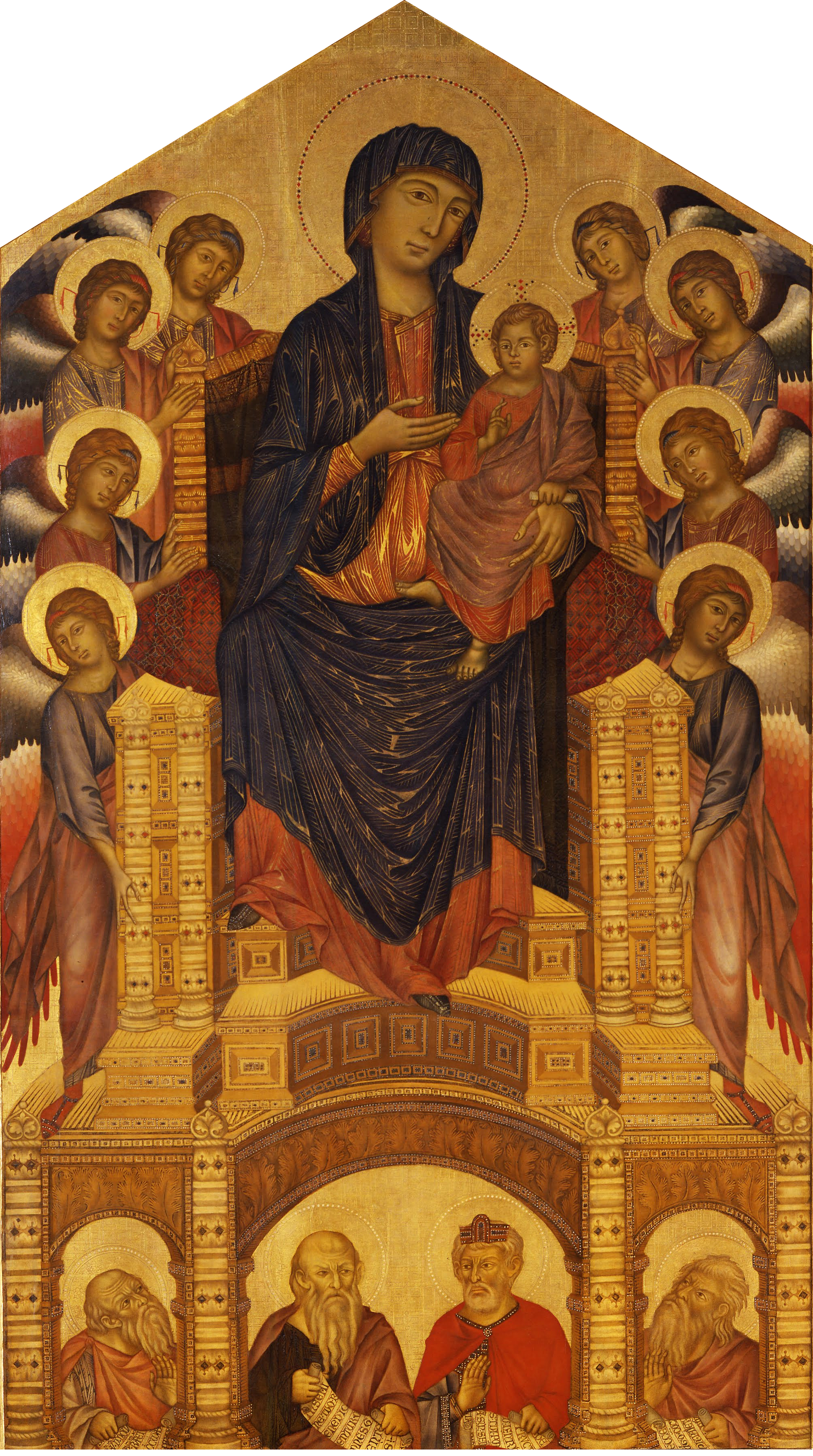
Cimabue's revolution was one of scale and feeling. His crucifixes replaced the impassive, open-eyed Christus triumphans with the suffering Christus patiens, the body slumped in a great S-curve, and pushed that formula toward anatomical and emotional truth. His enthroned Madonnas are colossal, their thrones built in receding tiers that grope toward real space. In fresco he achieved a dramatic force — mourners flinging up their arms beneath the cross at Assisi — that had no precedent in Italian painting. He remained a Byzantine painter in vocabulary, but the intensity he demanded of that vocabulary broke it open.
Major works
The Crucifixes of Arezzo and Santa Croce
The painted Crucifix in San Domenico, Arezzo (c. 1268–71) is his earliest generally accepted work. Its successor in Santa Croce, Florence (c. 1287–88), refined the type into one of the masterpieces of the century; catastrophically damaged in the 1966 Florence flood, it lost much of its paint surface and became a worldwide symbol of art's fragility and of the restoration effort that followed.
The Assisi frescoes
In the Basilica of San Francesco at Assisi, Cimabue and his workshop frescoed the transept and apse of the Upper Church — including a Crucifixion of extraordinary vehemence — and, in the Lower Church, a Maestà with St Francis that preserves what may be the most faithful early portrait of the saint. The lead white in the Upper Church frescoes has oxidized, so the scenes survive as ghostly negatives of themselves, light and dark reversed.
The Santa Trinita Maestà and the Louvre Maestà
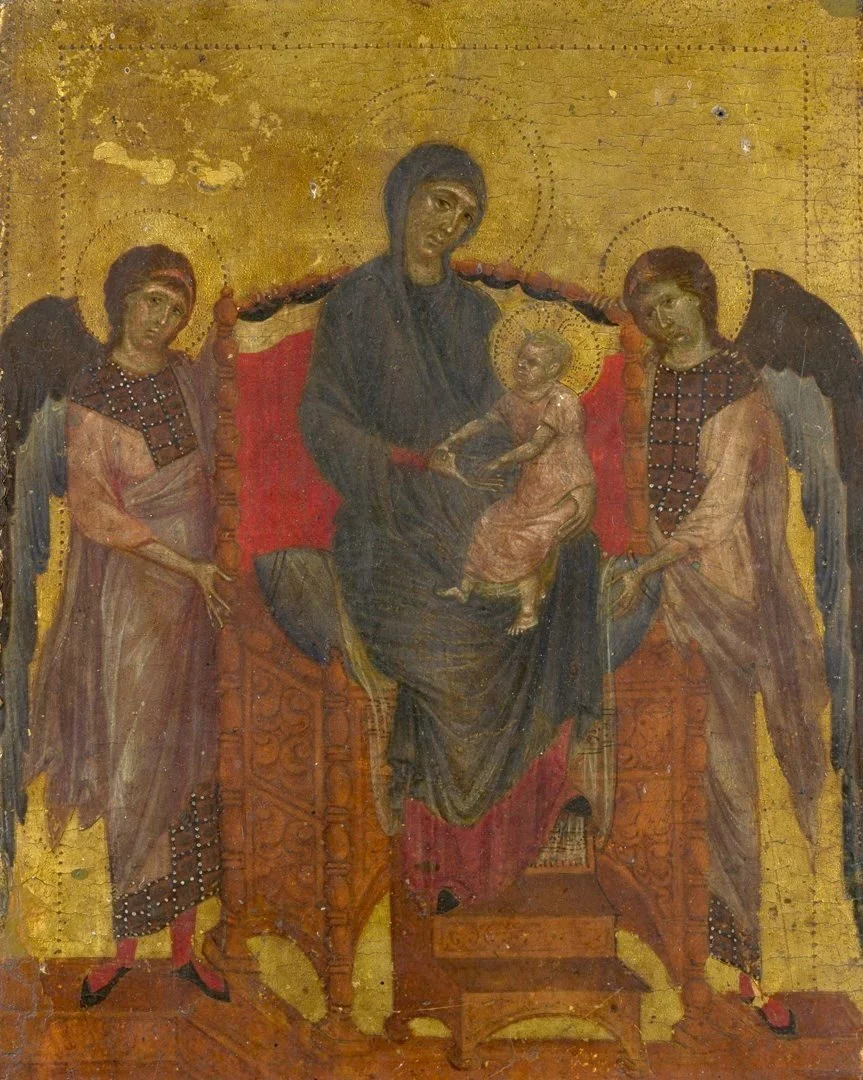
The Santa Trinita Maestà (c. 1290–1300), painted for the church of Santa Trinita in Florence and now in the Uffizi, shows the enthroned Virgin above four prophets in an arcade — a structure of new spatial ambition. The earlier Maestà painted for San Francesco in Pisa (c. 1280) hangs in the Louvre, freshly restored for the exhibition "Revoir Cimabue" (2025).
The Mocking of Christ
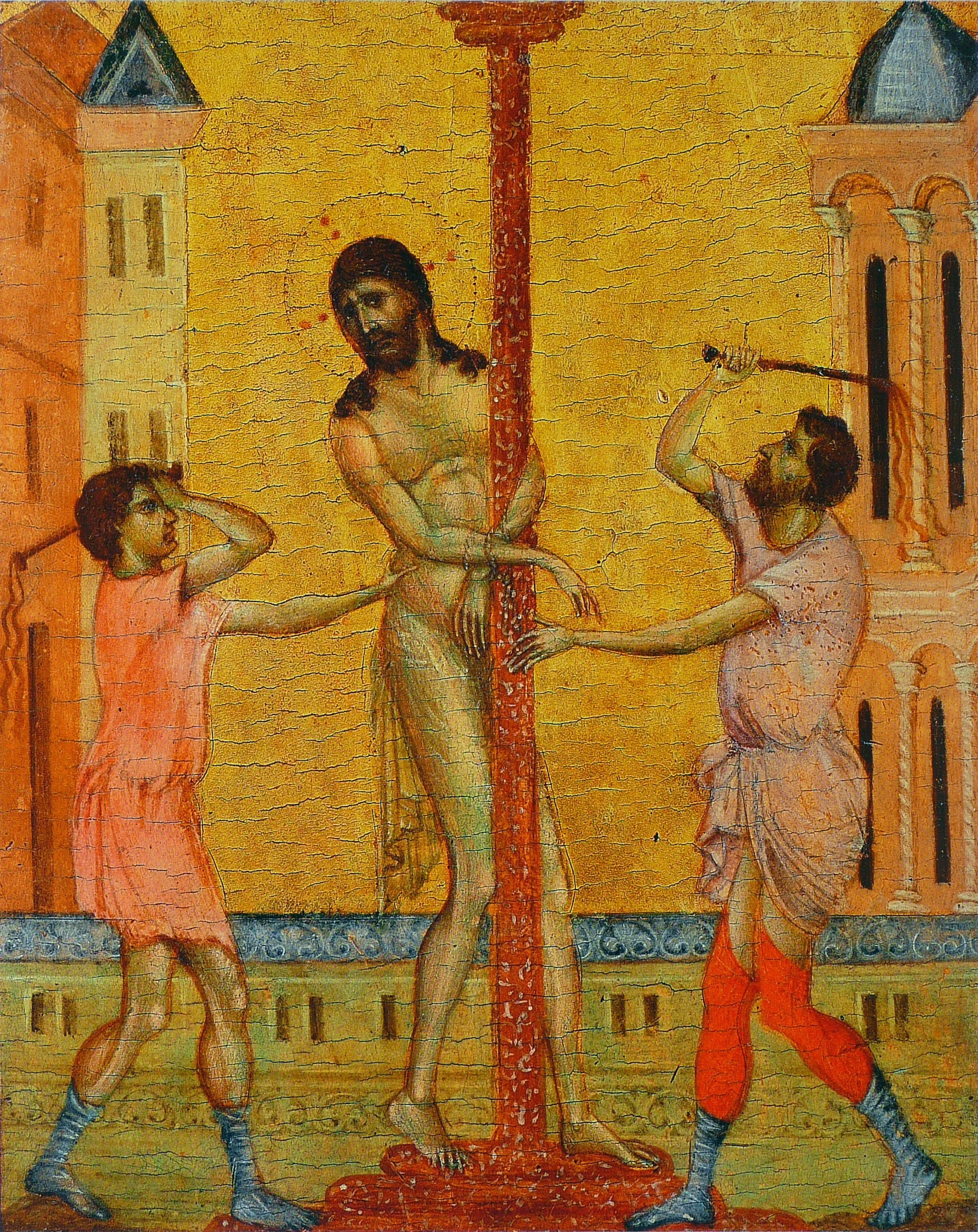
A small panel of the Mocking of Christ, part of a devotional diptych of about 1280 whose other surviving scenes are in the Frick Collection and the National Gallery in London, was discovered in 2019 hanging in the kitchen of an elderly woman near Compiègne. It sold at auction for some €24 million, was declared a French national treasure, and entered the Louvre in 2023 — the most sensational old-master discovery of recent decades.
The Pisa mosaic
The mosaic of Christ enthroned in the apse of Pisa Cathedral includes the figure of St John the Evangelist executed by Cimabue in 1301–02, the fixed point of his entire catalogue, completed shortly before his death.
Legacy
Cimabue's fame was eclipsed by his pupil within a generation — that is precisely the lesson about earthly vanity Dante drew from him. Yet every account of the birth of European painting begins with his name: Vasari made him the founder of the entire tradition, and modern scholarship, while trimming the legend, confirms him as the bridge from the Byzantine icon to Giotto's naturalism. The Fondazione Federico Zeri maintains the most comprehensive database for Italian art of this era; 26 catalogued works under Cenni di Pepo (Cimabue) can be found here: online catalogue 🔗.
Wikipedia 🔗 - Grokipedia 🔗 - Wikimedia Commons 🔗
Selected works
Publications
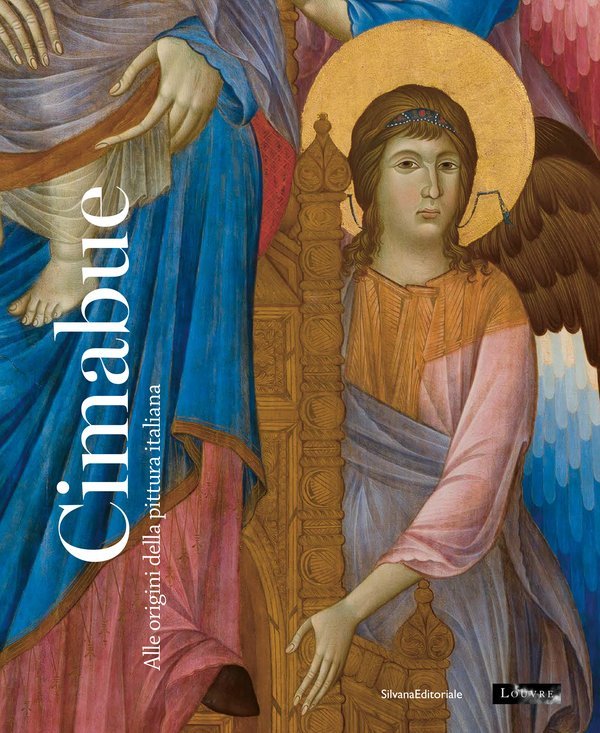
Photo credits
Cimabue: Maestà di Santa Trinita, 1290-1300, Wikimedia Commons (Public domain)
Cimabue: The Virgin and Child Enthroned with Two Angels, 1280-1285, Wikimedia Commons (Public domain)
Cimabue: Flagellation, ca. 1280, Wikimedia Commons (Public domain)
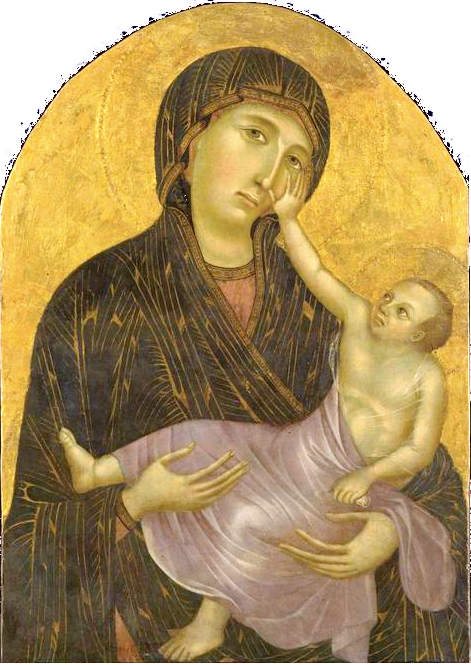
Cimabue: Madonna with child, 1283-1284, Wikimedia Commons (Public domain)