
Resources > Masters
Giotto di Bondone
c. 1267 in Colle di Vespignano, near Florence; † 1337 in Florence - 13th century - Duecento & Trecento - Florentine School
Giotto di Bondone — known mononymously as Giotto and Latinised as Giottus — was an Italian painter and architect from Florence during the Late Middle Ages, working in the Gothic and Proto-Renaissance period. His contemporary, the banker and chronicler Giovanni Villani, called him "the most sovereign master of painting in his time, who drew all his figures and their postures according to nature." Two centuries later Giorgio Vasari described Giotto as making a decisive break with the prevailing Byzantine style and as reviving "the great art of painting as we know it today, introducing the technique of drawing accurately from life, which had been neglected for more than two hundred years."
That break is why Giotto is so often called the father of European painting. Where late-medieval art was flat, linear and decorative, Giotto gave his figures weight and volume, set them in convincing space, and let them communicate through gesture and expression. The path that runs from Giotto to Masaccio and on to the High Renaissance begins here.
Life
Giotto was born around 1267 at Colle di Vespignano, in the Mugello hills north of Florence. Sources give dates ranging from 1266/67 to 1276. By tradition he trained under Cimabue, the leading Florentine painter of the previous generation; Vasari's charming tale of Cimabue discovering the boy drawing a sheep on a rock is almost certainly legend, but a real artistic descent from Cimabue is widely accepted.
Giotto's career took him across Italy. He worked in Assisi, Rome, Padua, Florence, Rimini and Naples, moving between fresco cycles and panel paintings in tempera and gold. He ran a large and busy workshop, which is one reason attribution is so contested today. In 1334 the commune of Florence appointed him capomaestro — chief master of works — of the cathedral, a mark of his standing as the most celebrated artist of his age. He died in Florence on 8 January 1337 and was buried in the church of Santa Reparata, whose remains lie beneath the present Duomo.
Style and innovation
Giotto's revolution was to make painted figures feel physically present. He modelled faces and drapery with light and shadow so that bodies read as solid masses; he arranged them in coherent architectural and landscape settings that suggest real depth; and he concentrated on the human drama of sacred stories — grief, tenderness, anger, doubt — rather than on abstract pattern. In scenes such as the Lamentation in Padua, mourners turn their backs to the viewer and angels wheel overhead in genuine anguish, an emotional realism without precedent in Western art. This clarity of structure and feeling is what later painters recognised as the foundation of Renaissance naturalism.
Major works
The Scrovegni (Arena) Chapel, Padua
Giotto's masterpiece is the fresco cycle in the Scrovegni Chapel in Padua, also called the Arena Chapel, painted for the banker Enrico Scrovegni and completed around 1305 (the chapel received its definitive consecration on 25 March 1305). In tiers around the walls it narrates the lives of Joachim and Anne, the Virgin Mary and Christ, framed below by grisaille personifications of the Virtues and Vices and closed by a vast Last Judgment on the entrance wall. It is one of the supreme achievements of Western painting and the fullest statement of Giotto's art.
The Life of St Francis, Assisi
In the Upper Church of the Basilica of San Francesco in Assisi, a cycle of frescoes on the life of St Francis — including the famous scene of the saint receiving the stigmata — is traditionally attributed to Giotto and his workshop, probably in the 1290s. The attribution has been debated for over a century, but the cycle's narrative force and solidity are closely bound up with Giotto's name.
The Ognissanti Madonna
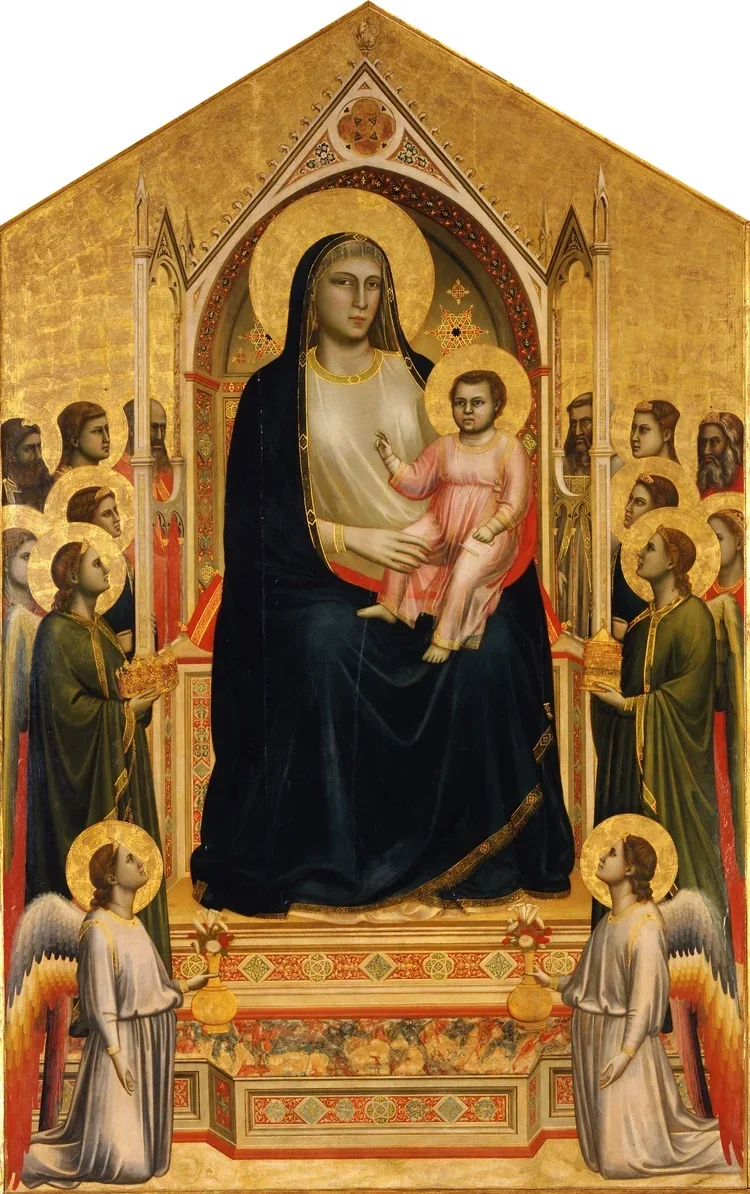
Painted around 1306–1310 for the church of Ognissanti in Florence and now in the Uffizi, the Ognissanti Madonna (Madonna in Maestà) shows the enthroned Virgin as a monumental, three-dimensional presence surrounded by angels and saints against a gold ground. Hung today beside earlier Maestà panels by Cimabue and Duccio, it makes Giotto's leap toward naturalism immediately visible.
The Bardi and Peruzzi Chapels, Santa Croce
In the Florentine basilica of Santa Croce, Giotto frescoed two chapels for the Bardi and Peruzzi banking families in the 1320s: the Bardi Chapel with scenes from the life of St Francis, and the Peruzzi Chapel with the lives of the two St Johns. Their calm, classicising grandeur deeply impressed later Florentine painters, Masaccio and Michelangelo among them.
Crucifix in Santa Maria Novella and the Stefaneschi Triptych
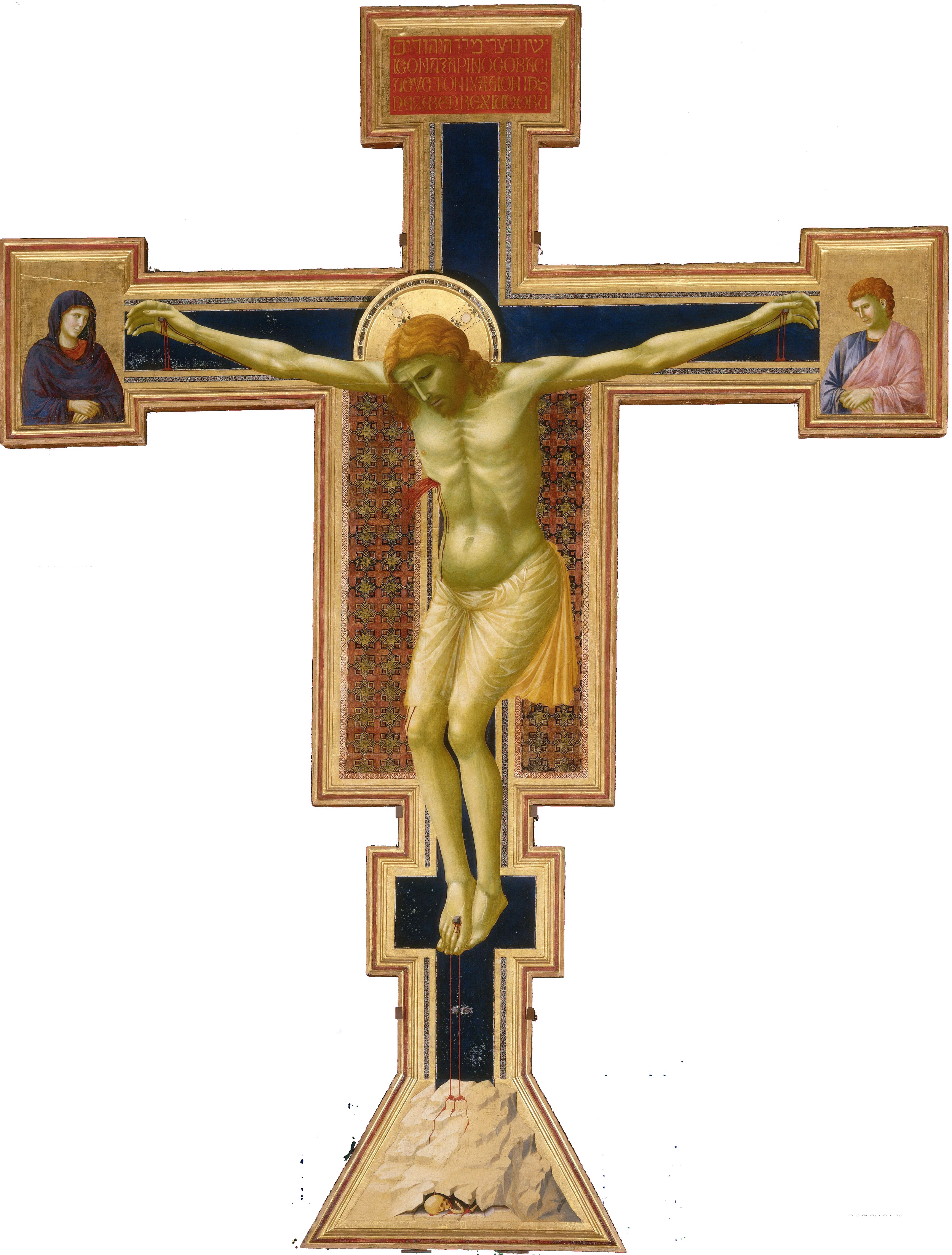
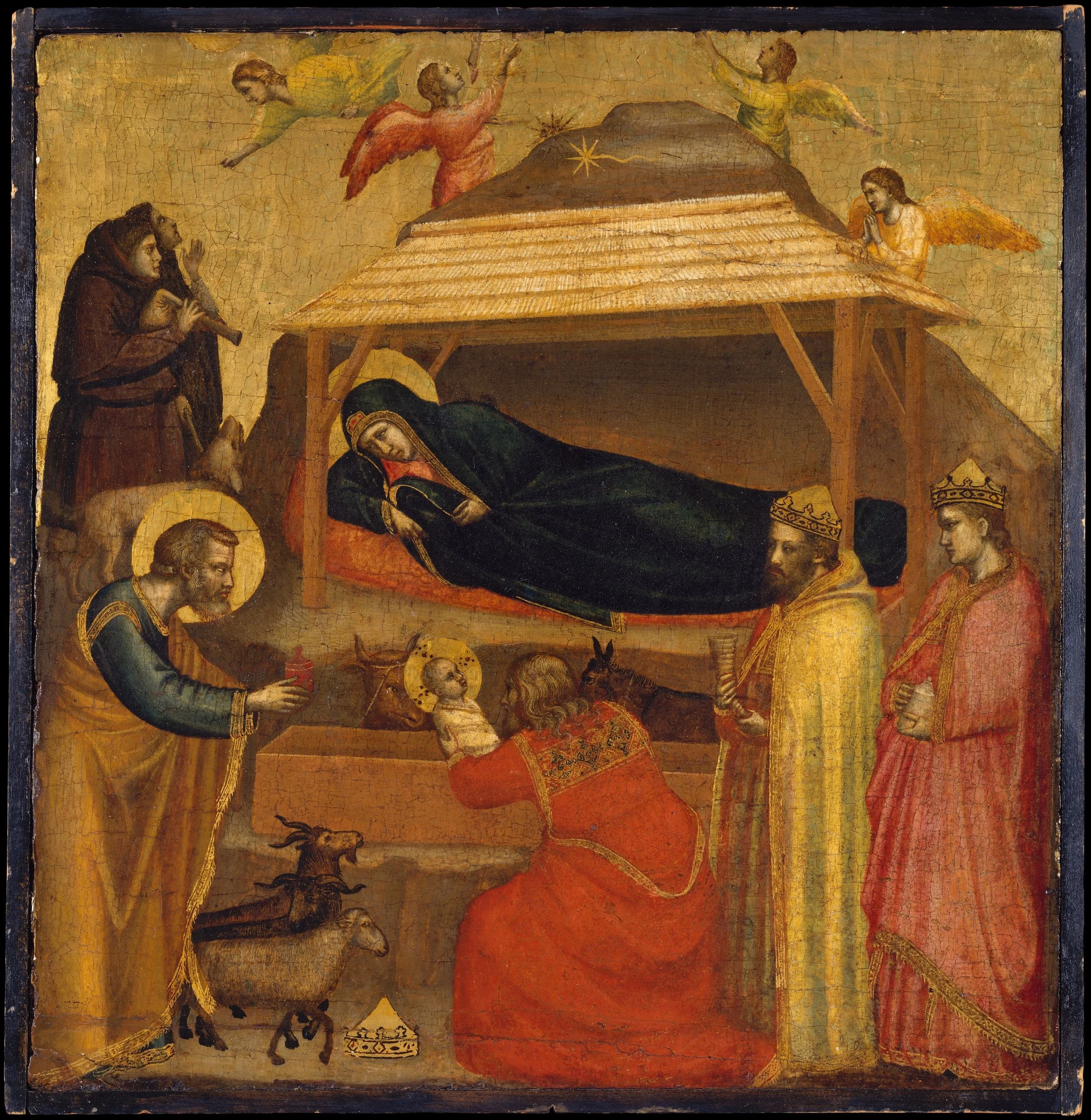
Giotto's panel work includes the great painted Crucifix in Santa Maria Novella, the Stefaneschi Triptych (Vatican Pinacoteca), the Badia Polyptych, and the dispersed panels of a Life of Christ series now scattered across museums including the Metropolitan Museum of Art and the National Gallery of Art. To these is added the lost or heavily reworked Navicella mosaic once over the entrance of Old St Peter's in Rome.
Architecture: Giotto's Campanile
In 1334 Giotto was made chief architect of Florence Cathedral and designed its free-standing bell tower, still known as Giotto's Campanile. He lived to see only its lowest storey built; after his death in 1337 the work was carried on by Andrea Pisano and completed by Francesco Talenti. The tower remains one of the landmarks of Florence and a reminder that Giotto's reputation extended well beyond painting.
Legacy
Dante named Giotto in the Divine Comedy as the painter who had eclipsed Cimabue's fame; Boccaccio praised him for bringing painting back to life. His influence runs directly through Taddeo Gaddi and the Giotteschi to Masaccio and the Florentine Renaissance. The Fondazione Federico Zeri maintains the most comprehensive database for Italian art of this era; its catalogue lists 225 unique works (see list 🔗) under Giotto di Bondone.
Wikipedia 🔗 - Grokipedia 🔗 - Wikimedia Commons 🔗
Selected works
Publications
FAQs
-
Giotto di Bondone (c. 1267–1337) was a Florentine painter and architect of the Late Middle Ages. He broke with the flat, stylised Byzantine manner and painted figures with weight, emotion and a sense of real space, which is why he is often called the father of European painting and a founder of the Renaissance tradition.
-
Giotto was born around 1267 at Colle di Vespignano, in the Mugello region near Florence — not in the city of Florence itself. Some sources give a range of 1266/67 to 1276. He died in Florence on 8 January 1337.
-
Tradition, following Vasari, holds that Giotto was a pupil of the Florentine painter Cimabue. The story that Cimabue discovered the boy drawing sheep on a stone is likely legend, but it reflects a genuine artistic link between the two.
-
His masterpiece is the fresco cycle in the Scrovegni Chapel (Arena Chapel) in Padua, completed around 1305. It covers the lives of Joachim and Anne, the Virgin Mary and Christ, and ends with a monumental Last Judgment.
-
Giotto reintroduced naturalism to Western painting: solid, three-dimensional figures, believable space, and genuine human emotion conveyed through gesture and expression. This break from Byzantine convention set the direction that Masaccio and later Renaissance painters would follow, which is why Vasari credited him with reviving "the great art of painting."
-
Yes. In 1334 Giotto was appointed chief master of works of Florence Cathedral and designed its bell tower, still known as Giotto's Campanile. He died in 1337 with only the lower part built; Andrea Pisano and Francesco Talenti completed it.
-
Giotto was buried in Florence in the ancient church of Santa Reparata, whose remains lie directly beneath the present cathedral. Because the cathedral rose over the older church, some sources describe the burial as being in the Duomo itself.
-
Attribution is debated, since few works are firmly documented. The Fondazione Federico Zeri catalogue lists 225 unique works under Giotto di Bondone, ranging from securely attributed masterpieces to workshop and school pieces.
Photo credits
Giotto di Bondone: Santa Maria Novella Crucifix, 1290, Wikimedia Commons (Public domain)
Giotto di Bondone: Madonna Enthroned, 1300-1305, Wikimedia Commons (Public domain)
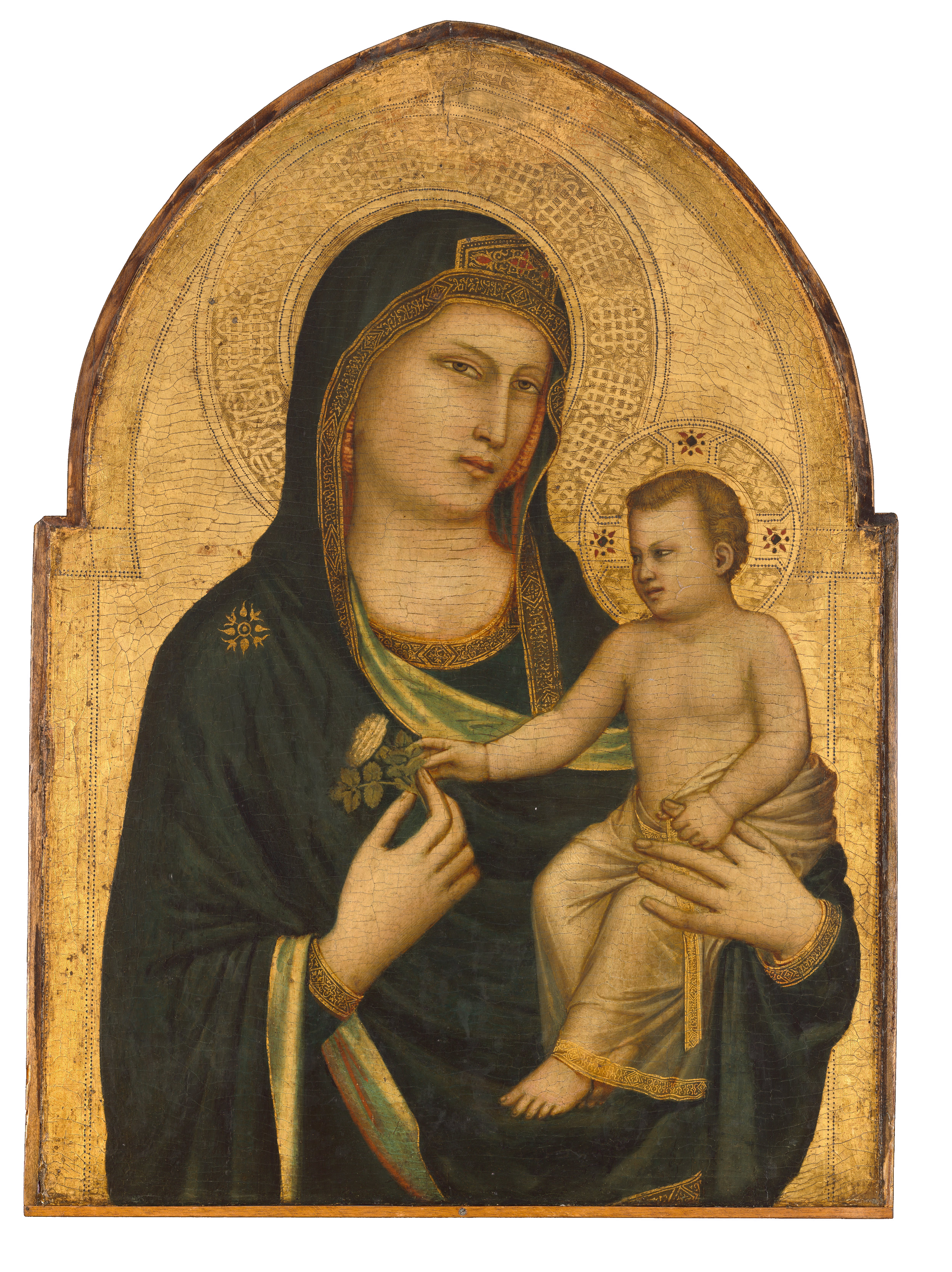
Giotto di Bondone: Madonna with Child, c. 1320-1330, Wikimedia Commons (Public domain)
Giotto di Bondone: The Adoration of the Magi, c. 1320, Wikimedia Commons (Public domain)