
Resources > Masters
Simone Martini
1284 in Siena; † 1344 in Avignone - 14th century - Trecento - Sienese School
Simone Martini was the most celebrated Sienese painter of the generation after Duccio, and the first Italian painter of the gold ground to become a court artist of international standing. Trained in Duccio's orbit — Vasari's claim that he studied under Giotto is not credited today — he took the Sienese line and refined it into an instrument of extraordinary elegance, absorbing the French Gothic that reached Siena along the Via Francigena in ivories and illuminated manuscripts.
Where Cimabue and Giotto pursued weight and volume, Simone pursued grace, colour and surface. He turned the gold ground itself into a worked field — punched, tooled, incised, sometimes raised in relief — and his manner, carried to the papal court at Avignon, became one of the principal sources of the International Gothic style across Europe.
Life
Simone was born in Siena around 1284. His first securely documented work is the Maestà of 1315 in the Palazzo Pubblico, for which he was paid again in 1321 after reworking parts of it. In 1317 he was in Naples in the service of King Robert of Anjou, who granted him a knighthood and an annual pension. He married Giovanna, daughter of the painter Memmo di Filippuccio, in 1324, becoming the brother-in-law of Lippo Memmi, his frequent collaborator. In the mid-1330s he moved with his household to Avignon, seat of the papal court, where he remained until his death in the summer of 1344. There he became a friend of Petrarch, who commemorated him in two sonnets praising a portrait of Laura — a work that does not survive.
Style and innovation
Simone's art is one of line and of light. His contours are long, sinuous and unbroken; his figures are slender, courtly and richly dressed, in a palette of coral, lilac and sharp acid greens unlike anything in Florence. He exploited every technical resource of the panel: mordant gilding, sgraffito, punched haloes, tooled borders, glass and gilded relief inserted into the surface, and inscriptions raised in gold across the ground. The result is not the illusion of space that Florentine painters sought, but a heightened, jewel-like reality — devotional images conceived with the precision of goldsmiths' work.
Major works
The Maestà, Siena
Painted in 1315 for the Sala del Mappamondo of the Palazzo Pubblico, Simone's fresco Maestà answers Duccio's altarpiece of 1311 in civic terms: the Virgin enthroned beneath a fictive canopy, addressing the governors of Siena in inscribed verses on justice and good government.
Saint Louis of Toulouse
Painted in Naples in 1317, shortly after the canonisation of Louis of Anjou, the panel (Museo di Capodimonte) shows the saint crowning his brother Robert — a dynastic argument in gold, with lavish punchwork and applied ornament.
The Chapel of St Martin, Assisi
The frescoes of the life of St Martin in the Lower Church of San Francesco, funded by Cardinal Gentile Partino da Montefiore (d. 1312), are Simone's fresco masterpiece; datings between c. 1312 and the 1320s are proposed. Their courtly detail — musicians, hunting dress, armour — is unmatched in the period.
The Annunciation
The Annunciation with Saints Ansanus and Margaret (Uffizi), painted in 1333 for the altar of Sant'Ansano in Siena Cathedral, is jointly signed by Simone and Lippo Memmi. The angel's greeting runs in raised gold letters across the ground; the Virgin's recoil is among the most acute psychological passages in Trecento painting. The identity of the second saint remains disputed.
The Guidoriccio and the Avignon years
The equestrian fresco of Guidoriccio da Fogliano in the Palazzo Pubblico has been attributed to Simone since the nineteenth century, supported by payments recorded in 1330; since 1977 its authorship and date have been contested, and the question is unresolved. From Avignon come the sinopie for the porch of Notre-Dame des Doms, the illuminated frontispiece to Petrarch's Virgil (Biblioteca Ambrosiana, Milan), the dispersed Orsini Polyptych of Passion scenes (Antwerp, Louvre, Berlin), and Christ Discovered in the Temple of 1342 (Walker Art Gallery, Liverpool).
Legacy
Simone's Avignon workshop placed Sienese gold-ground painting at the centre of European court culture, and its influence runs from Bohemia to Catalonia through the decades that follow. In Siena his prototypes were repeated for a century. The Fondazione Federico Zeri maintains the most comprehensive database for Italian art of this era; the works catalogued under Simone Martini can be found here: online catalogue 🔗.
Wikipedia 🔗 - Grokipedia 🔗 - Wikimedia Commons 🔗
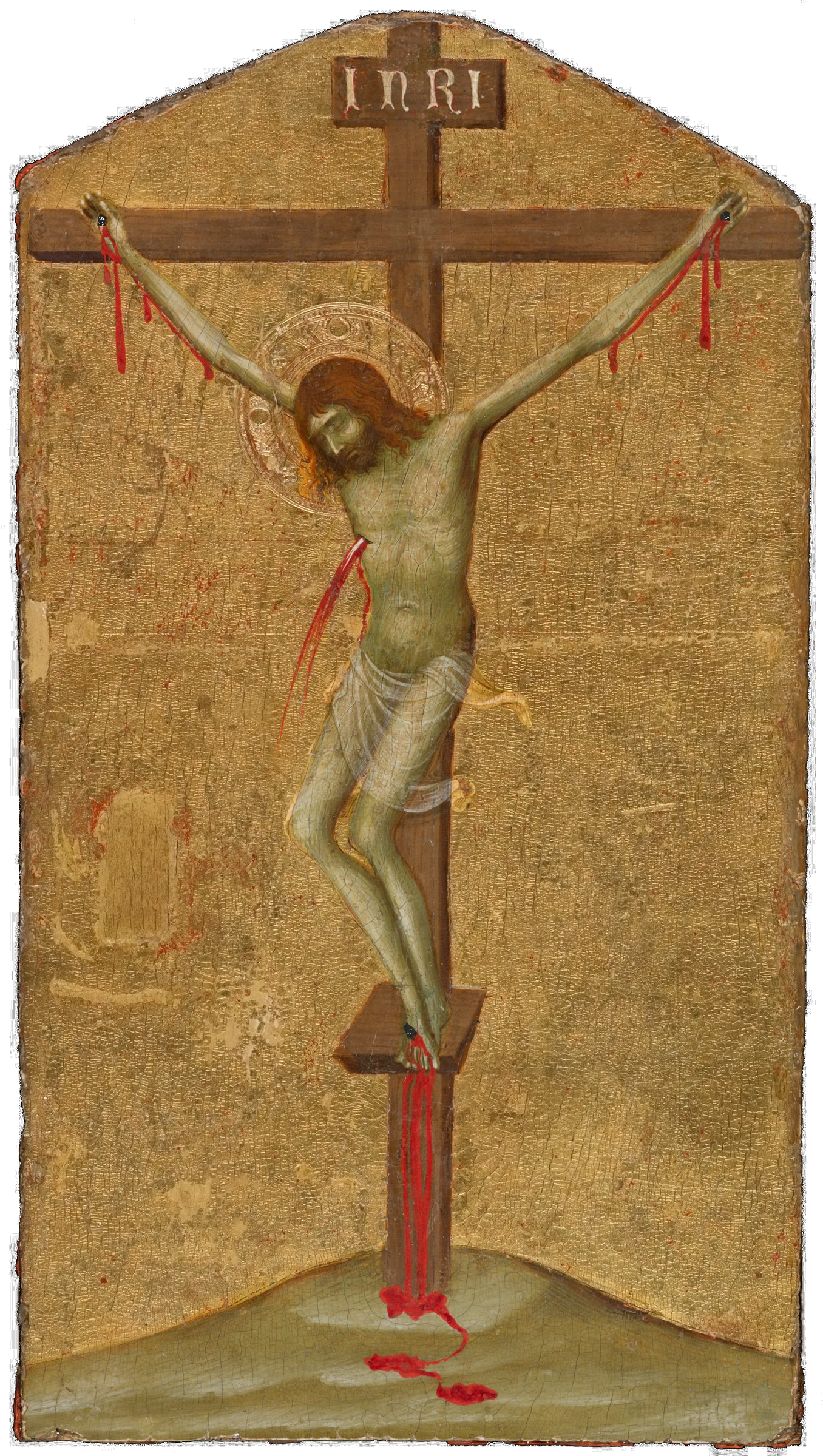
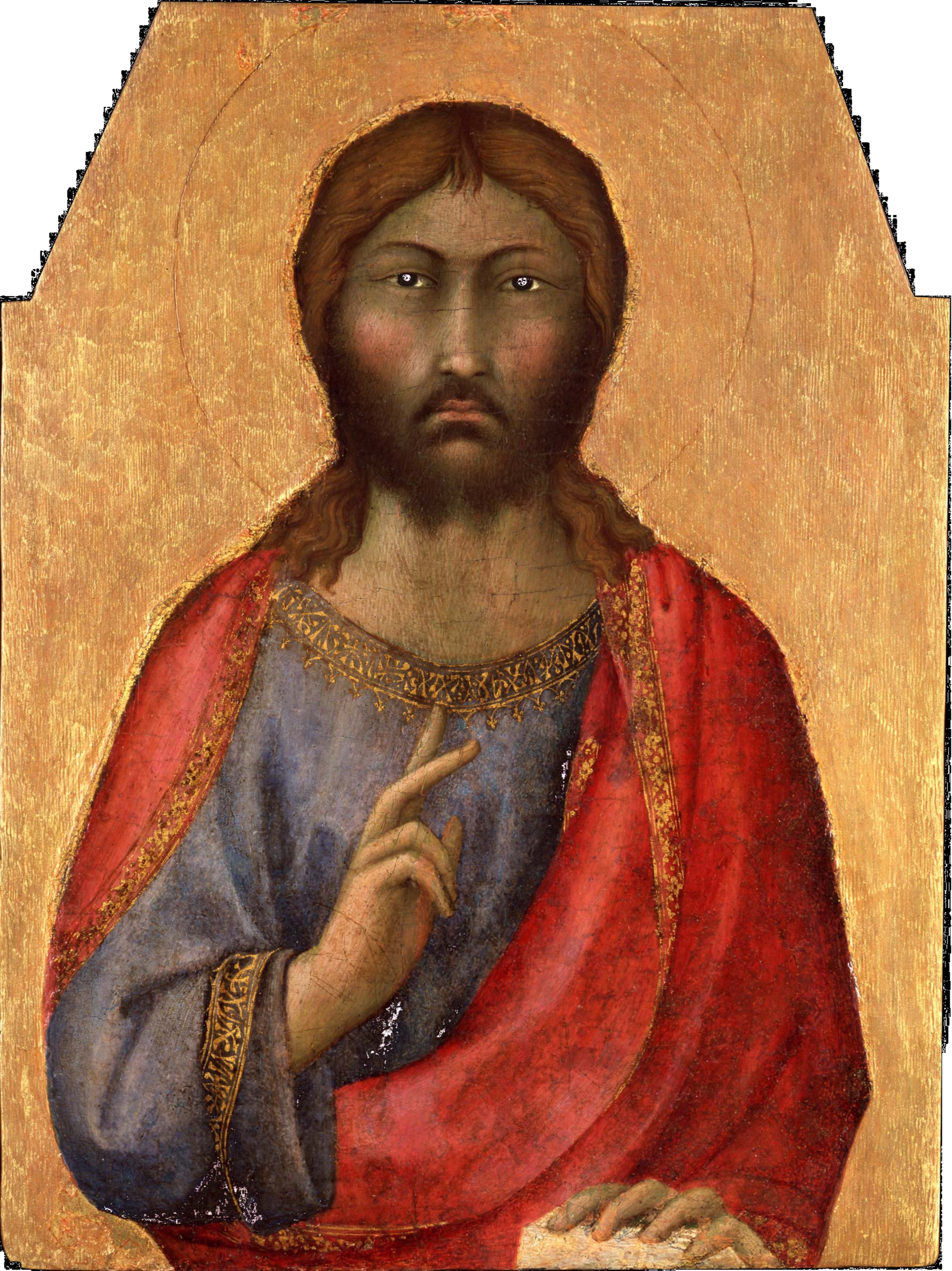

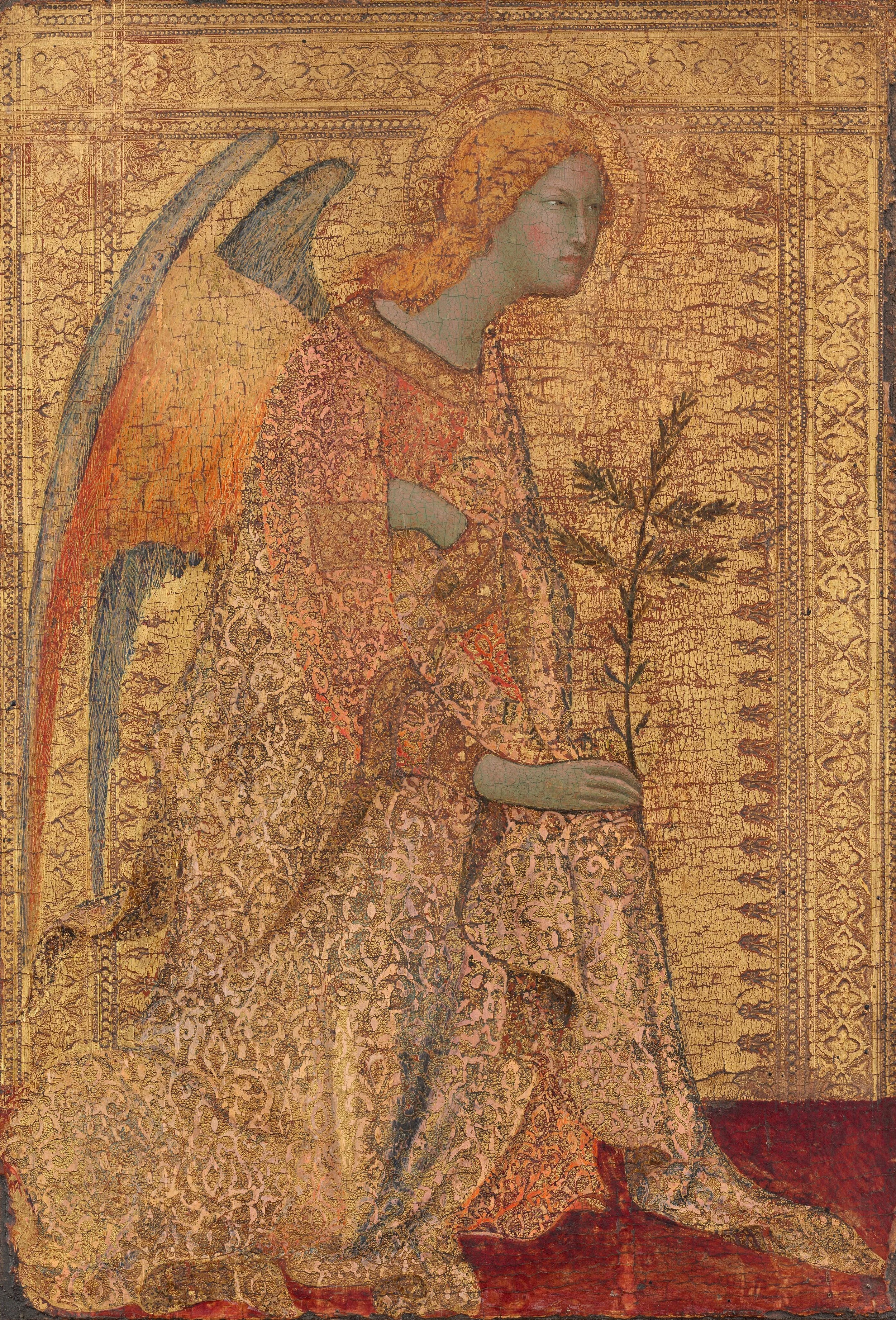
Photo credits
Simone Martini: Christ on the Cross, c. 1340, Wikimedia Commons, Creative Commons Attribution-Share Alike 4.0 International
Simone Martini: The Redeemer conferring a blessing, c. 1315-1320, Wikimedia Commons, Creative Commons Attribution-Share Alike 4.0 International
Simone Martini: Christ Discovered in the Temple, 1342, Wikimedia Commons (Public domain)
Simone Martini: The Angel of the Annunciation, c. 1330, nga.gov (Public domain)