
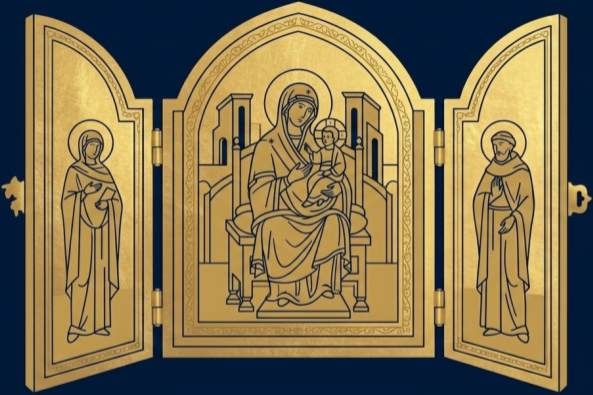
Schematic representation, generated with AI
Resources > Objects
Portable altarpiece
A Portable altarpiece (Italian: altarolo portatile) is a small-scale religious work designed for personal use, private devotion, and mobility. Created during the peak of the Italian Gold Ground (fondo oro) tradition between 1250 and 1430, these objects served as a private counterpart to the monumental church installations. While the "Polyptych” was part of a fixed, public structure, the portable altarpiece was a self-contained "micro-architecture" of faith that could be carried during travel or kept in a domestic chamber.
Design and Functional Mobility
The defining characteristic of the altaroloportatile was its ability to be closed and transported. These objects were usually constructed with a high degree of craftsmanship:
Folding Mechanisms: Most took the form of small triptychs or diptychs with hinged wings. When closed, the panels protected the delicate, burnished gold surfaces and tempera pigments from the wear and tear of movement.
Protection: The exterior of the wings was often left plain, covered in leather, or painted with simple decorative motifs or heraldic shields, while the interior contained a lavishly detailed sacred vision.
Scale: Unlike the massive panels of a cathedral altarpiece, the portable altarpiece was small enough to fit into a traveler's luggage or on a small desk, yet it maintained the same artistic rigor as its larger counterparts.
Quantitative Aspects
In the digital cataloging of the Fondazione Federico Zeri, the "altarolo portatile" is a category that distinguishes these complete, miniature units from the isolated fragments of larger complexes. Because they were held in private hands and were designed to be durable, a higher percentage of these objects have survived in their original, intended form compared to massive church polyptychs.
According to the Zeri archive, there are 144 registered objects classified as a altarolo portatile. This number highlights the exclusivity of the medium; while nearly 4,000 paintings were produced, the portable altarpiece remained a refined tool for the personal piety of the few.
Wikipedia 🔗 - Grokipedia 🔗