
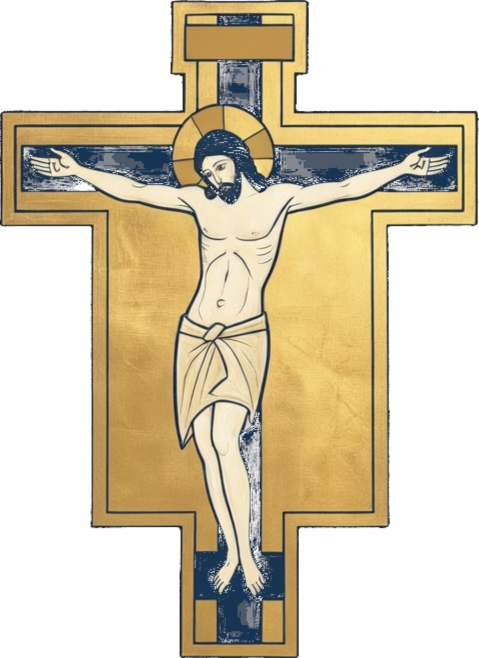
Schematic representation, generated with AI
Resources > Objects
Painted crucifix
A Painted crucifix (Italian: Croce dipinta) is a monumental wooden cross, shaped and painted with the figure of Christ, which served as one of the most powerful and iconic liturgical objects. While the Gold Ground (fondo oro) panel often belonged to an altarpiece, the painted crucifix was typically a freestanding object, often hanging from the central beam of a church.
Iconographic Evolution
The period between 1250 and 1430 saw a profound shift in how the crucifixion was depicted, moving from the symbolic to the deeply human:
Christus Triumphans (Triumphant Christ): Common in the early 13th century, showing Christ alive on the cross, eyes open, seemingly unaffected by physical suffering.
Christus Patiens (Suffering Christ): Under the influence of the Franciscan order and artists like Giunta Pisano and Cimabue, the depiction shifted to a dead Christ with closed eyes, a slumped body, and a face reflecting human agony. This was designed to evoke empathy and compassion (com-passio) from the viewer.
Formal Structure
The Croce dipinta was rarely just a simple cross. It usually featured specific anatomical and narrative components:
The Cymatium (Upper Panel): Often featured a depiction of Christ Blessing or the Pelican in her Piety.
The Apron (Lateral Panels): The flat areas to the left and right of Christ’s body, which frequently contained scenes of the Passion or figures of the Virgin Mary and St. John the Evangelist.
The Soppedaneo (Lower Panel): The base of the cross, which often depicted the hill of Golgotha or the skull of Adam.
Quantitative Aspects
In the digital taxonomy of the Fondazione Federico Zeri, the "Croce dipinta" is treated as a distinct object type beside the painting (dipinto) because of its unique silhouette and liturgical function, which differs from the rectangular or arched formats of a standard "Painting" or "Polyptych panel". According to the Zeri archive, there are 248 registered objects classified as a Painted crucifix. This relatively lower number compared to other panel types reflects the specialized nature of these objects—they were usually the single most important sculptural-painting hybrid in a church's nave, rather than being produced in the larger quantities seen with smaller devotional panels.
Wikipedia 🔗 - Grokipedia 🔗