Ask a fondo oro connoisseur to name Italian panel painters from the Duecento, Trecento and early Quattrocento, and you'll get the usual names: Cimabue, Duccio, Giotto, the Lorenzetti brothers, Simone Martini, Fra Angelico. Ask how many painters from that period — c. 1250 to 1430 — are actually known, and the room goes quiet. It's a simple question with a surprisingly hard answer, because no single, authoritative, up-to-date list of them exists anywhere.
So I decided to build and maintain one:
Why there's no easy answer
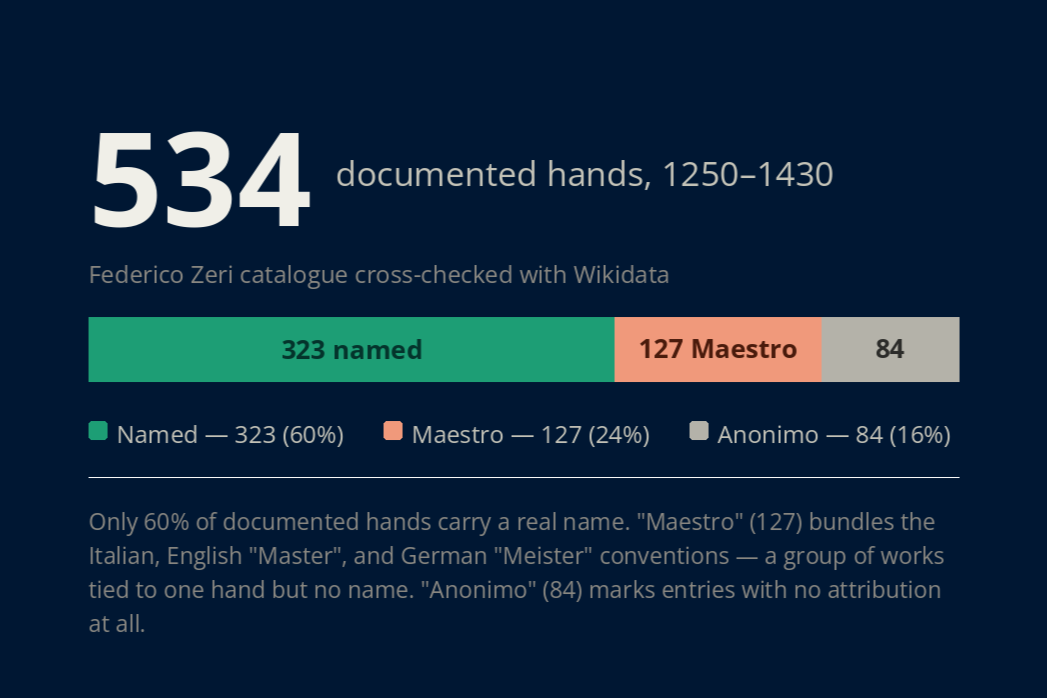
Fondo Oro Magazine's count of documented hands, September 2026
The obvious place to start is the Federico Zeri Foundation's photographic archive in Bologna — for decades the standard reference repertory for Italian painting, with hundreds of thousands of catalogued images and attributions built up over Zeri's career. It remains one of the most important resources of its kind. But the structured querying to pull painter names systematically out of the dipinti database section for our target period stopped working, so that route was no longer usable for compiling a name list at scale.
The second obvious source, Wikidata, has the opposite problem: it's queryable and open, but its coverage of minor Duecento and Trecento painters is uneven. A database request for Italian painters active between roughly 1230 and 1430 returned 253 names — a solid start, but incomplete.
What I did instead
I went back to the Zeri photo archive by hand: paging through its vast catalogue for the 1250–1430 window and writing down every painter name that appeared, including the many Maestro di… and Anonimo di… notnames that specialists use to group anonymous hands by shared style or by their best-known work. I then merged that list with the Wikidata export, matched variant spellings and duplicate entries, and cleaned the result into a single reference table.
The current tally: 450 painters known by name or notname, plus 84 additional "Anonimo" entries — identities assigned to hands that art history recognizes and discusses but cannot attach to a documented person. That's close to 540 distinct painting identities from a single specialist period of roughly 180 years — regional archives, sacristy account books, and attribution debates continue to add and occasionally subtract names. But we can be sure that all major master painters are on this list — everyone with even a single notable work, even if we don’t know the name.
Where they worked
Provincial distribution of gold-ground painters, based on the Federico Zeri Foundation and Wikidata records. This map shows where Italy's gold-ground painters actually worked, province by province. Of the 534 painters and workshops in our list, 303 could be traced to a specific school or region. Florence and Siena account for nearly a third of all attributed painters between them, a reminder of how concentrated this tradition was even at its broadest.
Where else this information lives
For readers who want to check the existing lists and numbers online, go deeper on a specific name, or build their own research trail, here's where the same territory is mapped elsewhere:
Federico Zeri Foundation Photo Archive (fondazionezeri.unibo.it) — the online catalogue of Zeri's roughly 290,000 photographs, searchable by author, location, subject and date; still the single richest repertory of attributions for Italian painting of this period.
Wikidata — an open, SPARQL-queryable dataset covering painters with Wikipedia or authority-file records; strong on well-documented masters, thinner on workshop hands and regional minor painters.
Getty Research Institute — Union List of Artist Names (ULAN) — a controlled vocabulary of several hundred thousand artist identities, including many anonymous "hands," with linked biographical and bibliographic data; useful for confirming standardized name forms.
RKD — Netherlands Institute for Art History (RKD Explore / RKDartists) — the Hague-based institute's combined search platform, covering Western artists from the late Middle Ages onward with strong bibliographic sourcing.
The classic printed scholarship still underpins all of the above: Raimond van Marle's multi-volume The Development of the Italian Schools of Painting, Richard Offner's A Corpus of Florentine Painting, and the exhibition catalogue Italian Panel Painting of the Duecento and Trecento (edited by Victor M. Schmidt) remain the printed reference points.
None of these sources agree perfectly with each other, and none of them, on their own, will hand you a clean count of "how many gold-ground painters we know." That number only emerges once you cross-reference them — which is exactly the gap this project set out to close, and why this combined list now lives on FOM as an open reference table for the field.