Giorgio Vasari's Vite (1550; expanded 1568)
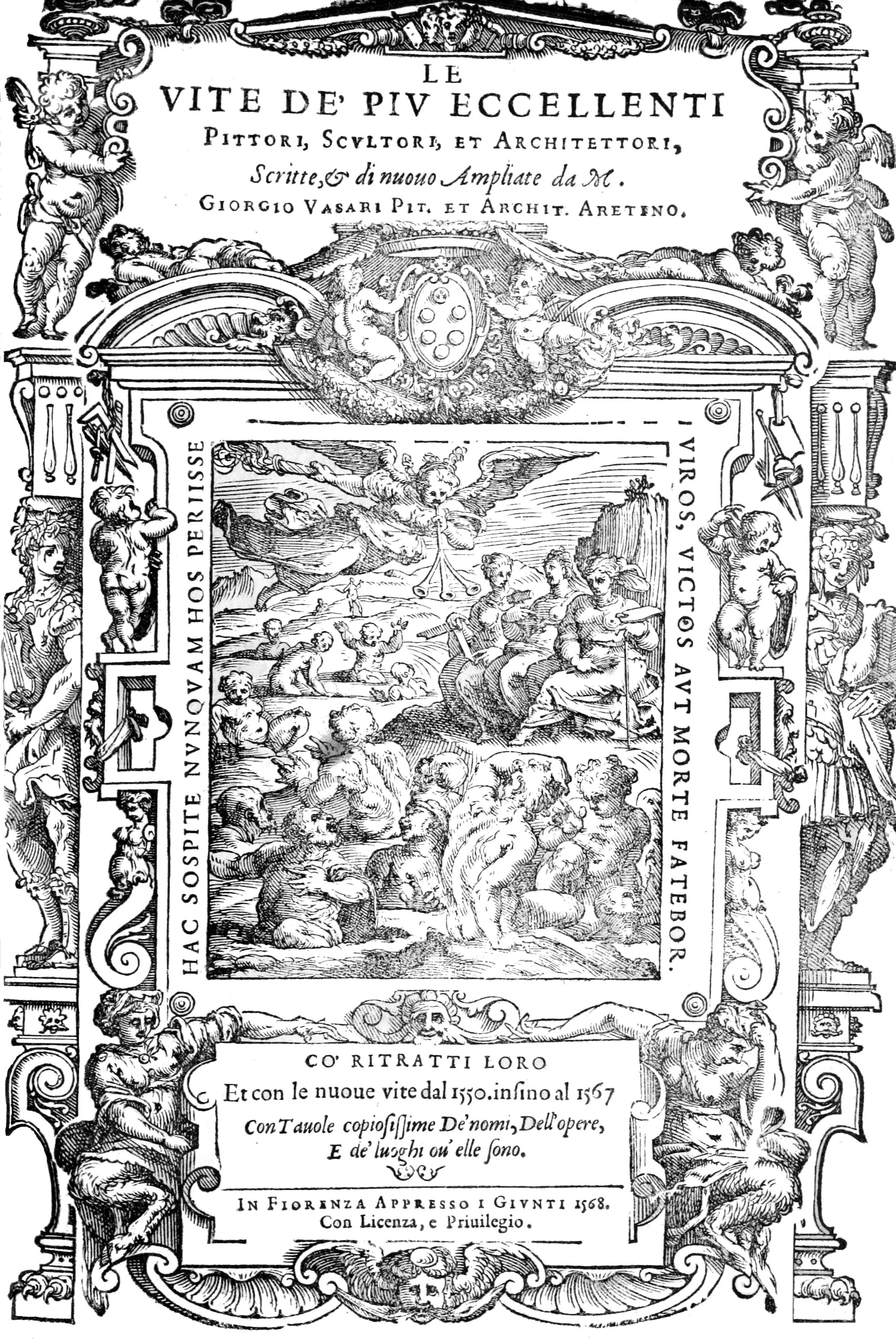
Frontespizio da: Giorgio Vasari, Le vite de’ piu eccellenti pittori, scultori, et architettori, Firenze, 1568. Vol. 1., Photo credits: Wikimedia Commons (Public domain)
Vasari's Lives set the tracks that every survey of Italian art still runs on — and the long neglect of the gold-ground panel runs on them too. The book is our indispensable early source for these painters and, in the same breath, the text that reduced them to a prologue.
Two books, not one. The first edition appeared in Florence in 1550 from the press of Lorenzo Torrentino — hence Torrentiniana — in two volumes; the biographies open with Cimabue and close with Michelangelo, the only artist described who was still alive. The revised and much enlarged second edition was printed in Florence by the Giunti in 1568 in three books, this time with portraits of the artists, and Vasari appended a long autobiography. The Giuntina title advertises what is new: lives of the living and of those who had died between 1550 and 1567. Vasari states in the text that he designed the 144 artists' portraits himself, the blocks being cut by "Maestro Christofano". He also added indexes — by artist, by location of works, and of noteworthy matters — at the head of each volume. The 1568 version, which gives noticeably more room to Venetian art, is the one normally translated and cited; Vasari has nonetheless been criticised ever since for his weighting toward Florence.
The three ages. Vasari's real invention was not biography but periodisation. In the preface to Part Two he divides the artists into three periods, each with its own character, running from the rebirth of the arts to his own day: a first age of beginnings (Cimabue, Giotto), a second of visible improvement in invention, design and finish, and a third in which art has done everything possible in imitating nature. The scheme is a ladder, and the fourteenth century is its bottom rung. Vasari's word for what Giotto began — rinascita — was taken up by Jules Michelet in his Histoire de France (1835) as Renaissance, and entered historiography from there.
The verdict on the maniera greca. Maniera greca was the term used at the time, and by Vasari, for the Italo-Byzantine style — one of the first post-classical European terms for style in art. Vasari was no admirer: he defined the new art as a rejection of "quella greca goffa maniera". In the Life of Giotto he credits the painter with freeing himself from the manner of the Greeks and bringing the true art of painting back to life. That is the sentence behind five centuries of museum labels calling gold-ground painters "primitives". Modern scholarship has since traced how the negative reading of the maniera greca by Vasari and his contemporaries shaped art-historical perception well into our own time.
What he preserved anyway. The Vite is prefaced by a technical Introduction to the Three Arts of Design, whose chapters run through painting, foreshortening, coloring, fresco, tempera, gilding, stained glass and more — the working vocabulary of the panel workshop, written by a practitioner. Vasari also transmitted the workshop genealogy that still frames Trecento technique: Giotto to Taddeo Gaddi, Taddeo to his son Agnolo, Agnolo to Cennino Cennini. He was not always right — his claim that oil painting was invented by Jan van Eyck was contradicted by Cennini and, earlier, by Theophilus — and the Vite mixes documented research with anecdote, gossip and scandal drawn from oral tradition.
How to read it. Treat the Vite as a Florentine argument of the 1550s and 1560s, not a chronicle. Where Vasari records an attribution, a location, or a patron, he is often our earliest witness. Where he judges, he is arguing for his own generation. The reversal took three centuries: Cimabue's Santa Trinita Maestà only moved into a public gallery in 1810, and reached the Uffizi in 1919, with the reconsideration of the Italian "primitives".
Cimabue, The Mocking of Christ, c. 1280, 25.8 cm x 20.3 cm, Louvre Museum, Paris, Photo credits: Wikimedia Commons (Public domain)
Sources
Le vite (1568 Giunti), Getty copy: https://archive.org/details/levitedepiveccel03vasa
Uffizi, on the Giuntina second edition: https://www.uffizi.it/en/artworks/vasari-giunti-en
Discover Arezzo, Torrentiniana / Giuntina: https://www.discoverarezzo.com/en/giorgio-vasari/lives-of-the-most-excellent-painters-sculptors-and-architects/
Wikipedia, Lives of the Most Excellent Painters…: https://en.wikipedia.org/wiki/Lives_of_the_Most_Excellent_Painters,_Sculptors,_and_Architects
Wikipedia (DE), Le vite…: https://de.wikipedia.org/wiki/Le_vite_de%E2%80%99_pi%C3%B9_eccellenti_pittori,_scultori_e_architettori
Wikipedia, Italo-Byzantine (maniera greca, with the Giotto passage in Italian): https://en.wikipedia.org/wiki/Italo-Byzantine
A. Drandaki, "A Maniera Greca: Content, Context and Transformation of a Term," Studies in Iconography 35 (2014): https://www.academia.edu/7439723
Vasari on Technique (Maclehose trans., full text): https://archive.org/details/cu31924020624742 — also at https://www.gutenberg.org/ebooks/73397
Florence As It Was, on Giotto and Vasari: https://florenceasitwas.wlu.edu/people/giotto-di-bondone
Wikipedia, Santa Trinita Maestà: https://en.wikipedia.org/wiki/Santa_Trinita_Maest%C3%A0