One of the strangest and most inventive works of early Italian panel painting
The Stuttgart Apocalypse Panels
Fifty visions on ultramarine, by an unknown master — Naples, c. 1332/34
Two long, narrow poplar panels in the Staatsgalerie Stuttgart hold one of the strangest and most inventive works of early Italian panel painting. An unknown Neapolitan painter set out the entire Book of Revelation — the Staatsgalerie counts fifty scenes, from John asleep on Patmos to the vision of the Heavenly Jerusalem. There is no gold ground. Instead, the scenes float as pale islands on a field of deep ultramarine.
Two panels, tempera on poplar. Acquired by Staatsgalerie Stuttgart with lottery funds in 1971.
Unknown Neapolitan painter, Scenes from the Apocalypse of John (chapters 1–13), c. 1332/34, , inv. 3082, 34.9 × 86.3 cm, © by Staatsgalerie Stuttgart
Unknown Neapolitan painter, Scenes from the Apocalypse of John (chapters 14–22), c. 1332/34, inv. 3100, 35.1 × 86.6 cm, © by Staatsgalerie Stuttgart
The first panel opens at the upper left with John on Patmos, gives its centre to the great adoration of God enthroned, and moves on to the catastrophes — the four horsemen among them. The second sets the war between divine and diabolical powers, the Whore of Babylon, and closes at the lower right with the Heavenly Jerusalem. The reading direction is broadly left to right, but the registers subdivide, and in places the eye is sent upward, downward, even back to the left.
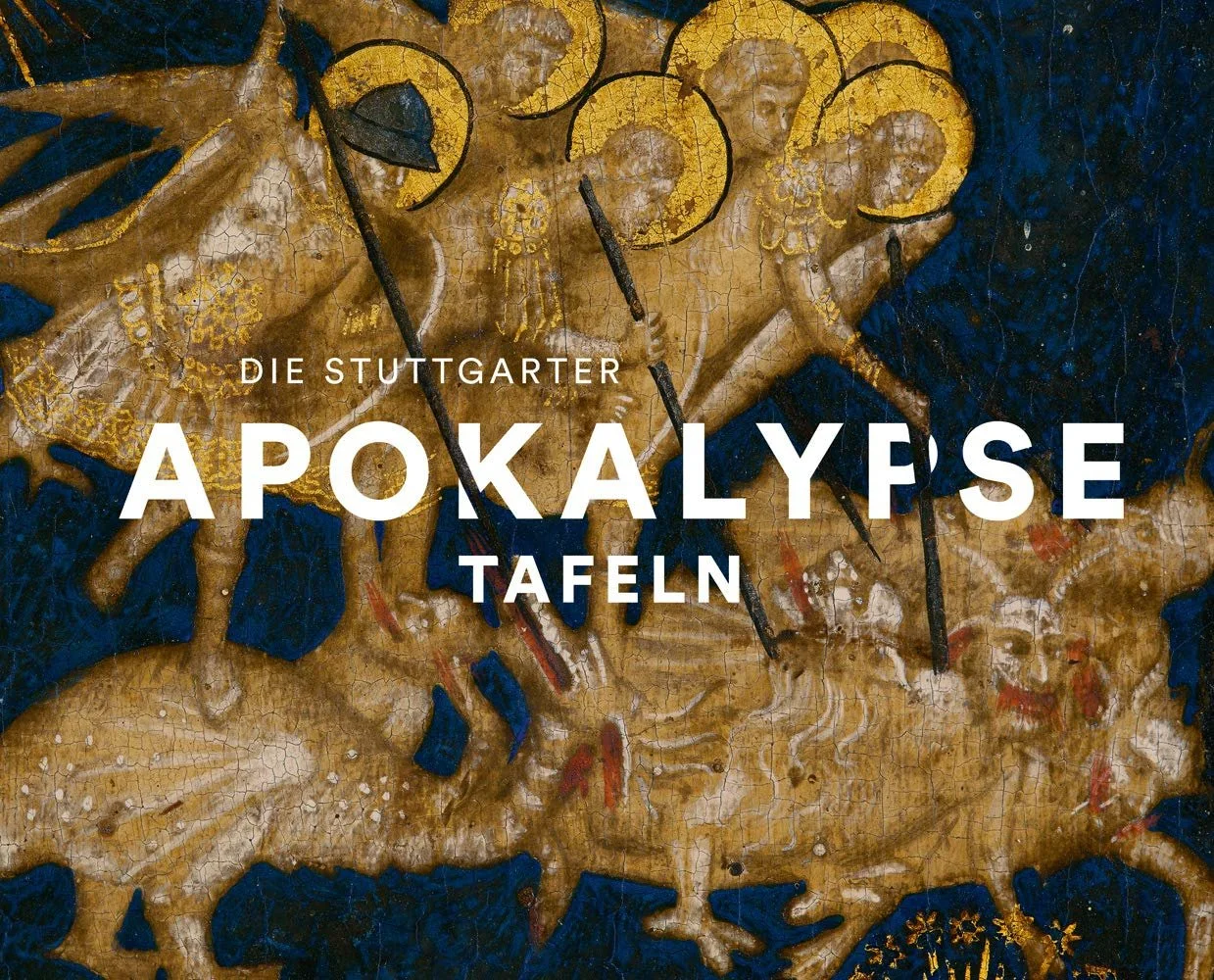
The 2017–2018 research project, funded by the Rudolf-August Oetker-Stiftung, concluded with a study day at the Staatsgalerie on 20 April 2018, held with the Institut für Kunstgeschichte of the University of Stuttgart, and with the volume (German publication) Die Stuttgarter Apokalypse-Tafeln (Sandstein Verlag, Dresden 2018), edited by Annette Hojer and Christoph Krekel.
A technique that breaks the rule
The panels are a technical anomaly in the Trecento. Where the period expects burnished gold behind the figures, the painter laid a thick, costly layer of lapis lazuli. Over a gesso ground he applied a translucent, ochre-toned priming, then drew the small figures with a fine brush in brownish tones, modulating the lightness to suggest depth. Only afterwards were the figures worked up in gold, with white and red heightening and silver applications; details of architecture and armour are picked out with a thin black line. The effect is closer to a goldsmith's work than to conventional panel painting.
The interdisciplinary research project of 2017–18 in Stuttgart, in which curators, conservators and scientists examined the panels together, added several surprises. No underdrawing could be detected. Two horizontal incised lines survive in the ground, dividing the field into registers — but the composition does not obey them consistently. Small passages show revisions made by the painter himself.
Made for whom, and for what?
The function remains open, and it is the most interesting unsolved problem the panels pose. Their format fits no altarpiece type. Traces of an old mounting led Peter Beye to suggest that they sheathed a reliquary; Annegrit Schmitt argued for a studiolo or palace chapel; Rosemary Muir-Wright kept the reliquary idea alive; others have read them as a model for wall painting. The Staatsgalerie's current line, following Annette Hojer, is that they formed the long sides of a chest that looked like a jewel casket — Hojer proposes a book chest, perhaps for the king's own apocalyptic writings, in a private room at court.
That court is Naples under Robert of Anjou (1278–1343). They had a marked appetite for Revelation, and Robert intervened personally in the theological quarrel over the visio beatifica, arguing against the papal position that even saints must wait until the Last Judgement to see God in full glory. Hojer reads the throne vision on the first panel as programmatically charged in exactly that debate, and takes it as evidence not only of Robert's patronage but of his intellectual authorship of the program — which is what carries the dating to c. 1332/34. Other readings have stressed Franciscan Spiritual theology, the commentary of Peter of John Olivi and the influence of Joachim of Fiore; Laurence Rivière-Ciavaldini has argued instead for a dynastic program they are celebrating the sanctity of the Angevin house. The panels are dense enough to sustain all of it.
A century of attributions
Nobody has ever put a name to the painter
Émile Bertaux (1906) connected the panels to the Apocalypse fresco in Santa Maria Donnaregina Vecchia in Naples. Count Adalbert zu Erbach-Fürstenau, who owned them, identified them in 1937 with the Apocalypse that Vasari says Giotto painted for King Robert in Santa Chiara — without insisting that Giotto held the brush. Roberto Longhi in 1940 gave them to the North Italian Giusto de' Menabuoi, and much of Italian scholarship followed him; Robert Oertel objected that the Neapolitan manuscripts and the Galatina frescoes required an earlier date and a southern origin. After the work of Bernhard Degenhart and Annegrit Schmitt in 1968–70, Naples was no longer seriously questioned. Pierluigi Leone de Castris looked to the circle of the illuminator Cristoforo Orimina; Alessandra Perriccioli Saggese to the orbit of the Master of Giovanni Barrile. Miklós Boskovits revived the attribution to Giotto himself for the Florence exhibition of 2000; it found no support. The 2018 volume holds the line: an outstanding, anonymous Neapolitan master, working with a deliberate orientation towards Giotto, Simone Martini and Pietro Cavallini.
The afterlife of an invention
The iconography travelled. The Apocalypse cycles of the Hamilton Bible in Berlin, the Vienna Bible and the Andrew of Hungary Bible in Leuven all depend on it — the Hamilton painter copied scenes without always understanding them, misplacing some and arbitrarily separating the four horsemen. The frescoes of Santa Caterina at Galatina in Puglia repeat it. Its reach extends beyond Italy, to the wall paintings at Karlštejn near Prague, to Memling's altarpiece in the Sint-Janshospitaal in Bruges, and to the Savoy Apocalypse in the Escorial, where Jean de Colombe worked from the second Stuttgart panel between 1486 and 1490.
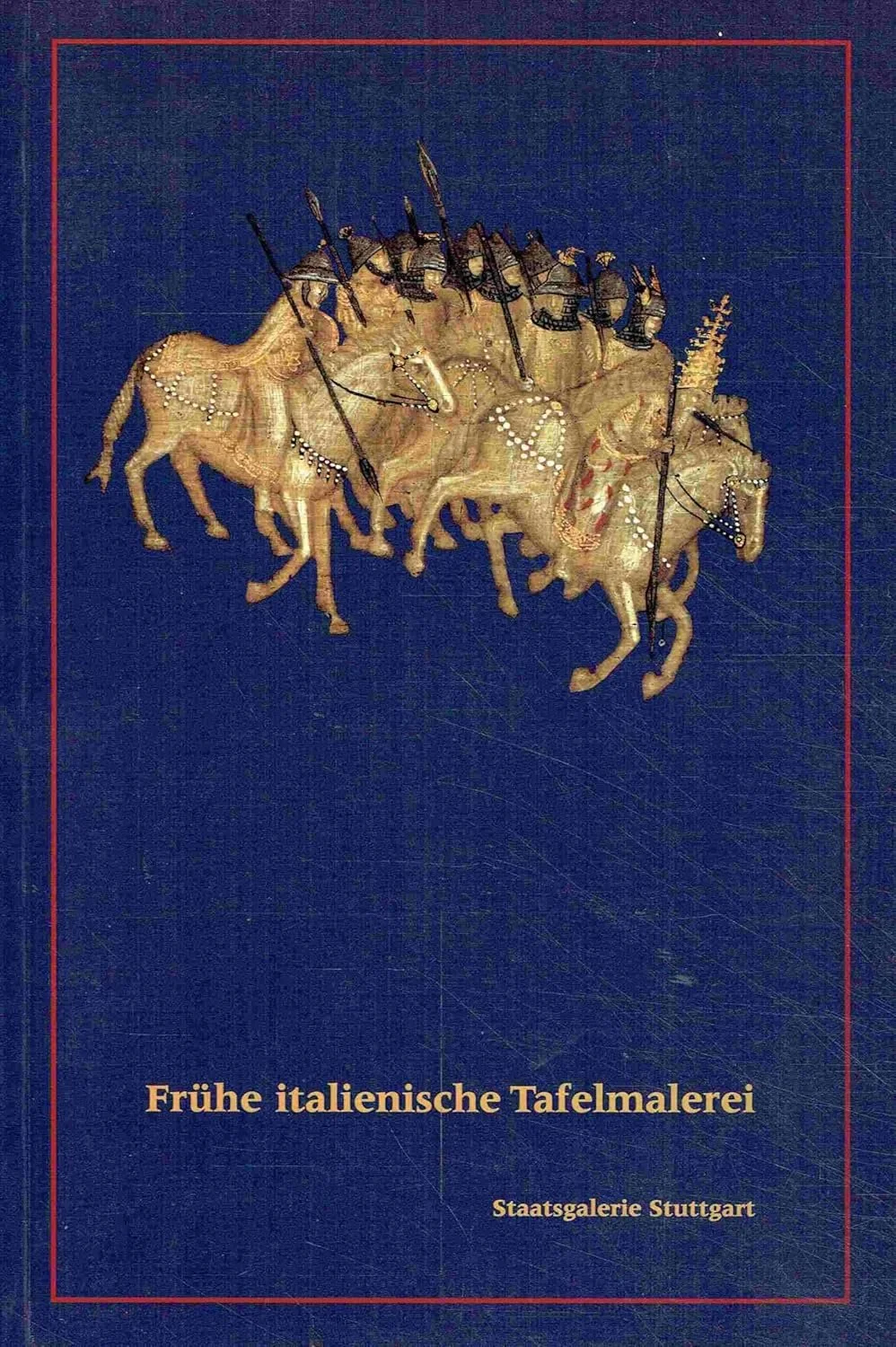
German publication: Frühe italienische Tafelmalerei - Vollständiger Katalog der italienischen Gemälde der Gotik. Bearbeitet von August Bernhard Rave mit Beiträgen von Ralph Melcher, Staatsgalerie Stuttgart, 1999
How they reached Stuttgart
The early history is oral tradition rather than document. No known source mentions the panels before the modern era. The story handed down is that they were brought back from Italy by Johann Georg Schlosser (1739–1799), Goethe's brother-in-law. They were kept at Stift Neuburg near Heidelberg, and later belonged to the painter Edward Jakob von Steinle (d. 1886) in Frankfurt. From Steinle's estate they were bought in 1905 by Count Adalbert zu Erbach-Fürstenau (1862–1944), an art historian who published them that same year in L'Arte, connecting them with a group of illuminated manuscripts from the Neapolitan court and recognising them as the source those manuscripts drew on. The panels stayed with the family in the Odenwald, which is where the old notname — Master of the Erbach Panels — comes from.
The Staatsgalerie acquired them in two steps, from Adalbert's children Alfred and Luise: the first panel in 1970, the second in 1971, each reported in Peter Beye's annual acquisition notices for the Staatliche Kunstsammlungen in Baden-Württemberg. They later appeared in the survey of works bought for the state's museums withlottery funds. Today they count among the Staatsgalerie's principal works and among the most important early Italian paintings in any German museum.
Sources
Staatsgalerie Stuttgart, collection online: Szenen der Apokalypse des Johannes (Kapitel 1–13), inv. 3082, and (Kapitel 14–22), inv. 3100
Annette Hojer / Christoph Krekel (eds.), Die Stuttgarter Apokalypse-Tafeln, Sandstein Verlag, Dresden 2018
Daniela Rapetti, Die Erbach-Fürstenauer Apokalypse und andere italienische Zyklen der Gotik, diss., Universität Tübingen 2017
ArtHist.net, program of the study day Die Stuttgarter Apokalypse-Tafeln, Staatsgalerie Stuttgart, 20 April 2018
August Bernhard Rave, Frühe italienische Tafelmalerei, Staatsgalerie Stuttgart, 1999