Il Libro dell’Arte - The book that tells us how gold ground works were made
Around 1400 a Tuscan painter of no great fame wrote down everything he knew. Il Libro dell'Arte is the closest we can get to standing in a Trecento workshop.
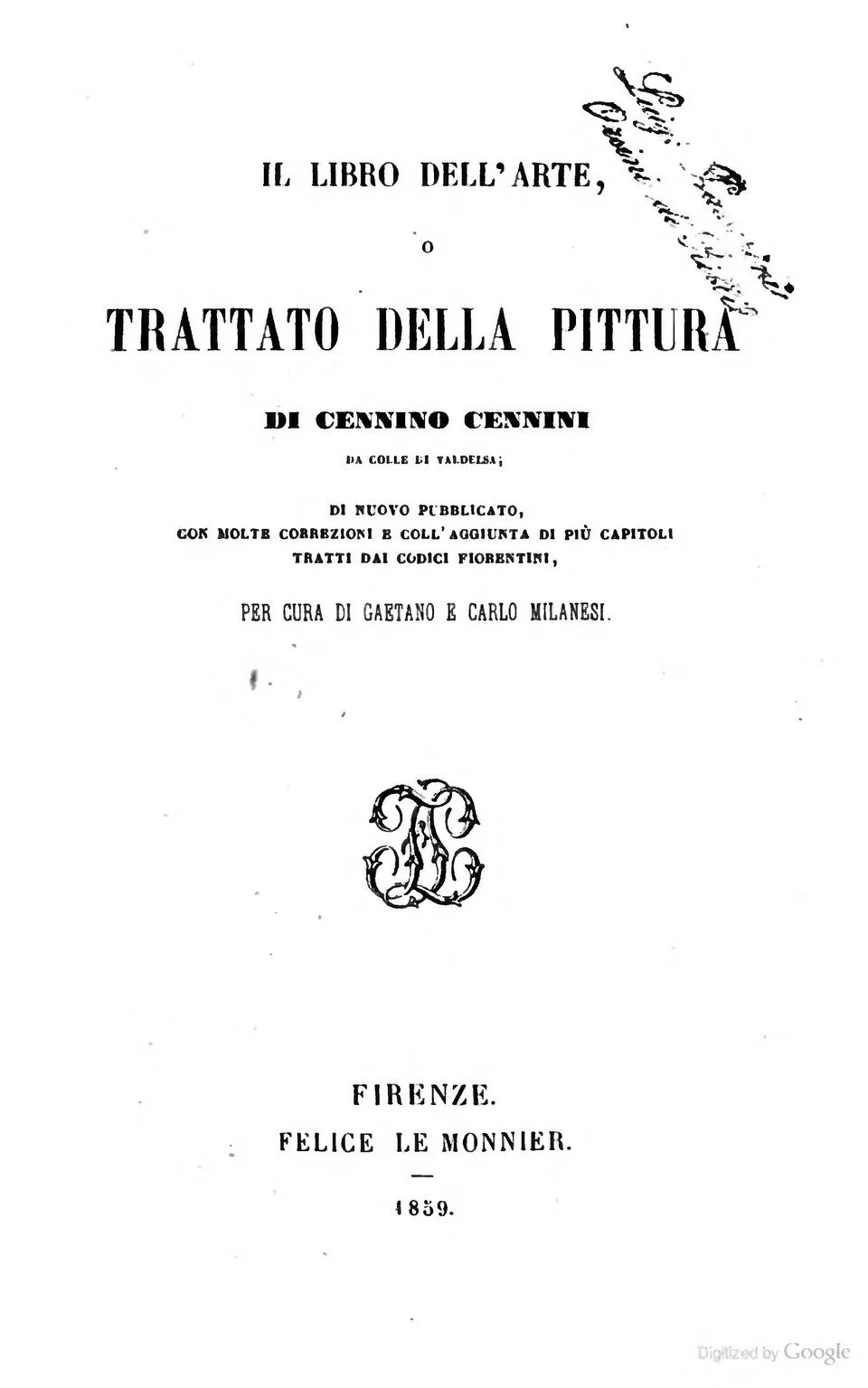
«Il libro dell'arte, o Trattato della pittura», here in a version from 1859 (Publisher
F. Le Monnier, Florence), Photo credit: Wikimedia Commons (Public domain)
Almost nothing survives of the painters who made gold-ground panels. We have the objects; the men who made them are silent. What we do have is one book — Il Libro dell'Arte, written by Cennino d'Andrea Cennini of Colle di Val d'Elsa at the end of the fourteenth century. It is the only substantial account of Italian panel painting written from inside the tradition while the tradition was still alive. Cennino spent twelve years in the Florentine workshop of Agnolo Gaddi, son and pupil of Taddeo Gaddi, who was Giotto's pupil; he makes a great deal of that lineage. He is the reverse of the usual case: normally the panel survives without its painter, here the painter survives without a single picture we can give him.
What is in it
Roughly 250 short chapters, running from drawing to pigments to wall painting to panels and gilding, with a tail of related crafts — painting on cloth and glass, mosaic, casting from life.
The heart of it, for anyone who looks at gold grounds, is the panel sequence. Cennino takes the board from raw wood to finished surface without skipping a step: seasoned poplar; sizing with glue boiled from parchment clippings; linen laid over the joins; coarse gesso grosso followed by many thin coats of gesso sottile, scraped back to an ivory smoothness. Then the drawing, the incised outlines, the raised ornament. Then the red bole ground laid with egg white, and the leaf itself — applied in damp weather, breathed upon to soften the size, burnished with a stone until it becomes a mirror. Punching and sgraffito follow. Colour arrives last: egg tempera, hatched in fine parallel strokes, flesh built up in three values over a green underpaint he calls verdaccio.
What makes the book unlike any later treatise is how much workshop reality it carries. Which brushes to make from minever tails and which from hog bristle. How to tell a cheated pigment. How long ultramarine takes to knead out of lapis, and why you should watch the person doing it for you. Which colors will not survive on a wall. He sets out a course of training running well over a decade and insists on drawing every single day, without exception. He also mentions oil painting in passing — a detail that later helped dismantle Vasari's story that Jan van Eyck invented the medium.
How far to trust it
Further than any other source, and not as far as we would like. Cennino describes one lineage — Florentine by training, Paduan by residence — at one moment. He is not reporting on Siena, or on the previous century, or on workshops that solved the same problems differently. Some recipes read as ideal practice rather than daily habit.
Conservation science has made him testable. Cross-sections, X-radiography and infrared reflectography confirm a great deal of what he describes, while also showing constant variation in the details. Read him as the best available witness rather than a specification sheet.
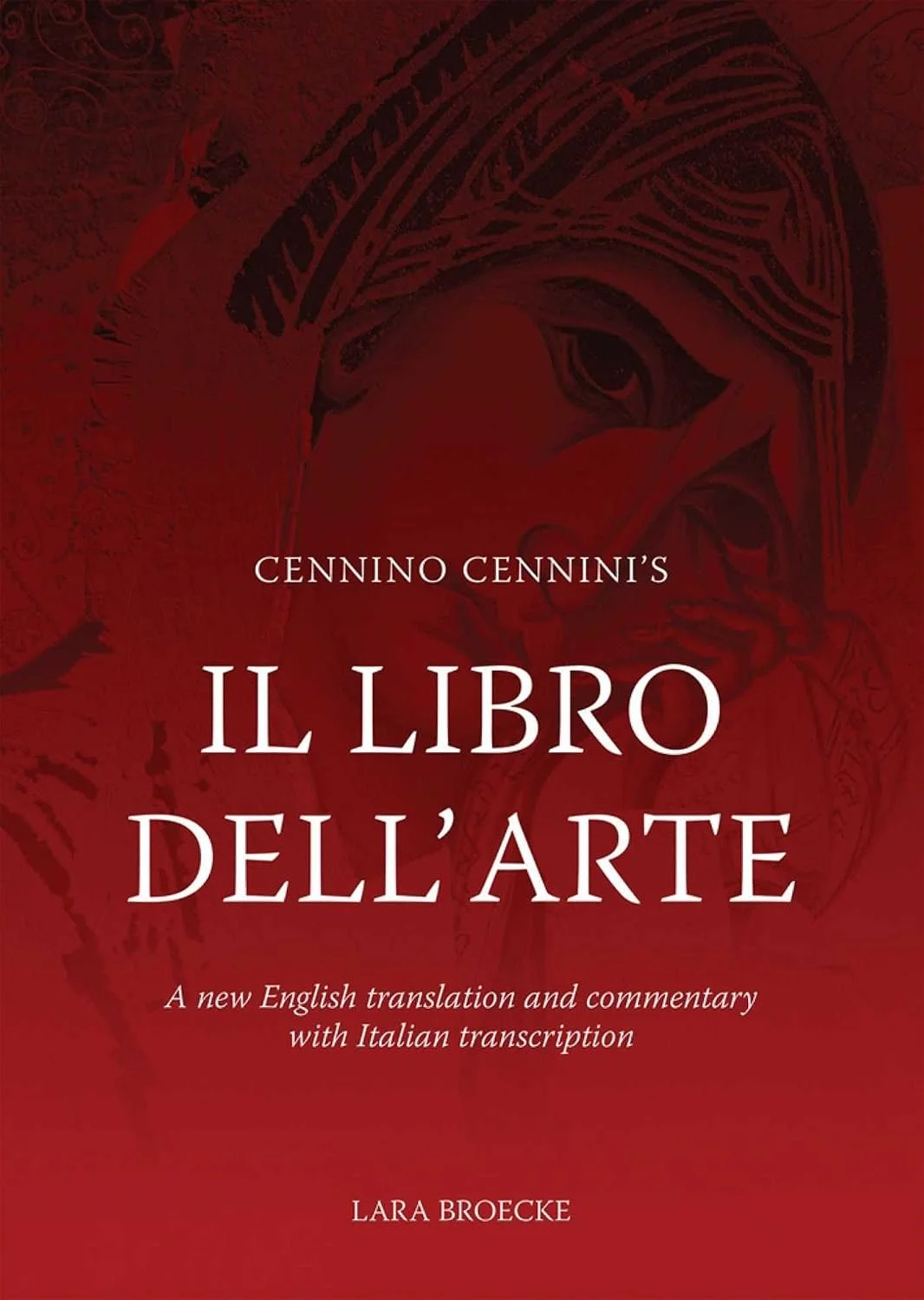
A New English Translation and Commentary with Italian Transcription (Publisher Archetype, 2015)
Where to start: Lara Broecke, Cennino Cennini's Il Libro dell'Arte: A New English Translation and Commentary with Italian Transcription (Archetype, 2015) — now the standard, correcting more than four hundred errors in Daniel V. Thompson's long-dominant The Craftsman's Handbook (1933), which remains in print and cheap. In German, Albert Ilg's 1871 translation is freely available, if antique.
Then go and look at a panel. Cennino makes the surface legible in a way no amount of stylistic analysis can: the burnish, the punch, the green under the cheek.