Beyond stylistic attribution: Erling Skaug’s «Punch Marks» as the foundational corpus for panel painting
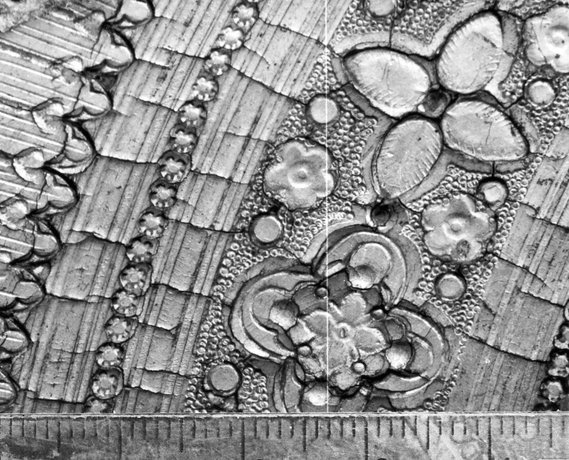
Punch Marks on Gold-ground (Source: punchmarks.net)
In 1994, the late Norwegian art conservator and professor Erling Sigvard Skaug (1938–2022) published a massive, two-volume monograph that permanently transformed early Italian art history: Punch Marks - from Giotto to Fra Angelico: Attribution, Chronology, and Workshop Relationships in Tuscan Panel Painting (c. 1330–1430).
Over three decades, Skaug traveled across public institutions and private collections worldwide. Armed with macro-photography, precision gauges, and a conservator’s eye, he meticulously documented thousands of micro-impressions stamped into the gilded halos and borders of 14th- and 15th-century Tuscan panels.
Thirty years later, in an era dominated by computers and AI, a key question arises for scholars and collectors alike: Is Skaug’s work still the definitive reference today?
The short answer is yes. Skaug’s two volumes remain the undisputed foundational text. However, the way we interact with his research has evolved.
“Sphragiology” as art historical science
Before Skaug, punch marks—the tiny rosettes, quatrefoils, arcs, and stars stamped into gold leaf—were often treated as mere decorative embellishments. Skaug elevated their study into a systematic auxiliary science, coining the term sphragiology (from the Greek sphragis, meaning seal or stamp).
His methodology rests on three core tenets:
Uniqueness: Because punch tools were individual hand-engraved or cast metal dies, no two punch designs from different toolmakers were identical.
Persistence: A single metal tool could survive for decades, leaving an identical "fingerprint" across multiple works produced by the same master or workshop.
Mobility & Inheritance: The movement of these tools—through workshop inheritance, master-apprentice transfers, partnerships, or emergency sales following catastrophic events like the Black Death of 1348—maps the precise economic and social history of Trecento art production.
By establishing a rigorous typology of these shapes, Skaug provided art historians with a diagnostic tool independent of subjective stylistic attribution. If an unattributed panel shares a set of unique, damaged punch marks with a securely documented altarpiece by Bernardo Daddi or Jacopo del Casentino, the structural connection is virtually undeniable.
Online resources & further reading
The Official Punchmarks Website: Maintained to honor Skaug’s legacy, providing access to his core bibliographies, glossaries, and methodology.
Digital Edition of Punch Marks (Corpus della Pittura Fiorentina): The official semantic database edited by V. Macovaz, digitizing Skaug’s catalog and visual archive.
Nodegoat Interactive Network Viewer: An interactive network visualization tool demonstrating the spatial and chronological links between workshops based on Skaug’s data.
Cambridge University Apollo Repository: Academic research detailing deep learning and automated punch mark classification citing Skaug as the ground-truth standard (open access)