

Schematic representation, generated with AI
Resources > Recurring depictions
Cristo Redentore benedicente
The Cristo Redentore benedicente (Blessing Christ the Redeemer) constitutes the most direct and authoritative image of divine majesty within the Italian Fondo Oro tradition. It presents Christ as both Saviour and Judge, offering His blessing to the faithful while embodying the dual nature of mercy and sovereign power.
This iconographic type served as one of the most solemn and frequently repeated subjects in Italian painting from the 13th to the 15th century. It often occupied the central pinnacle of polyptychs, the lunette above the main register, or stood alone as a devotional panel for private or public veneration. Its commanding presence made it a fundamental element of liturgical spaces, and it constitutes a major category within the photographic archives of the Federico Zeri Foundation.
The iconography is governed by a powerful frontal hierarchy: Christ is shown half-length or full-length, facing the viewer directly, with His right hand raised in the gesture of blessing (two fingers extended) and His left hand holding the closed or open Book of the Gospels. The cruciform halo frames His head, while the rich red and blue robes, often highlighted with gold striations, emphasize His royal and priestly dignity. Against the radiant gold ground — the eternal light of the Heavenly Jerusalem — the figure appears both timeless and immediate, creating a powerful spiritual encounter between the divine Redeemer and the beholder.
From the austere, hieratic rigidity of the early Maniera Greca, with its strong Byzantine influence and flat, symbolic modelling, to the more humanised and emotionally engaging interpretations of Giotto, Simone Martini, and the 14th- and 15th-century masters, the Cristo Redentore benedicente accompanied the profound evolution of Italian art. The figure gradually gained volume and anatomical presence, the blessing gesture became more natural, and the drapery developed richer folds and luminous depth. While the gold background remained, the composition moved toward greater spatial awareness and psychological intensity, paving the way for the majestic blessing Christs of the Renaissance.
Wikipedia 🔗 - Grokipedia 🔗

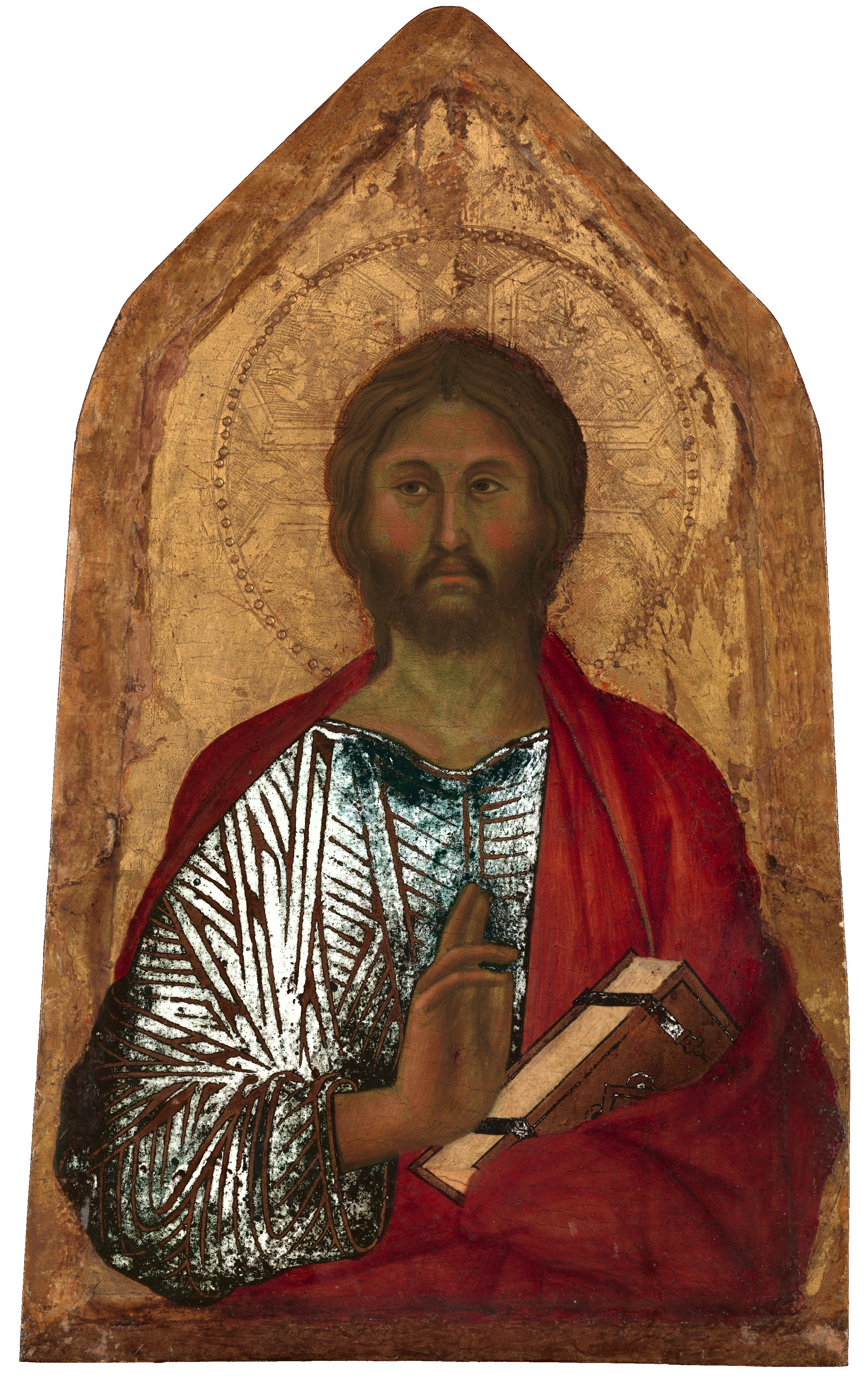


Photo credits
Simone Martini: The Redeemer conferring a blessing, c. 1315-1320, Wikimedia Commons, Creative Commons Attribution-Share Alike 4.0 International
Segna di Bonaventura: Christ Blessing, c. 1311, Wikimedia Commons, Creative Commons CC0 1.0 Universal Public Domain Dedication
Grifo di Tancredi: Christ Blessing, c. 1310, Wikimedia Commons (Public domain)
Gherardo Starnina: Christ as Salvator Mundi, 1405, Wikimedia Commons, Creative Commons Public Domain Mark 1.0