
Resources > Publications
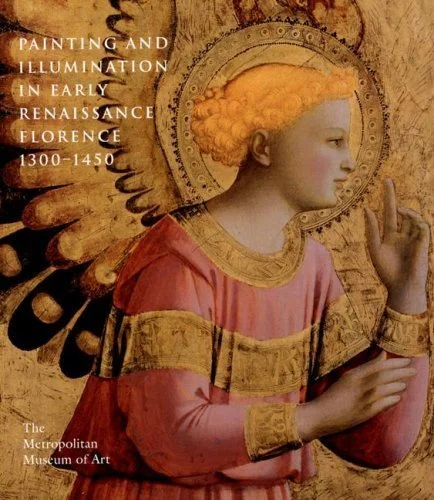
Painting and Illumination in early Renaissance Florence 1300-1450
THE METROPOLITAN MUSEUM OF ART, New York
With texte from Kanter, Laurence B., Barbara Drake Boehm, Carl Brandon Strehlke, Gaudenz Freuler, Christa C. Mayer Thurman, and Pia Palladino
Fondo Oro Magazine:
By reuniting disseminated leaves and reconstructing the spiritual ambiance of the Camaldolese monastery, this Metropolitan Museum of Art catalogue allows us to witness the same genius—figures like Pacino di Bonaguida and Lorenzo Monaco—applying their mastery across vastly different scales.
What makes this volume a personal favorite is its rigorous commitment to the "perishable" history of the bottega. With peerless contributions from scholars like Laurence Kanter and Carl Brandon Strehlke, the text offers more than just beautiful reproductions; it presents groundbreaking archival research into the early years of Fra Angelico and his innovative naturalism. For the connoisseur who seeks to understand the true evolution of the Florentine style, seeing these 55 entries and nearly 300 illustrations is like peering directly over the shoulder of a 14th-century master. It is a rare, luminous map of a period where light, gold, and devotion were one and the same.
Harry N. Abrams, New York, 1994, 408 pages, Hardcover, ISBN: 9780300086591
The sumptuous illuminated manuscripts of Early Renaissance Florence have traditionally been overshadowed by the better-known monumental arts of the period. The Metropolitan Museum of Art seeks to redress the imbalance by mounting an exhibition of Florentine miniatures produced between 1300 and 1450 from collections in Europe and the United States. A selective group of bound manuscripts and single leaves from disassembled books is joined with panel paintings and works in perishable media—such as drawings, embroideries, and reverse painting on glass—created by the same masters. Some of the important books whose pages have been disseminated are here reconstructed for the first time since they were cut apart.
During the incredible efflorescence of the visual arts in Florence of the fourteenth and fifteenth centuries, some artists turned their hands equally to various media, manuscript painting among them. In the fourteenth century these included one of the most mysterious and engaging personalities of early Renaissance Italian painting, the Master of the Codex of Saint George, as well as such artists as Pacino di Bonaguida, the Maestro Dadesco, the Master of the Dominican Effigies, Don Silvestro dei Gherarducci, and Don Simone Camaldolese. Toward the close of the fourteenth century, there emerged in the same Camaldolese ambiance where Don Silvestro and Don Simone flourished a major artist of international stature, Lorenzo Monaco. Don Lorenzo eventually left the monastery to operate a secular workshop that became an important force in the early fifteenth century Florentine art world, producing lavish illuminated manuscripts in addition to frescoes, altarpieces, and numerous picture for a growing domestic market. One of Don Lorenzo's greatest legacies may have been the training of Fra Angelico, a Dominican monk, and a painter of surpassing genius, who is in large part responsible for the evolution of a truly Renaissance style in the visual arts. The innovative naturalism of Angelico and his followers effectively brings to a close the great age of illumination in Early Renaissance Florence. By way of introduction to the objects themselves are three essays. The first, by Laurence B. Kanter, presents an overview of Florentine illumination between 1300 and 1450 and thumbnail sketches of the artists featured in this volume. The second essay, by Barbara Drake Boehm, focuses on the types of books illuminators helped to create. As most of them were liturgical, her contribution limns for the modern reader the medieval religious ceremonies in which the manuscripts were utilized. Carl Brandon Strehlke here publishes important new material about Fra Angelico's early years and patrons, the result of the author's recent archival research in Florence. In addition to the three essays elucidating different aspects of the topic, this volume contains 55 entries on works of art, accompanied by 296 illustrations, 120 of them in color. Each entry includes a descriptive commentary, a provenance, and references. A bibliography and an index appear as well.
Table of content
Director's Foreword
Philippe de Montebello
Acknowledgments
Laurence B. Kanter and Barbara Drake Boehm
Lenders to the Exhibition
Note to the Reader
Introduction
The Illuminators of Early Renaissance Florence
Laurence B. Kanter
The Books of the Florentine Illuminators
Barbara Drake Boehm
Fra Angelico Studies
Carl Brandon Strehlke
Painting and Illumination in Early Renaissance Florence, 1300–1450
Barbara Drake Boehm, Gaudenz Freuler, Laurence B. Kanter, Carl Brandon Strehlke, Christa C. Mayer Thurman
Bibliography
Index
Photograph Credits