
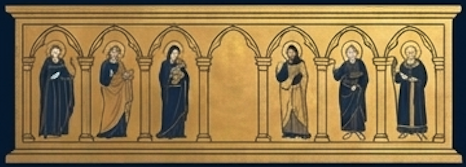
Schematic representation, generated with AI
Resources > Objects
Dossal
A Dossal (derived from the Latin dorsum, meaning "back") is an early form of altarpiece that developed as a prominent visual backdrop for the Christian liturgy. Rising to prominence in the 12th and 13th centuries, the dossal stands as a vital evolutionary bridge in art history, marking the transition from plain altar decorations to the monumental, multi-panel polyptychs of the later Renaissance.
Distinction and Form
The classic medieval dossal is defined by its horizontal orientation and rigid, flat geometry.
The Horizontal Format: Unlike the soaring, gabled polyptychs of the 14th century, the traditional dossal was often a long, low rectangular panel. It sat directly on the back edge of the altar table or was mounted on the wall immediately behind it, spanning the width of the altar to create a continuous narrative screen.
The "Saint Dossal" Variant: While many dossals were wide rectangles, a major stylistic variant emerged as a tall, vertical rectangle featuring a full-length, highly stylized portrait of a central saint (such as St. Francis or St. Dominic).
Materiality and Technique: Created during the Romanesque and early Gothic periods, these panels heavily relied on the fondo oro (gold ground) technique. Artists applied egg tempera over a layer of gesso and meticulously burnished gold leaf, which was designed to catch the flickering candlelight of a dim church, projecting a heavenly glow into the sanctuary.
Quantitative Aspects
In the cataloging of the Fondazione Federico Zeri, the "Dossal" is categorized as a complete, self-contained object. According to the Zeri archive, there are 118 registered objects specifically classified as a dossale.
Wikipedia 🔗 - Grokipedia 🔗