
Resources > Publications
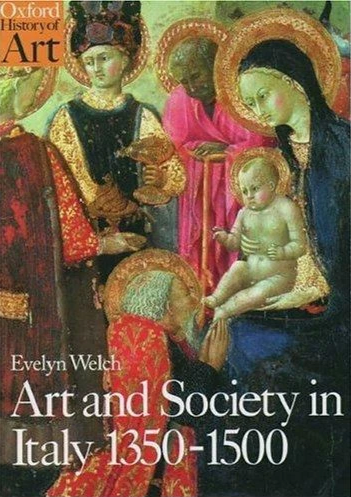
Art and Society in Italy 1350-1500
by Evelyn Welch
Fondo Oro Magazine:
Evelyn Welch’s Art and Society in Italy 1350–1500 is in our recommended library because it rejects the traditional, dry narrative of "great masters" in favor of a fresh, visceral portrait of the Italian Renaissance. By meticulously exploring the relationships between patrons, artists, and the public, Welch illuminates how visual imagery was intimately woven into the social, sexual, and political tapestry of the age. This volume provides that essential contextual depth—covering everything from workshop practices to the impact of the Black Death—that allows us to appreciate the true materiality and purpose of the art we love.
Oxford University Press, 1997, 351 pages, Softcover
The Italian Renaissance was a pivotal period in the history of Western culture during which artists such as Masaccio, Donatello, Fra Angelico, and Leonardo created some of the world's most influential and exciting works in a variety of artistic fields. Here, Evelyn Welch presents a fresh picture of the Italian Renaissance by challenging traditional scholarship and placing emphasis on recreating the experience of contemporary Italians: the patrons who commissioned the works, the members of the public who viewed them, and the artists who produced them. Art and Society in Italy 1350-1500 dramatically revises the traditional story of the Renaissance and takes into account new issues that have greatly enriched our understanding of the period. From paintings and coins to sculptures and tapestries, Welch examines the issues of materials, workshop practices, and artist-patron relationships, and explores the ways in which visual imagery related to contemporary sexual, social, and political behavior.
The traditional story of the Italian Renaissance- a succession of great achievements by famous artists- is familiar. But recently this well-known narrative has been revised and enriched by new scholarship.
Drawing on that scholarship, Evelyn Welch presents a fresh picture of Italian art between the 'Black Death' in the mid-fourteenth century and the French invasions at the end of the fifteenth. In it, Florence is no longer the only important centre of artistic activity but takes its place alongside other equally interesting and varied cities of the Italian peninsula. Oil paintings are examined alongside frescos, tapestries, sculptures in bronze and marble, manuscript illuminations, objects in precious metals, and a wide range of other works.
Evelyn Welch explains artistic techniques and workshop practices, and discusses contextual issues such as artist-patron relationships, political and religious uses of art, and the ways in which visual imagery related to contemporary sexual and social behaviour. Above all she recreates the dramatic experiences of contemporary Italians -the patrons who commissioned the works, the members of the public who viewed them, and the artists who produced them.
Table of contents
Introduction
Part I
Artistic Enterprises
2. Materials and Methods
3. The Organization of Art
4. Defining Relationships: Artists and Patrons
Part II
Audiences for Art
5. The Sacred Setting
6. Sites of Devotion
Part III
The Art of Government
7. Creating Authority
8. Rome and the Republics
Part IV
Art and the Household
9. The Domestic Setting
Notes
List of Illustrations
Bibliographic Essay
Timeline
Index