
Resources > Publications
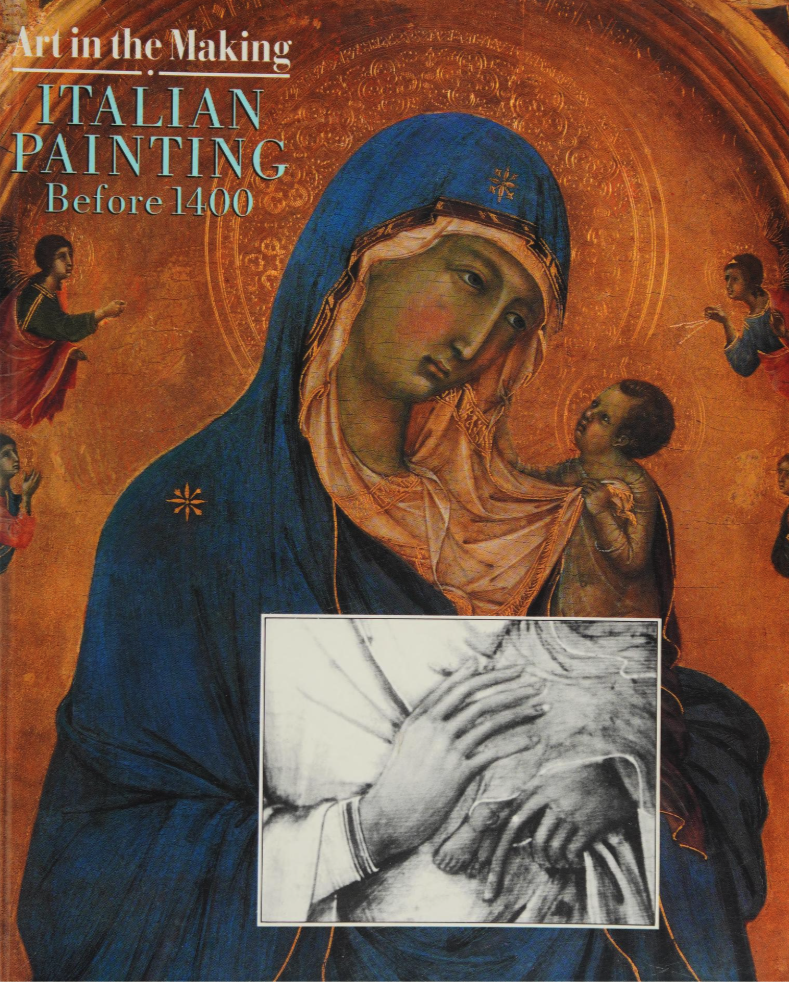
Italian Painting Before 1400
Art in the Making
Fondo Oro Magazine:
Italian Painting Before 1400: Art in the Making is an indispensable addition to our recommended library because it approaches the 13th and 14th centuries as a visceral, technical revolution. This National Gallery volume meticulously details the materials—the pigments, the intricate carpentry of massive altarpieces, and the precise chemistry of the gilding—that allowed a radical and enduring change in European painting to take place between 1270 and 1370.
What elevates this work is its use of scientific rigor to reveal the hidden hand of the master. Through the lens of infrared reflectography, we are invited to witness Duccio’s initial pen underdrawings and the strategic decisions made within the workshop, such as Ugolino’s deliberate choice of greenish azurite over lapis lazuli. For the student of the gold-ground tradition, this text offers a rare opportunity to watch artistic choices being made in real-time, bridging the gap between the finished, divine object and the human labor of the studio. It is, quite simply, the essential manual for anyone who wishes to understand how the light of the early Renaissance was physically constructed.
National Gallery, 1994, 225 pages, Softcover, ISBN 9780947645670
A central duty of the National Gallery's role is to present to the widest possible public the results of recent research on the collection. This series of exhibitions, Art in the Making, generously sponsored by Esso UK plc, aims to examine, year by year, new work on different artists or periods. The first exhibition was devoted to paintings by Rembrandt. This year's focus is not on an artist, but a century - the years in Italy between 1270 and 1370, during which the whole tradition of European painting underwent a radical and enduring change of direction. We examine here the materials with which that transformation, the early Renaissance, was effected.
The National Gallery's holding of works from this critical period is rich but fragmentary. Many of the greatest panels in this exhibition are small parts rescued, or wrenched, from a monumental whole. Many have been seriously damaged. Yet the damage and the disruption have, paradoxically, made it easier to see how the original problems of making and assembling were tackled and resolved.
Drawing on the combined resources of the Gallery's Conservation, Framing, Photographic and Scientific Departments, the four authors have set out to discover the pigments with which the artists chose to work; the processes by which the panels were prepared, gilded and decorated; the carpentry techniques required to hold the huge Florentine and Sienese altarpieces safely together and securely in place; and the changes subsequently wrought on them by time and by man.
In preparing this exhibition, many discoveries have been made. Thanks to infrared reflectography, we can now confidently distinguish Duccio's underdrawing in pen from that of his associates, and reconstruct something of the methods of his workshop. And pigment analysis has shown that the entire palette of Ugolino's high altarpiece for Santa Croce in Florence was determined by his initial decision to use for his blue pigment a greenish azurite rather than brilliant lapis lazuli. In a period of outstanding artistic innovation, we can, through this exhibition, watch artistic choices being made.
The National Gallery's staff is a small one, and the mounting of an exhibition such as this is possible only through much dedicated work. David Bomford, Sue Curnow, Diana Davies, Jill Dunkerton, John England, Herb Gillman, Dillian Gor- don, Sara Hattrick, Jo Kirby, Jacqui McComish and Ashok Roy have worked unstintingly and good-humouredly. On behalf of all at the National Gallery I should like to express our sincere thanks to them and to our sponsors, Esso UK plc, who have supported this exhibition and this catalogue with outstanding generosity.
Neil MacGregor Director
Table of contents
Sponsor's Preface
Foreword
Acknowledgements
Introduction
Cennino Cennini - Function and Setting - Patronage - Image and Imagination - Guilds - Contracts - The Artist - Workshops - Panel Construction - The Gesso Ground - Preliminary Drawing - Gilding Tooling and Punching - The Paint Film - Pigments and Colour: Red; Blue; Yellow; Mauve; Green; White and Black - Mordant Gilding and Shell Gold - Varnishing - Condition, Conservation and Restoration
CATALOGUE
Appendices
I Present location of the surviving fragments from Duccio's Maestà
II Surviving documents relating to Duccio's Maestà (with English translation)
III The surviving accounts for the San Pier Maggiore Altarpiece (with English translation)
IV Tables
Glossary
Annotated Bibliography
Photographic Credits
Index of Painters and Paintings