
Resources > Publications
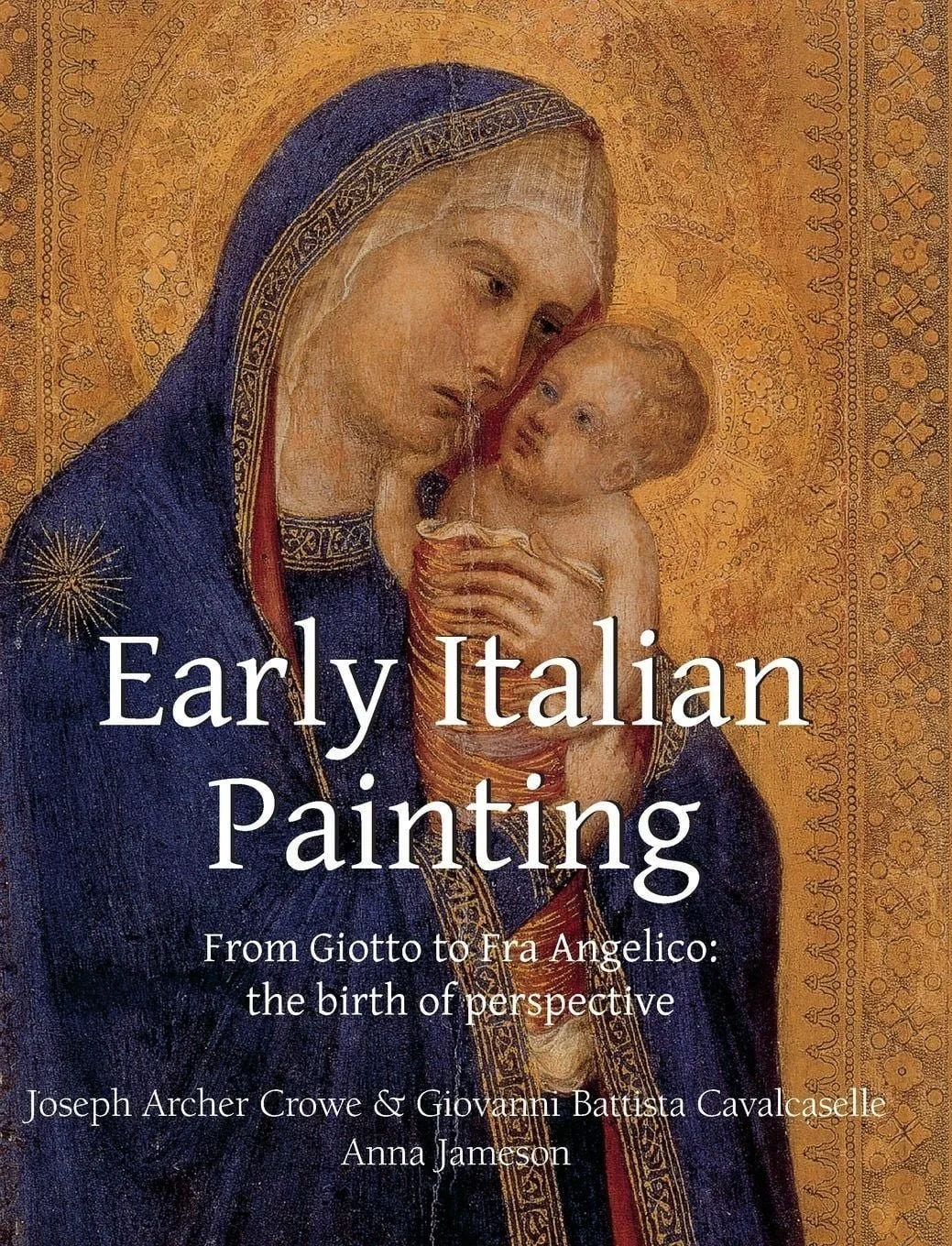
Early Italian Painting
by Joseph Archer Crowe, Giovanni Battista Cavalcaselle, Anna Jameson
Fondo Oro Magazine:
We believe that one cannot truly look forward without respecting those who first taught us how to see. It is with a sense of historical reverence that we recommend Early Italian Painting, a volume that brings together the insights of Joseph Archer Crowe, Giovanni Battista Cavalcaselle, and Anna Jameson. To understand the "Italian Primitives" is to understand the very birth of our discipline; these authors—titans of nineteenth-century scholarship—laid the groundwork for every technical and aesthetic discussion we engage in today.
What makes this work relevant is its sensitive analysis of the transformative power of the "gold ground" and the gradual humanization of the divine. The authors masterfully trace the oscillation between the rigid majesty of the Byzantine tradition and the revolutionary, breathing world predicted by Giotto. For the connoisseur of early panels, the discussion on how the Sienese and Florentine rivalries shaped the evolution of perspective is nothing short of illuminating. It reminds us that every brushstroke on a wooden panel was a step toward making the invisible world tangible.
Parkstone Press, 2020, 200 pages, Softcover, ISBN: 9781783103928
Oscillating between the majesty of the Greco-Byzantine tradition and the modernity predicted by Giotto, Early Italian Painting addresses the first important aesthetic movement that would lead to the Renaissance, the Italian Primitives. Trying new mediums and techniques, these revolutionary artists no longer painted frescoes on walls, but created the first mobile paintings on wooden panels. The visages of the figures were painted to shock the spectator in order to emphasise the divinity of the character being represented. The bright gold leafed backgrounds were used to highlight the godliness of the subject. The elegance of both line and colour were combined to reinforce specific symbolic choices. Ultimately the Early Italian artists wished to make the invisible - visible. In this magnificent book, the authors emphasise the importance that the rivalry between the Sienese and Florentine schools played in the evolution of art history. The reader, in the course of these forgotten masterworks, will discover how the sacred began to take a more human form, opening a discrete but definitive door through the use of anthropomorphism, a technique that would be cherished by the Renaissance.
Sir Joseph Archer Crowe was an English consular official and art critic, whose volumes of The History of Painting in Italy, co-written with the Italian critic Giovanni Battista Cavalcaselle (1819-1897), stand at the beginning of disciplined, modern art-history writing in English. With Cavalcaselle (an Italian writer and art critic), he produced several historical works on art of classic importance, notably Early Flemish Painters (London,1857) and A New History of Painting in Italy from the Second to the Sixteenth Century (London, 1864-1871, 5 vols.).
Table of content
Introducing: Something about Pictures and Painters
Revival of Art in Siena - Fundamental Difference between Sienese and Florentine Art
Early Christianity and Art
Memoirs of the Early Italian Painters
Guido da Siena
Giovanni Cimabue
Cimabue and the Rucellai Madonna
Duccio di Buoninsegna
Ugolio di Nerio
Segna di Bonaventura
Giotto di Bondone
Pietro Cavallini
The Campo Santo
Andrea Orcagna
Taddeo Gaddi
Simone Martini (Simone Memmi)
Conclusion